


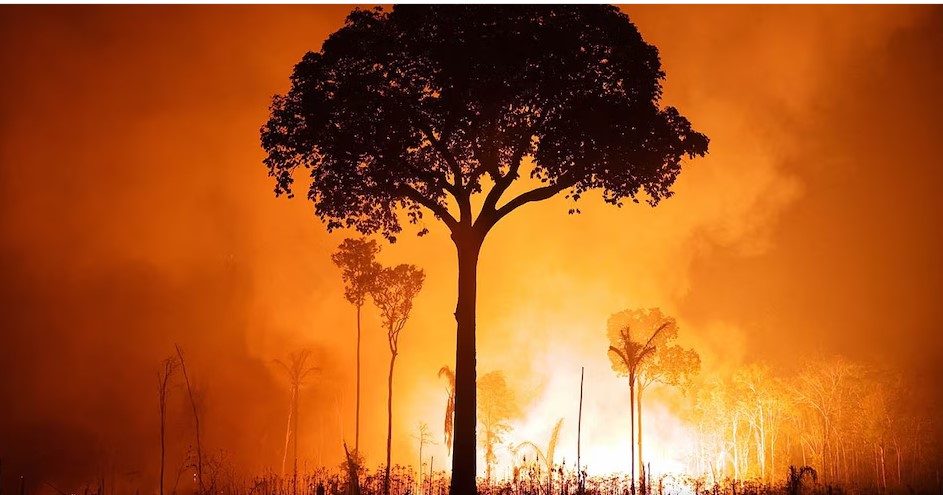
CNN Central News & Network-ITDC India Epress/ITDC News Bhopal: New Delhi. The Earth’s rising temperature is no longer limited to heat and changes in weather. Scientists have warned that a 1.5 degrees Celsius rise in global temperature compared with pre-industrial levels could put severe pressure on several of the planet’s critical natural systems.
The Amazon’s vast rainforests, coral reefs in the oceans and Atlantic Ocean currents are among the major systems where large-scale changes could have far-reaching effects on the world’s environment and weather. Johan Rockstrom, director of the Potsdam Institute for Climate Impact Research and a leading climate scientist, raised the concern at Reuters’ climate conference on October 20, 2026. According to him, rising temperatures driven by the continued use of fossil fuels are pushing natural systems close to their critical limits.
What are Earth’s “tipping points”?
In climate science, a “tipping point” refers to a situation in which change in a natural system reaches a threshold after which the system may lose its ability to return to its earlier state, or large and long-lasting changes may begin.
For example, in a forest, rising temperatures, prolonged droughts and large-scale tree cutting can together create changes that weaken the forest’s ability to retain moisture. After that, drought and fire can cause further damage to the forest. In this way, changes begin to reinforce one another. However, such thresholds are not the same for all natural systems. Scientists still face uncertainty over the exact temperatures at which these limits may be crossed and the speed of the resulting changes.
Growing threat to the Amazon forests
The Amazon rainforest spread across South America is among the world’s most important ecosystems. It plays a key role in absorbing carbon dioxide from the atmosphere, maintaining biodiversity and supporting regional rainfall cycles. But rising temperatures, repeated droughts, forest fires and tree cutting are weakening its natural capacity.
Moisture from forests reaches the atmosphere and helps maintain rainfall cycles. If forests are destroyed across large areas, rainfall patterns may change and drought conditions may become more severe.
A study published in the journal Nature in 2026 indicated that the combined effect of temperature rise and large-scale deforestation could push large parts of the Amazon towards serious ecological change. The study, under a scenario of 1.5 to 1.9 degrees Celsius warming along with 22 to 28 percent deforestation, found a risk of widespread change across 62 to 77 percent of the Amazon region. This is a model-based estimate, not a definite prediction that the entire region will change in the same way.
Ocean coral reefs also in crisis
Coral reefs found in the oceans provide food, shelter and breeding grounds for thousands of marine species. But rising ocean temperatures have a serious impact on corals. Because of excessively warm water, corals can lose the symbiotic algae living in their tissues. This process is called “coral bleaching”.
If ocean temperatures remain high for a long period, corals can weaken and die. This can affect marine biodiversity, fisheries and the livelihoods of coastal communities that depend on these ecosystems. Rockstrom has warned that many coral reefs are facing pressure that could make their damage difficult to reverse.
Concerns over changes in Atlantic Ocean currents
A vast system of water movement in the Atlantic Ocean influences the distribution of heat and rainfall around the world. It is known as the Atlantic Meridional Overturning Circulation, or AMOC. The system is linked to the movement of warm water northwards and the sinking of colder, denser water.
Due to global warming, melting ice in Greenland and the increase of freshwater in the ocean can affect water density and ocean circulation. If this system weakens significantly, there could be important changes in the weather of parts of Europe, tropical rainfall belts and water cycles in other regions.
However, scientific uncertainty remains over the scale and timing of possible future changes in the AMOC. Climate assessments have indicated the possibility of the system weakening, but it is not possible to state with certainty the likelihood or timing of a sudden complete shutdown.
1.5 degrees does not mean the same warming everywhere
To understand scientists’ warnings, it is important to know that the figure of 1.5 degrees Celsius refers to an increase in the world’s average surface temperature compared with pre-industrial levels. It does not mean that the temperature of every city or region on Earth will rise by exactly 1.5 degrees.
A global average temperature crossing 1.5 degrees in a single year and temperatures remaining at that level over the long term are different things. Climate targets are generally assessed on the basis of averages over several years. Even so, with every additional rise in temperature, the risk of heatwaves, marine heat, heavy rainfall and drought in some regions can increase.
Protecting nature is also necessary along with cutting emissions
According to Rockstrom, reducing carbon emissions alone will not be enough to tackle climate change. Protecting forests, biodiversity and freshwater sources is equally important. Along with reducing dependence on fossil fuels such as coal, petrol and diesel, conservation of natural resources will have to be made part of development plans.
The United Nations climate conference COP-31 is scheduled to be held in November 2026. In this context, international cooperation on emissions cuts, nature conservation and measures to deal with the effects of climate change will remain important.
Earth’s natural systems are interconnected. The health of the Amazon forests, the survival of coral reefs in the oceans and the currents of the Atlantic Ocean are not separate environmental issues alone. Pressure on them can affect the wider climate system. Scientists’ message is that rapid cuts in emissions and protection of nature will be decisive steps to reduce future risks.
Hashtags: #ScienceTechnology #ClimateChange #GlobalWarming #TippingPoints #AmazonRainforest #CoralReefs #AMOC #Science #Technology #15CWarming



