


Charles Darwin / John Murray · Public domain
Published in London, Darwin’s book assembled a far-reaching explanation of biological diversity, placing natural selection at the centre of a new scientific argument.
On 24 November 1859, the London publisher John Murray issued Charles Darwin’s On the Origin of Species. The book proposed that living species were connected by descent and that natural selection helped explain how they changed. It offered readers a powerful way to understand both the variety of life and the relationships within it.
Darwin had spent years gathering evidence from observation, correspondence and experiments. His voyage aboard HMS Beagle had exposed him to fossils, landscapes and organisms that raised questions about geographical distribution and change through time. Back in Britain, he continued investigating rather than relying on one dramatic discovery.
The central argument began with variation. Individuals within a population differ, and some of those differences can be inherited. More organisms are produced than can all survive and reproduce. Under particular conditions, inherited variations that improve reproductive success may become more common over generations. Accumulated change can contribute to the emergence of distinct species.
Darwin connected this explanation with familiar examples of selective breeding. People could produce different forms of domesticated animals and cultivated plants by choosing which individuals reproduced. Natural selection required no human breeder: environmental conditions and reproductive differences supplied the process.
The publication also had an important shared background. Alfred Russel Wallace independently developed a similar explanation and sent Darwin an essay in 1858. Material by both men was presented to the Linnean Society that year. Origin then set out Darwin’s extended argument for a much wider readership.
The book challenged assumptions that species were fixed and separately created. Its influence came from the range of questions it addressed, including adaptation, geographical distribution and the fossil record. It also provoked opposition and disagreement. Acceptance of evolutionary change and agreement about its mechanisms did not occur everywhere at the same pace.
Darwin lacked the later understanding of genes and DNA. Modern evolutionary biology therefore incorporates discoveries unavailable to him, rather than simply repeating every explanation in the first edition. This distinction makes his achievement more precise: he provided a durable framework that subsequent research could test, revise and expand.
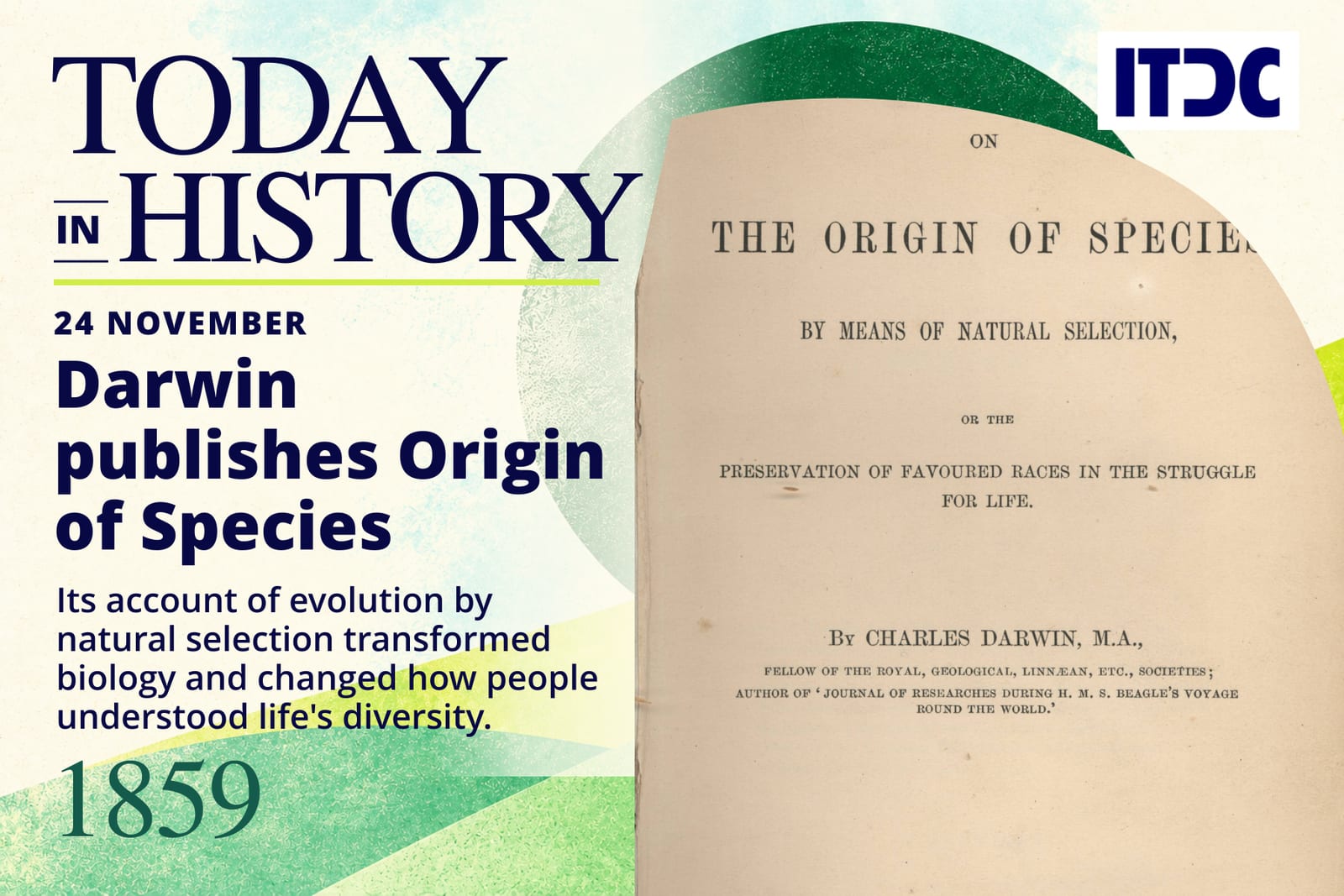
The title page accompanying this anniversary belongs to that first edition. It marks the moment a long investigation became a public book. The enduring importance of 24 November 1859 is not that scientific discussion ended, but that biological diversity could thereafter be investigated through a new, connected account of inheritance, environment and historical change.




