


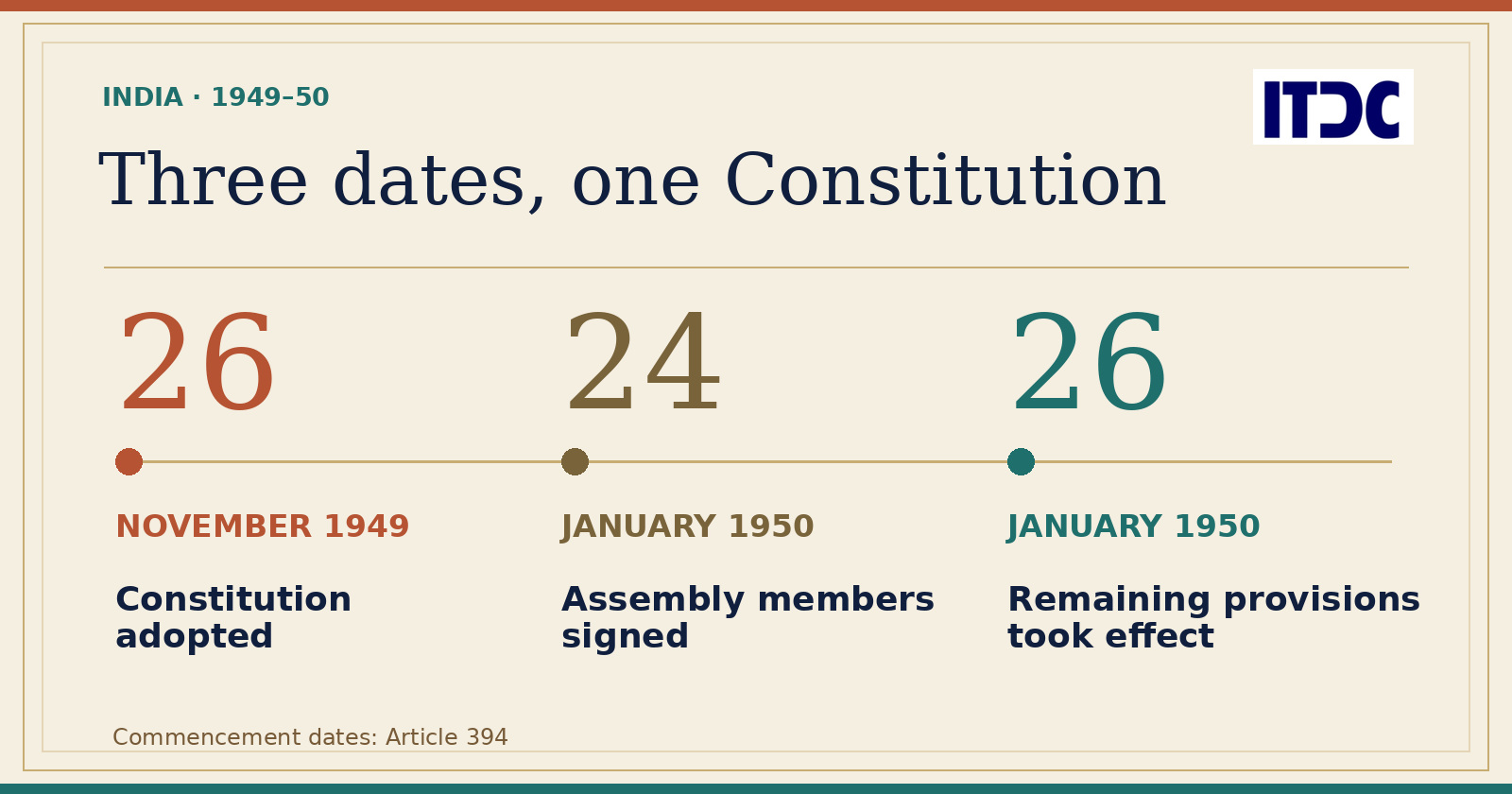
On 26 November 1949, India’s Constituent Assembly adopted the Constitution in New Delhi. Rajendra Prasad presided over the sitting. The decision gave the country an agreed constitutional framework after years of debate, committee work and revision, while much of the document would begin operating two months later.
The distinction between adoption and commencement is important. India had already become independent in August 1947. The Constitution’s adoption in November 1949 was another stage in the transition, and 26 January 1950 became the principal commencement date and the beginning of the republic. Some provisions took effect immediately on adoption.
The Assembly had first met in December 1946. Its work continued through Partition, independence and the integration of princely states. Creating a constitution under those conditions involved decisions about institutions, representation, rights and the distribution of public power across a large and diverse country.
B. R. Ambedkar chaired the Drafting Committee, but the document was the product of a wider assembly and its many contributors. Debates brought competing proposals into a common constitutional text. Recognising that collective work gives a fuller account than attributing the entire document to one individual.
The Constitution established the structure of parliamentary government and the relationship between the Union and the states. Fundamental rights placed limits on state action, while directive principles set out goals for public policy. These elements connected the machinery of government with questions about equality, justice and the conditions of everyday life.
The proceedings of 26 November record attention to the place of the former princely states in the new order. Vallabhbhai Patel informed the Assembly that the nine states listed in Part B of the First Schedule had accepted the Constitution. The final vote therefore belonged to the broader task of bringing different territories into a shared political framework.
The document adopted in 1949 must also be distinguished from its subsequently amended form. Its provisions and wording have changed through constitutional processes over the decades. An image of the original preamble preserves an earlier historical text, rather than every word used in the present-day version.
Adoption was a defining institutional achievement, but a constitution also depends on how it is put into practice. The anniversary invites attention to courts, legislatures, governments and citizens, each of whom participates in that continuing work. The significance of 26 November lies in the establishment of a common framework through which public power could be exercised, questioned and held to constitutional standards.



