CNN Central News & Network-ITDC India Epress/ITDC News Bhopal: “Your knowledge, energy, and determination will help realize the dream of a developed India. I urge you to use your education and talent not merely for personal success but for the greater welfare of society. Understand the problems faced by the underprivileged and rural communities around you, work toward solving them, empower them, and help connect them with the mainstream of development. You will go on to become senior officials and leaders, and with those positions come significant responsibilities.” These remarks were made by the President of India, Droupadi Murmu.
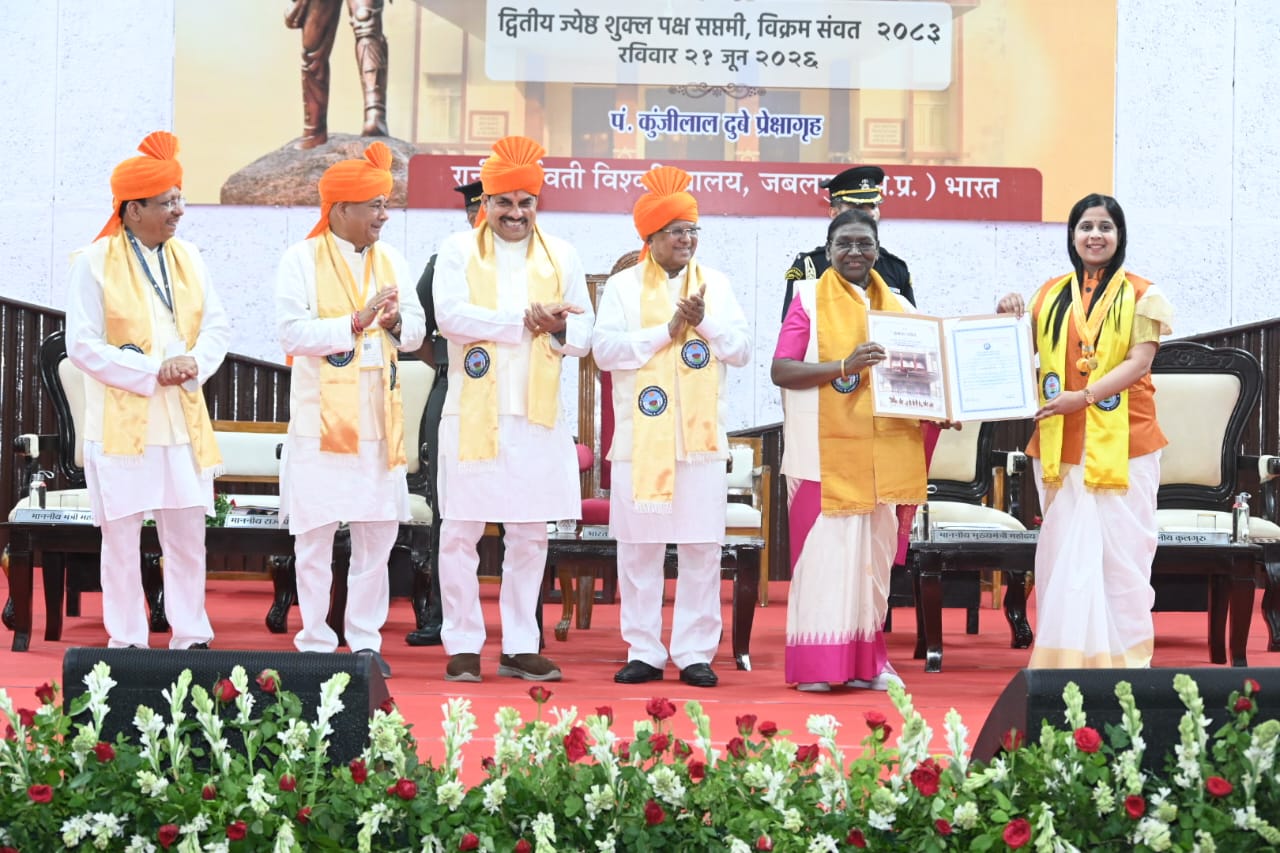
President Murmu was addressing the 36th Convocation Ceremony of Rani Durgavati University in Jabalpur on June 21 as the Chief Guest. The event was attended by Mangubhai Patel and Mohan Yadav.
A total of 141 meritorious students received 240 gold medals during the ceremony. President Murmu personally awarded 20 gold medals to selected students. Additionally, 182 research scholars were conferred Ph.D. degrees. Three scholars received D.Litt. degrees, one scholar was awarded a D.Sc. degree, and Vijaydutt Shridhar was honored with an honorary degree. Undergraduate and postgraduate degrees were also awarded to students from various faculties.
Rani Durgavati: A Symbol of Courage and Women’s Empowerment
Addressing the gathering, President Murmu expressed her happiness at being part of the university’s convocation ceremony. She paid tribute to Rani Durgavati, after whom the university is named, describing her as a symbol of indomitable courage, bravery, and valor.
She noted that the nation celebrated the 501st birth anniversary of the legendary queen of the Gondwana Kingdom last year and that her 462nd martyrdom day would be observed in a few days. According to the President, Rani Durgavati remains an enduring source of inspiration for women’s empowerment and symbolizes the strength of Indian womanhood.
The President said that everyone associated with the university should take pride in its 36-year journey. Located amidst a region rich in tribal culture and heritage, the university must work actively toward the empowerment of daughters from tribal, marginalized, and backward communities to truly honor the legacy of Rani Durgavati.
Importance of Supporting Tribal Communities
President Murmu emphasized that tribal communities are self-respecting and resilient. As India approaches 80 years of independence, many tribal communities continue to face challenges because they often do not voice their hardships and concerns.
She observed that while increasing numbers of tribal youth are receiving higher education, it is important not to distance themselves from their communities. Those who achieve success should remain connected to their roots and contribute to society. Educated young men and women living in cities should take time to visit their villages and guide community members.
The President noted that tribal communities generally do not seek financial assistance, especially since governments are implementing numerous welfare schemes. However, many people are unaware of how to access these benefits. Educated youth can play a crucial role in guiding them toward government services and opportunities.
Recalling former Prime Minister Atal Bihari Vajpayee, she quoted his belief that India is not merely a piece of land but a living nation. She stressed that the development of villages across the country is essential for achieving holistic growth. The vision of a Developed India by 2047 can only be realized when the most disadvantaged citizens are brought into the mainstream.
Education as the Most Effective Tool for Development
President Murmu described education as the most powerful instrument of development and emphasized the importance of advancing educational opportunities within tribal communities.
She appreciated the university’s efforts to support the holistic development of students from rural and marginalized backgrounds. She said that tribal youth should be given opportunities to participate in modern development while preserving their unique identity, heritage, traditions, and culture.
The President highlighted the need to promote tribal knowledge systems and skills through modern platforms. Universities and educational institutions should take special initiatives in this regard. She stated that wider study and documentation of tribal knowledge and craftsmanship would benefit the entire nation.
According to her, higher educational institutions are not only centers of learning but also hubs of innovation and research. They have the responsibility to nurture creativity, scientific thinking, and entrepreneurship among students while fostering respect for Indian culture, traditions, and languages.
She remarked that India’s diversity—its food habits, lifestyles, attire, languages, and cultural traditions—is a source of strength and identity. Balanced national development, she said, can be achieved through the harmonious integration of modernity and tradition.
Youth Possess Extraordinary Potential
President Murmu praised the university for incorporating elements of India’s traditional knowledge systems into its academic framework. She noted that the university is actively promoting Vedic Mathematics and Indian educational values through collaborations with other institutions.
She also appreciated the university’s emphasis on innovation, mentioning that its Design Innovation Center has secured patents. Calling the convocation a significant milestone in students’ lives, she observed that a larger number of female students had received gold medals, reflecting both their determination and the nation’s progress toward inclusive development.
She highlighted that approximately 65 percent of India’s population is young and possesses immense courage and potential. The nation has high expectations from its youth, and these aspirations can be fulfilled when young people receive employment opportunities aligned with their capabilities. Both the state and central governments, she noted, are working toward this goal.
Build Life on Strong Values
President Murmu stressed the importance of including themes such as environmental conservation, women’s empowerment, development of marginalized communities, cleanliness, and social harmony in academic research and studies.
Such research, she said, benefits society and contributes to the formulation of effective development policies. She expressed hope that all Indian universities would become globally recognized centers of knowledge, science, and research.
The President observed that the world is changing rapidly and that languages, lifestyles, and ways of living are evolving quickly. However, she emphasized that core values must never be forgotten. Values such as truth, non-violence, compassion, service, and honesty should form the foundation of young people’s lives.
By embracing these values, students can face challenges effectively, become ideal citizens, and make meaningful contributions to nation-building. She reminded graduates that they are not merely representatives of their families or universities but also custodians of the nation’s aspirations and future.
Highlighting India’s advancements in digital technology, startups, green energy, and space research, she encouraged students to innovate, seize emerging opportunities, and establish a global identity while remaining environmentally responsible. She concluded by expressing confidence in their ability to fulfill their responsibilities and wished them success in the future.
Governor Calls for Service to Tribal Villages
Governor Mangubhai Patel said that students receiving degrees and medals are the new strength behind the vision of Developed India 2047. He urged young graduates to draw inspiration from the public service spirit of Rani Durgavati and tribal heroes who dedicated themselves to social welfare.
He proposed that educated tribal youth adopt groups of villages and work closely with communities to support their comprehensive development. Referring to Madhya Pradesh’s Baiga, Bharia, and Sahariya tribal populations, which together exceed 1.4 million people, he highlighted major government initiatives aimed at improving their lives.
He urged students to help ensure that government welfare schemes reach poor tribal families at the village and tehsil levels and encouraged them never to forget their society and nation.
Madhya Pradesh Government Committed to Student Welfare
Chief Minister Dr. Mohan Yadav said that the Madhya Pradesh government has begun using the term “Kulguru” instead of Vice-Chancellor in universities, inspired by India’s ancient guru tradition.
Congratulating the students receiving medals and degrees, he expressed confidence that India would continue to advance rapidly under the leadership of Prime Minister Narendra Modi.
He praised Rani Durgavati’s courage in defending tribal pride and culture against the Mughal Empire and recalled her historic resistance. The Chief Minister stated that President Murmu’s presence at the convocation was a source of inspiration for the state’s young talent.
Highlighting progress in higher education, he said that Madhya Pradesh’s Gross Enrollment Ratio in higher education has reached 28.9 percent, while the school dropout rate has fallen to zero. He added that the state government is working to establish three new government universities and expand opportunities for higher education.
Dr. Yadav also noted that agricultural studies have been introduced in universities and that new courses are being launched to enhance skill development and employment prospects for youth across the state.
Hashtags: #MadhyaPradeshState #Bhopal #Desksource #36th #Convocation #Ceremony #DeskSource #Rani #Durgavati #University