


Photo credit
Today in History
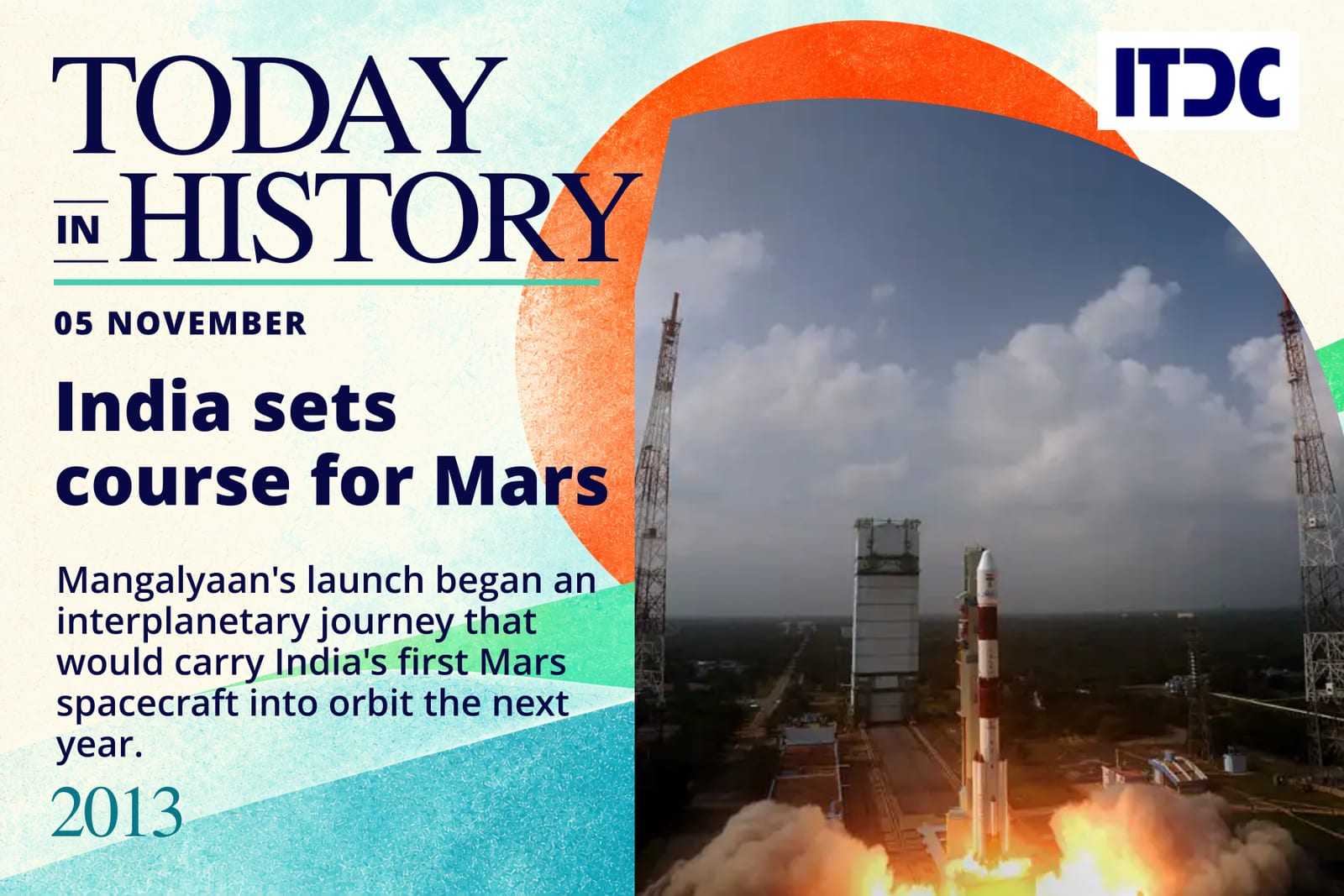
On 5 November 2013, a Polar Satellite Launch Vehicle rose from Sriharikota carrying a spacecraft bound for a destination no Indian mission had previously reached: Mars. The launch of the Mars Orbiter Mission, widely called Mangalyaan, began a journey that would extend India’s space programme beyond the Earth–Moon system.
The launch vehicle was PSLV-C25, and the departure point was the Satish Dhawan Space Centre. Launch day was the beginning of the undertaking, not its arrival at the Red Planet. The spacecraft first used a sequence of Earth-orbit manoeuvres before setting out on its interplanetary trajectory. It entered orbit around Mars on 24 September 2014.
For the Indian Space Research Organisation, the central challenge was technological. A spacecraft travelling so far from Earth needed reliable navigation, propulsion, communications and enough autonomy to manage situations without instant instructions from the ground. Mars-orbit insertion demanded a further critical manoeuvre: the spacecraft had to slow sufficiently to be captured rather than simply pass the planet.
A technology demonstrator with scientific work
Mangalyaan carried five scientific instruments. They included the Mars Colour Camera, instruments for studying the atmosphere and exosphere, a thermal infrared imaging spectrometer and a methane sensor. Their objectives should not be confused with claims that every proposed measurement produced a discovery. The mission was designed to test capabilities while also gathering useful planetary observations.
Its elongated orbit allowed the camera to photograph both regional features and broader views of Mars. ISRO later highlighted studies of atmospheric composition, dust, clouds and changes in the polar ice caps. Images from the mission also contributed to an atlas of the planet.
The successful arrival made ISRO the fourth space agency to place a spacecraft in Mars orbit. India succeeded on its first Mars mission, a significant achievement in an undertaking that requires many operations to work across enormous distances.
The spacecraft was designed for a six-month working life but remained in Martian orbit for about eight years. ISRO reported that communication was lost after a long eclipse in April 2022 and subsequently declared the mission unrecoverable. Mangalyaan should therefore be remembered as a completed mission, not described as a spacecraft still sending observations today.
The significance of 5 November lies in the ambition made concrete that afternoon: a launch from the Indian coast became the starting point for learning how to operate at another planet. The achievement rests as much in those engineering lessons as in the memorable pictures of Mars.



