


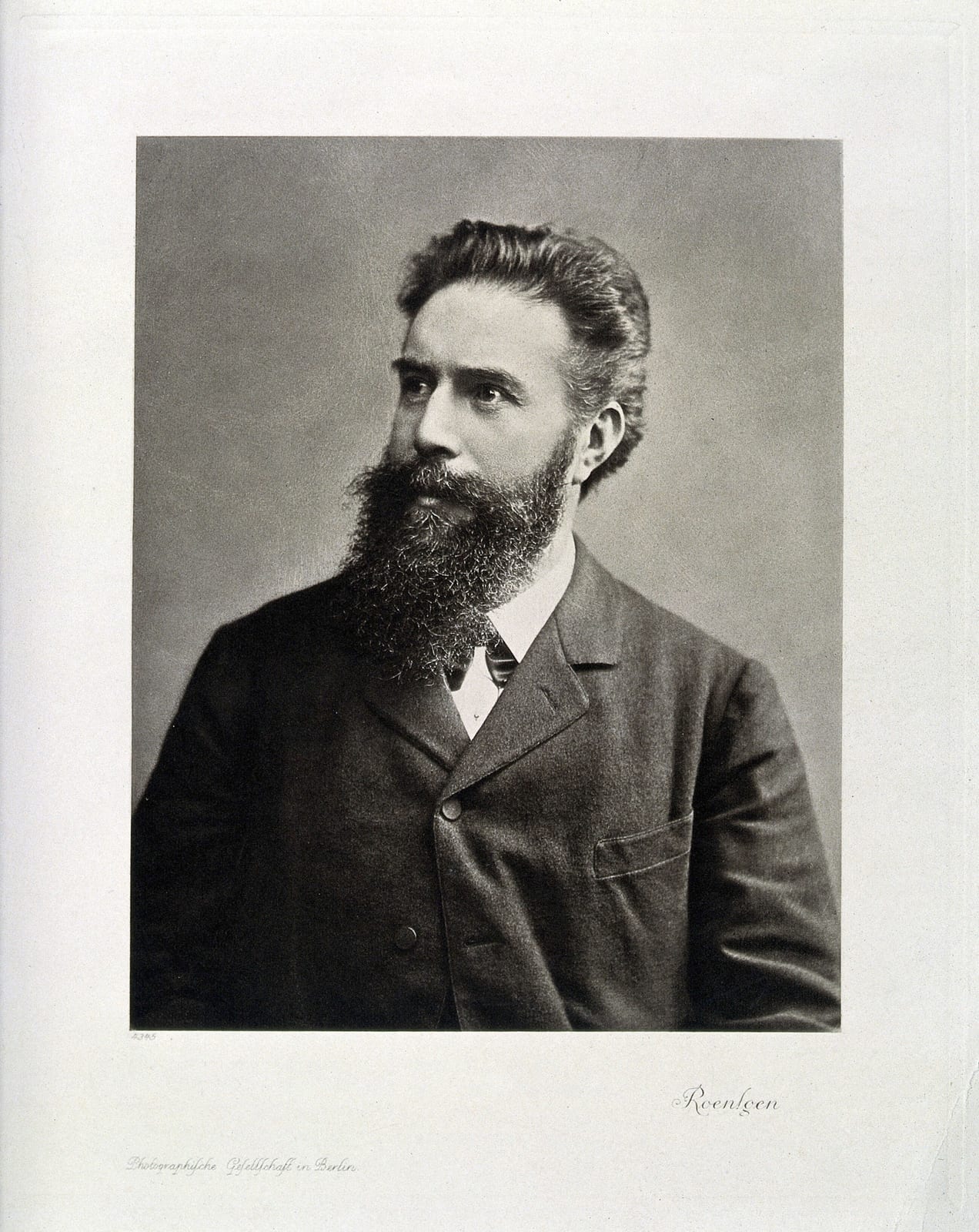
Wellcome Collection. Public Domain Mark.
On 8 November 1895, Wilhelm Conrad Röntgen was investigating electrical discharges in a laboratory in Würzburg, Germany, when an unexpected glow demanded an explanation. A nearby fluorescent screen responded even though the discharge tube was covered. Something capable of passing through the covering was reaching it.
Röntgen was working with the experimental equipment of his time: evacuated glass tubes in which electrical effects could be observed. Such apparatus was already familiar to physicists. The decisive step was to treat the unexplained response as a question worth pursuing, rather than dismiss it as an inconvenience in an existing experiment.
He investigated the penetrating radiation and called it X-rays, using the letter to indicate an unknown. Different substances obstructed the rays to different degrees. That property made it possible to produce images in which internal structures appeared without cutting an object open.
The breakthrough was not the creation of ordinary visible light. X-rays are a form of electromagnetic radiation with a much shorter wavelength than the light people see. Their different interaction with materials is what makes an X-ray image unlike a conventional photograph.
A new way of looking inside
Röntgen’s experiments included the celebrated image of his wife’s hand, with bones and a ring conspicuous against the softer tissue. It became an exceptionally clear demonstration of the discovery’s possibilities. The hand image belongs to the subsequent experimental story; it should not be used to collapse every stage of the research into the initial observation on 8 November.
Medical applications followed rapidly. Doctors gained a way to investigate fractures and locate objects inside the body without relying only on external examination or exploratory surgery. A laboratory discovery had supplied a different kind of evidence for clinical decisions.
The excitement also preceded a full understanding of radiation hazards. The history of X-rays is therefore not simply a story of increasing visibility: safe use required further knowledge, protective practices and careful control of exposure. Seeing more did not remove the responsibility to understand how an image was obtained.
In 1901, Röntgen received the first Nobel Prize in Physics. The honour recognised a discovery whose importance had become evident within only a few years.
The date remains a striking example of the relationship between surprise and disciplined investigation. The glow itself was an observation. Establishing what caused it, testing what the rays could penetrate and making the results intelligible to others turned that observation into a scientific breakthrough. A covered tube in Würzburg had opened a new route into the unseen.



