


Public.Resource.Org / CC BY 2.0
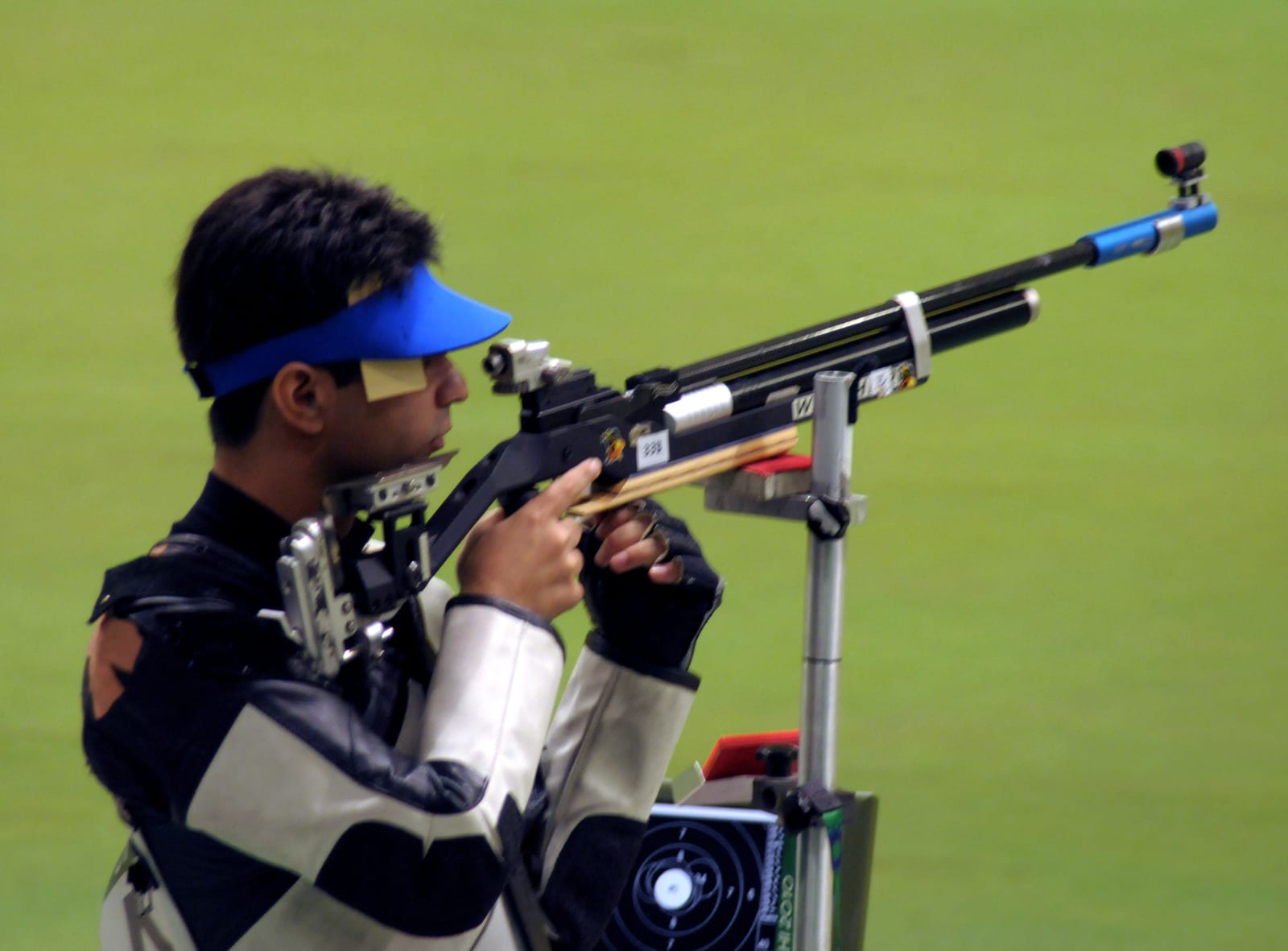
India’s first individual Olympic gold medal came from a contest measured in fractions. On 11 August 2008, Abhinav Bindra won the men’s 10m air rifle event at the Beijing Games with a combined score of 700.5. A sporting distinction that had remained beyond Indian athletes was finally achieved through an exceptionally controlled final.
The victory was not India’s first Olympic gold in any form. The country’s men’s hockey teams had already built a celebrated history of titles. Bindra’s achievement was different: an Indian competitor had won an individual event. Keeping that distinction clear explains why Beijing occupies such a particular place in the country’s Olympic story.
Bindra entered the final with a qualification score of 596, which placed him fourth. Under the scoring system then in use, qualification points carried forward and were added to a ten-shot final scored in decimals. The medal contest therefore demanded both a strong opening stage and the ability to improve a position under concentrated pressure.
He produced 104.5 in the final. China’s Zhu Qinan, the defending champion from Athens, finished with 699.7 overall, while Finland’s Henri Häkkinen took bronze with 699.4. Those totals make the closeness of the contest plain: the gap between first and second was less than one point.
Bindra’s final shot was 10.8. It completed a sequence in which every attempt reached at least 10.0, as the official result sheet records. Such consistency is easy to miss when a national milestone is reduced to one famous last shot. The decisive moment rested on the accuracy of the shots that preceded it.
He had also arrived in Beijing as the reigning world champion. The gold was therefore a breakthrough for Indian Olympic history, rather than the sudden emergence of an unknown shooter. The international federation’s contemporary report placed the result within a longer process of preparation after the Athens Games.
For Indian readers, the importance of the event lies in that combination: a major national first achieved by an athlete already operating at the highest level of his sport. It showed what an individual Olympic title looked like in practice, not as an abstract aspiration but as a qualification score, a demanding final and a confirmed result.
Beijing did not erase the uncertainty inherent in sport. It supplied a concrete answer to one long-standing question. On that August morning, Bindra finished ahead of the field, and India’s Olympic record acquired an individual gold medallist.



