


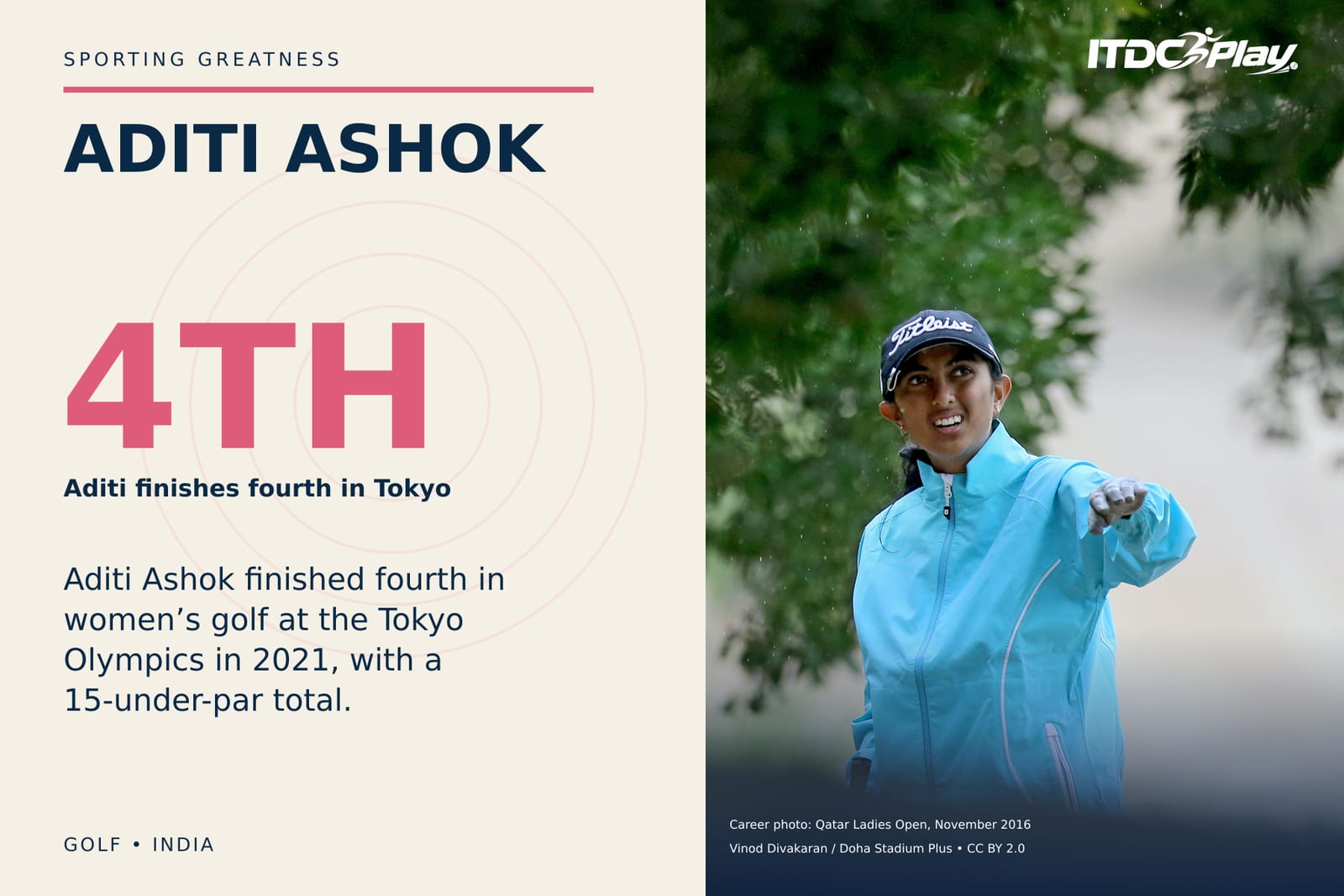
Vinod Divakaran / Doha Stadium Plus · CC BY 2.0
Aditi Ashok finished the women’s Olympic golf tournament on 7 August 2021 just outside the medals. Her total of 269, fifteen under par, placed her fourth at Kasumigaseki Country Club in Japan. One additional stroke separated her from the score that took Mone Inami and Lydia Ko into a playoff for silver and bronze.
It was a narrow sporting disappointment and, at the same time, an unusually visible moment for Indian golf. Ashok remained close enough to the leaders for the possibility of a medal to persist through the final day. The result needed no invented podium finish to make it significant: fourth place itself represented a sustained challenge against an elite Olympic field.
The tournament was part of Tokyo 2020, the Games held in 2021 after their postponement. Nelly Korda of the United States won gold at seventeen under par. Japan’s Inami and New Zealand’s Ko finished one stroke behind her, with Inami taking silver in their playoff and Ko bronze.
Ashok began the final round three strokes behind Korda. The American’s closing round was not straightforward, and the competition also had to accommodate a storm interruption. Over a four-round golf tournament, however, the final ranking is determined by the accumulated score, not by how long a player occupies a medal position along the way.
That is part of what made Ashok’s performance absorbing. Golf offers no certainty that a strong finish will be rewarded if competitors are also improving their scores. The last round can leave an athlete playing well yet still outside the top three. Ashok’s fifteen-under total was excellent; on that leaderboard, three players had done just enough to finish ahead.
Her Olympic progression was clear. She had finished 41st at Rio in 2016. Tokyo brought her much closer to the leading positions, and the broader attention outlasted the event. Looking back before the Paris Games in 2024, the LPGA described how the Tokyo performance had introduced her to Indians who did not ordinarily follow golf.
That later recognition should not be mistaken for a claim that one result transformed the entire sport. It does show how the Olympics can bring an unfamiliar discipline into a wider public conversation.
Ashok’s Tokyo story therefore holds two truths together. She missed the medal she was pursuing, and she produced a performance worth remembering. The fourth-place finish remains a precise result, while the attention it attracted helped more Indian viewers see the skill and suspense of her sport.



