


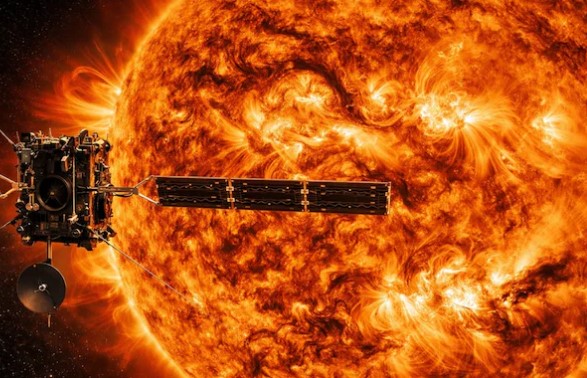
India’s first dedicated solar mission, Aditya-L1, has achieved an important milestone in efforts to understand the mysteries of the Sun. Its Solar Ultraviolet Imaging Telescope (SUIT) has successfully completed one year of scientific observations. During this period, the instrument has collected important images and data on the Sun’s lower atmosphere, solar flares and other activities. These are helping scientists better understand the Sun’s complex processes.
A research paper based on this one-year study details the operation, calibration, maintenance and scientific observations of the SUIT instrument. The paper, prepared under the leadership of Rahul Gopalakrishnan, has been accepted for publication in the Journal of Astrophysics and Astronomy.
Studying the Sun’s layers
SUIT captures images in the near-ultraviolet range of the Sun, between wavelengths of 200 and 400 nanometres. It is being used to study layers such as the Sun’s photosphere and chromosphere. Activities in these layers play an important role in understanding the onset of solar flares and major eruptions.
Aditya-L1 was launched by the Indian Space Research Organisation (ISRO) on September 2, 2023. It was placed in a halo orbit around the Lagrange Point-1 (L1) of the Sun-Earth system on January 6, 2024. Located about 15 lakh kilometres from Earth, this position enables the spacecraft to continuously observe the Sun.
Will help in understanding space weather
Aditya-L1 carries seven scientific instruments. Their purpose is to study the Sun’s outer atmosphere, solar wind, magnetic field and solar flares. Large eruptions of energy and matter from the Sun can affect Earth’s satellites, communication networks and power systems.
The data received from this mission will help scientists understand space weather processes and the effects of solar activity on Earth. During its planned five-year mission life, Aditya-L1 will continue to provide new scientific data related to the Sun.
Hashtags: #ScienceTechnology #Bhopal #AdityaL1 #Sun #SUIT #ISRO #SolarMission #SolarFlares #SpaceWeather #AdityaL1CompletesFirst



