


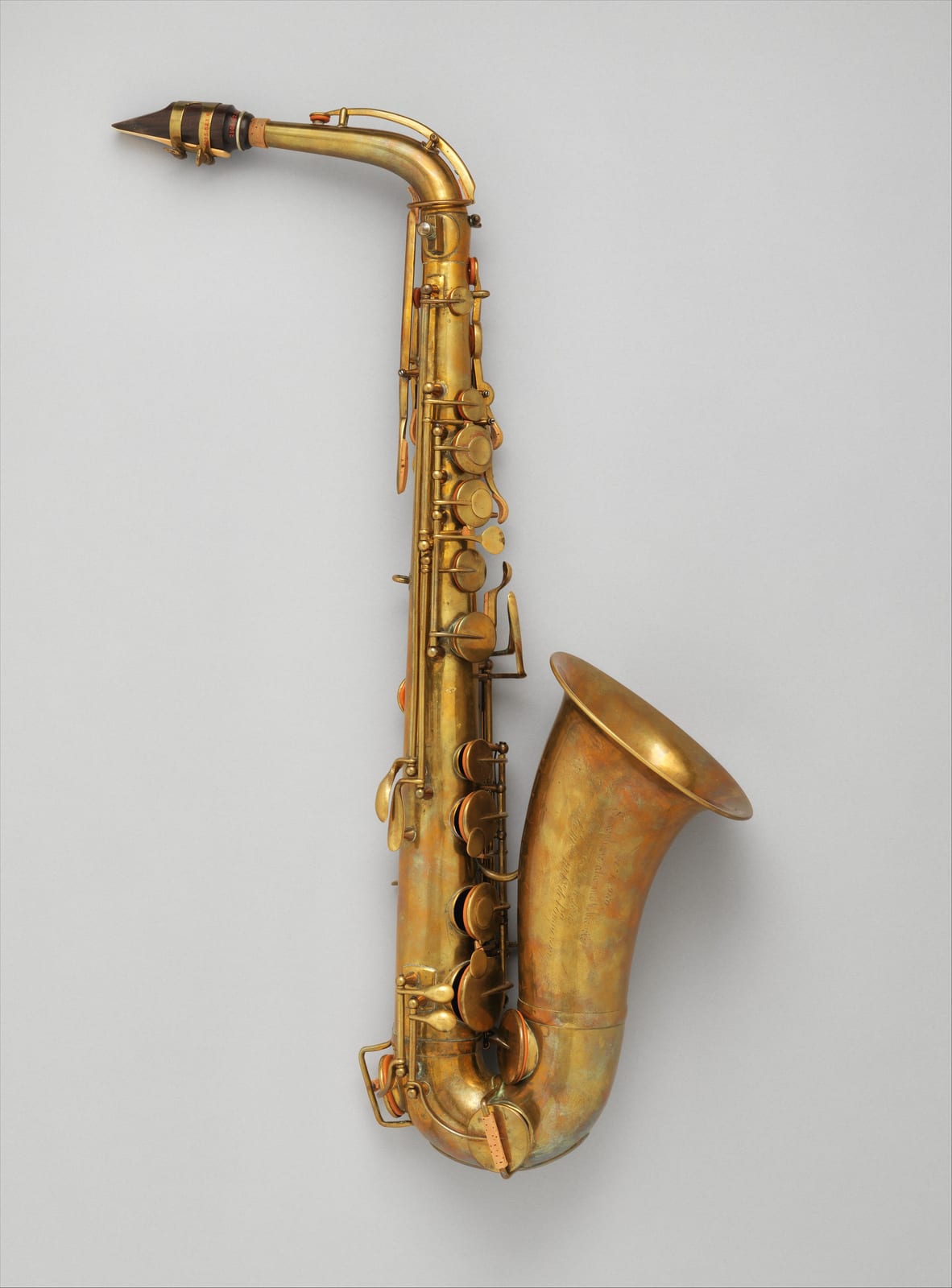
The saxophone’s sound is so closely associated with jazz that it can be easy to forget how much older the instrument is. Its inventor, Adolphe Sax, was born on 6 November 1814 in Dinant, in present-day Belgium. He designed his best-known instrument decades before jazz emerged.
Sax grew up around the practical business of making musical instruments. His father, Charles Joseph, was an instrument maker, and the younger Sax worked in the family workshop while developing as a musician. His early experiments included improvements to the clarinet and bass clarinet. Building instruments and playing them were connected forms of enquiry: a design had to work in a performer’s hands as well as on the workbench.
His ambition was not simply to produce a novel shape. Nineteenth-century wind ensembles had problems of balance, power and consistency. Instrument makers tried to supply voices that could blend with others while remaining clear enough to be heard. Sax investigated the dimensions and proportions of tubes and the ways in which they influenced tone.
A new family of instruments
The saxophone, patented in 1846, combined a single-reed mouthpiece with a metal body and a tapering bore. Despite its brass appearance, it belongs to the woodwind family because of the way the vibrating reed produces sound. The material of an instrument’s body does not alone determine its musical classification.
Sax developed a family rather than one instrument at a single pitch. This reflected his broader interest in building coherent groups of wind instruments. He also worked on the saxhorn family, extending his influence beyond the instrument that bears his name most visibly.
Acceptance was not immediate or uniform. The Metropolitan Museum of Art notes that conservative orchestral composers were difficult to persuade, while bands offered a more successful setting during Sax’s lifetime. The instrument’s later cultural identity was therefore not the straightforward fulfilment of one original plan.
Jazz and popular music brought the saxophone a different kind of prominence. Its flexible, voice-like tone, and the performer’s ability to shape pitch and expression, suited musical languages that had not existed when Sax filed his patent. Musicians made the invention their own.
Sax died in 1894, before many of those developments. His birthday recalls a craftsman whose work outgrew its first intended setting. The saxophone’s history shows that an invention is shaped twice: first by the person who makes it, and then by generations of people who discover what they can do with it.



