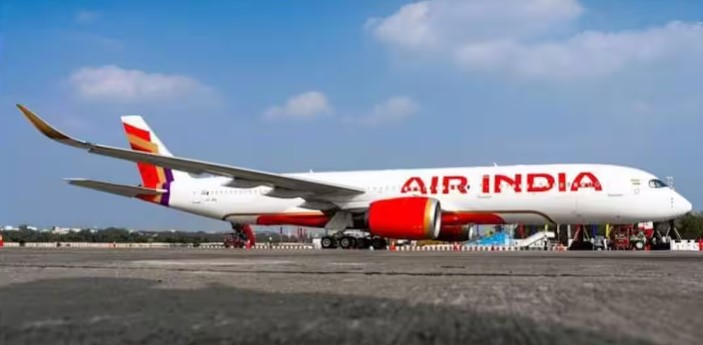
CNN Central News & Network-ITDC India Epress/ITDC News Bhopal: A major technical finding has emerged in the investigation into the serious incident involving Air India flight AI-2379, travelling from Phuket to Delhi, on August 4, 2026. Initially, the aircraft’s sudden loss of altitude was attributed to turbulence, but Airbus’s preliminary technical probe found that all three hydraulic systems on the aircraft lost pressure within a very short interval. As a result, some critical flight controls were unable to function for about four seconds.
The incident took place at around 36,000 feet. AI-2379 was an Airbus A320 aircraft and, at the time of the incident, it was flying over Odisha at an altitude of about 36,000 feet. According to Airbus’s initial DFDR data analysis, the aircraft’s green, blue and yellow hydraulic systems all suffered rapid pressure loss. The Airbus A320 has three independent hydraulic systems, designed so that the aircraft does not become completely uncontrollable if one system fails. All three systems being affected together is considered highly unusual.
The controls were affected for about four seconds. With all three hydraulic systems affected, important flight-control surfaces such as the elevator and ailerons did not respond normally for nearly four seconds. Elevators help move the aircraft’s nose up and down, while ailerons help roll the aircraft to the right or left.
During this period, the aircraft’s nose pitched upward and the autopilot disconnected. According to the report, the first officer gave full input to bring the aircraft’s nose down, but initially the flight-control surfaces did not respond as expected. After hydraulic pressure returned, control became normal and the aircraft moved sharply downward.
The aircraft dropped by about 300 feet. During the incident, a sudden fall of around 300 feet in the aircraft’s altitude was recorded. The jolt injured 24 people on board, including 20 passengers and four crew members, according to the information cited. The aircraft later landed safely at Delhi airport.
Why did all three systems fail? The most important question is how three separate and independent hydraulic systems were affected at the same time. Investigating agencies do not yet have a final answer.
Airbus’s preliminary investigation has indicated the need to examine a possible fault linked to hydraulic pressure sensors or pressure switches. Airbus has asked Air India to carry out a detailed inspection of the hydraulic pressure switches, pressure transducers, wiring and flight-control system. Details of hydraulic system-related maintenance activity on the aircraft over the past month have also been sought.
The investigation is still under way and the cause has not been determined. The Aircraft Accident Investigation Bureau (AAIB) is investigating the matter. Airbus and France’s BEA are also assisting in the technical probe. For now, the final reason for all three hydraulic systems losing pressure together has not been officially established. Therefore, a sensor fault or a problem in any other technical component is being treated only as a possible cause at this stage.
The incident has raised serious questions about the aircraft’s safety systems and hydraulic system redundancy. Only after the investigation is completed will it be clear whether this was a failure of a single technical component, a wiring or sensor-related problem, or a chain of events that together created the situation.
Hashtags: #MadhyaPradesh #Bhopal #AirIndia #AI2379 #AirbusA320 #AAIB #BEA #HydraulicSystems #DelhiAirport #PhuketDelhiFlight