


Photo: Lorie Shaull · CC BY-SA 2.0
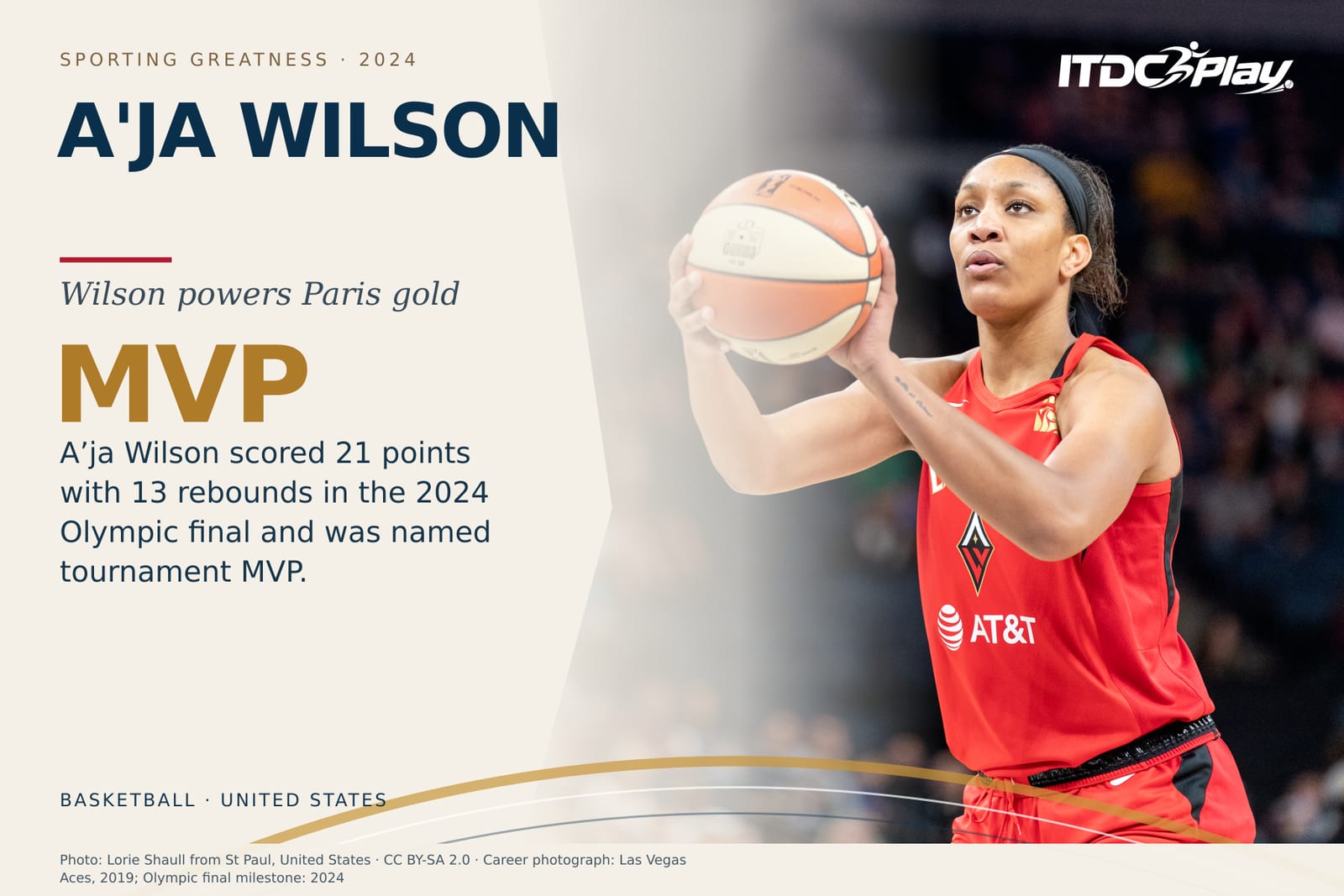
The score was 67–66, and an era of American dominance had survived by the smallest possible margin. On 11 August 2024, the United States defeated France in the women’s Olympic basketball final in Paris. At the centre of that hard-earned victory was A’ja Wilson, who finished with 21 points, 13 rebounds and four blocks.
The numbers describe an all-round performance, not simply a successful shooting afternoon. Wilson led all players in those three categories. Her rebounds helped recover possession; her blocks interrupted French attempts near the basket. In a final decided by one point, preventing a score mattered as much as making one.
France refused to allow the defending champions a comfortable procession. The teams reached half-time level at 25–25, and the hosts opened a ten-point advantage early in the third quarter. The Americans had to recover their balance while playing against both a determined opponent and the expectations attached to their own remarkable record.
The ending preserved that tension. Gabby Williams made a shot at the buzzer, but her foot was on the three-point line. It counted for two rather than the three France needed to force overtime. The final score therefore recorded both the champions’ resilience and how close the challengers had come.
Wilson’s influence extended beyond the final. FIBA named her the tournament’s Most Valuable Player, recognising the contribution that accompanied her second Olympic gold medal. Across six games she averaged 18.7 points and 10.2 rebounds, combining a dependable attacking presence with sustained work under the boards. The award belonged to a complete tournament rather than one dramatic closing contest.
For the United States, Paris brought an eighth consecutive women’s Olympic basketball title and a tenth overall. Those are team achievements, built across generations. Wilson’s performance illustrates how such continuity still depends on particular players answering difficult questions in particular matches. A long winning history cannot rebound a missed shot or defend the next possession.
That is why this gold remains more revealing than a comfortable scoreline might have been. Wilson did not lead a victory that could be taken for granted. She helped secure one that France contested until the final second, giving the American sequence another chapter through the demanding work of scoring, protecting the basket and keeping possession alive.




