


Zafer / Wikimedia Commons · CC BY 4.0
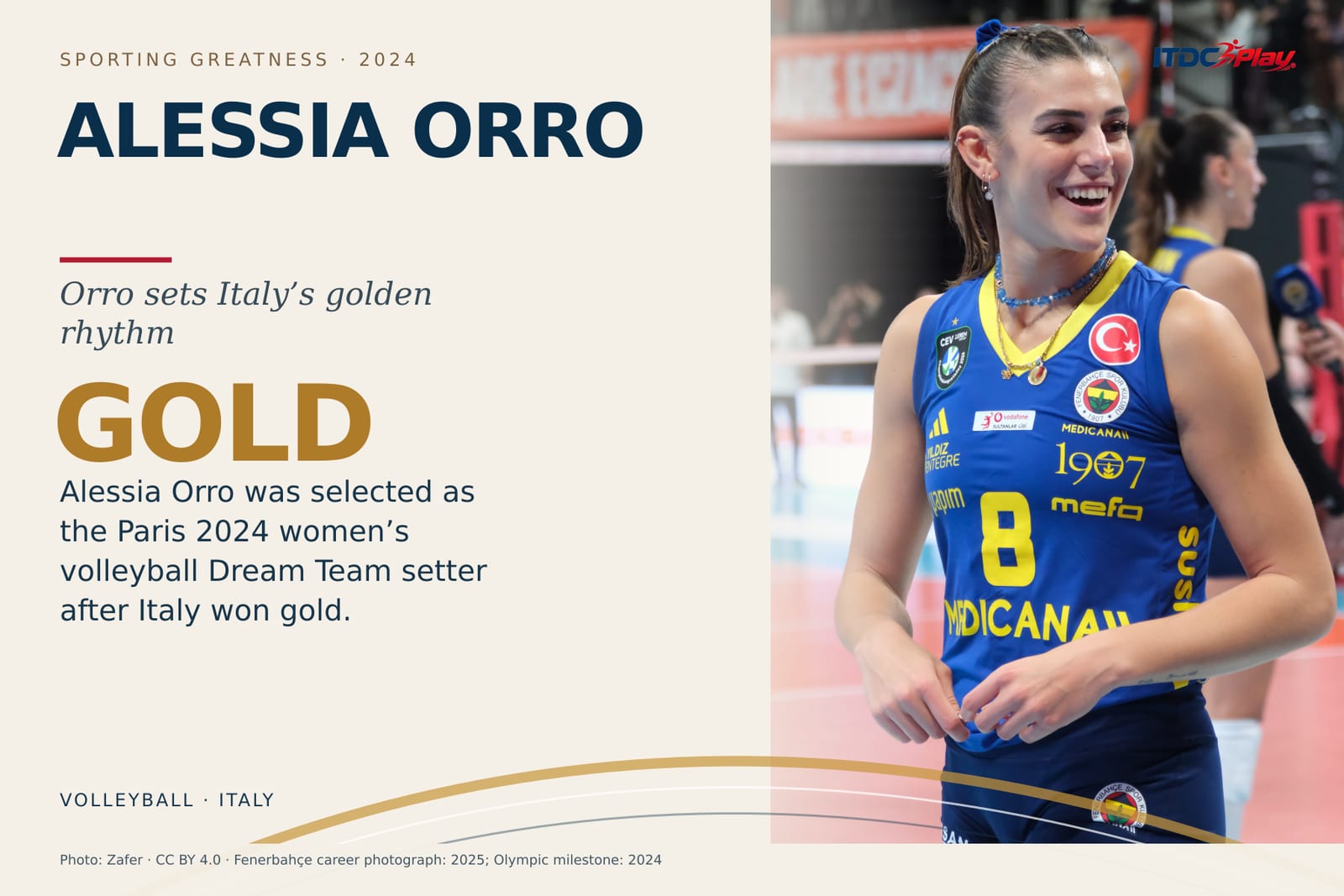
The player who finishes a volleyball attack usually receives the most immediate applause. Alessia Orro’s recognition at Paris 2024 drew attention to the work that makes those attacks possible. After Italy won the women’s Olympic title on 11 August, she was selected as the setter in the tournament’s Dream Team.
The distinction followed a final in which Italy defeated the United States 3–0 at South Paris Arena 1. The set scores were 25–18, 25–20 and 25–17. Against the reigning Olympic champions, Italy completed its own first Olympic gold-medal campaign in women’s volleyball without needing a fourth set.
A setter links reception and defence to the attacking options at the net. The task involves choosing the recipient of the next ball, setting its height and pace, and responding to how opponents have arranged their block. A powerful hitter remains crucial, but the opportunity to strike effectively often begins with that preceding decision.
Italy’s starting formation in the final paired Orro with opposite Paola Egonu. Caterina Bosetti and Myriam Sylla played as outside hitters, Anna Danesi and Sarah Fahr occupied the middle, and Monica De Gennaro served as libero. Coach Julio Velasco’s side therefore offered several attacking and defensive strengths rather than relying on a single player to do everything.
Egonu scored 22 points in the final and received the tournament’s Most Valuable Player award. Orro’s separate selection recognised a different contribution within the same successful structure. The Dream Team honoured roles, making it possible to distinguish the athlete who supplied much of the finishing power from the setter helping organise those opportunities.
The final was consistent with Italy’s tournament as a whole. The team won all six matches and dropped only one set. That sequence does not make every rally easy, but it shows that the championship rested on repeated performances rather than one exceptional afternoon.
For Orro, the award also placed her individual skill within a shared milestone. Volleyball is particularly resistant to the idea of a solitary hero: a point may depend on a reception, a set, an attack and covering work from players who never touch the ball. The best setter distinction made one part of that chain visible.
Paris is remembered as Italy’s first Olympic women’s volleyball title. Within that larger achievement, Orro’s story is about the value of preparation and choice at speed. The gold medal belonged to the team; her place in the Dream Team identified the quality of the player helping determine how its attacks would unfold.




