YellowMonkey / Wikimedia Commons · CC BY-SA 3.0
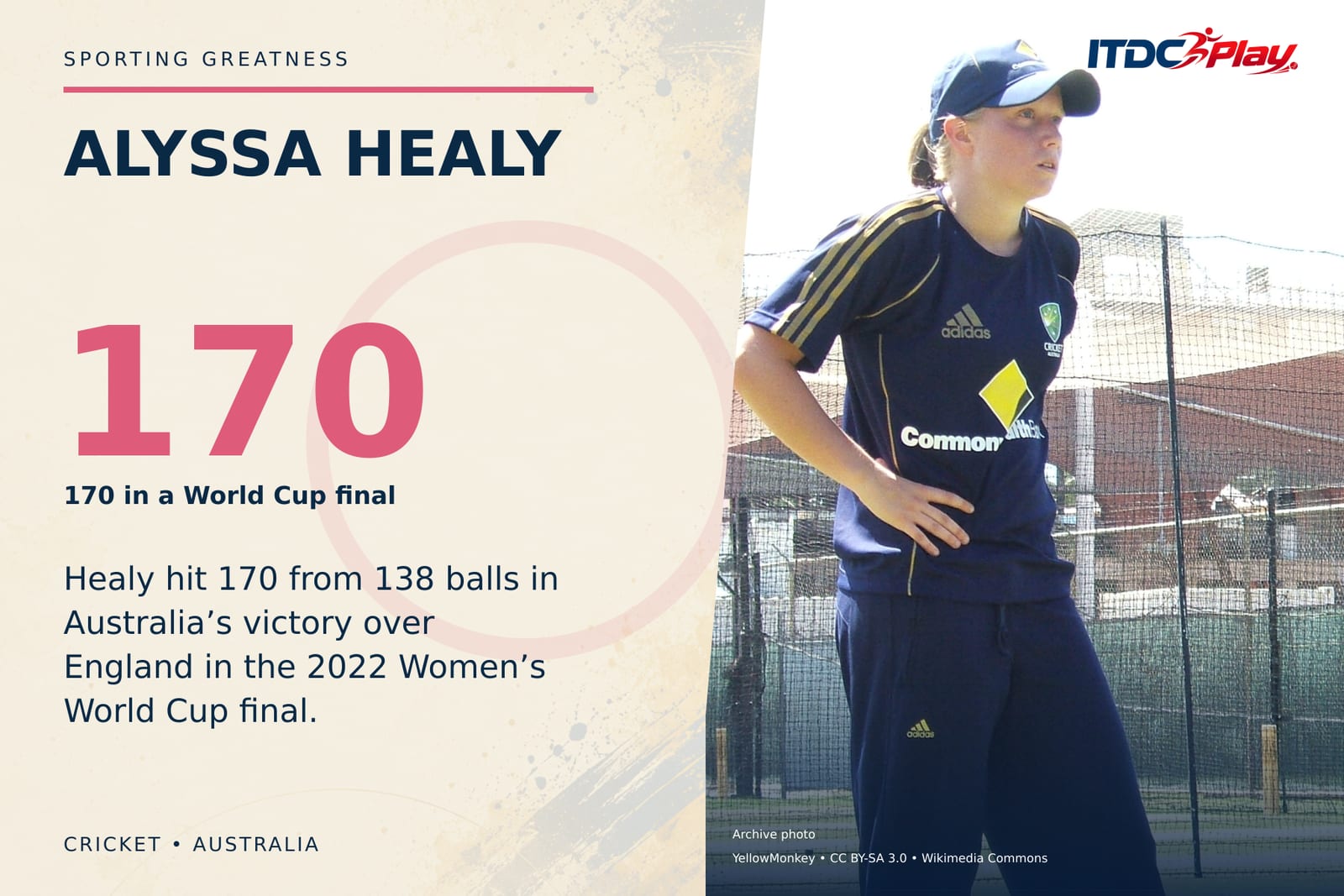
A World Cup final is supposed to compress possibility: fewer chances, greater pressure and little room to repair a mistake. Alyssa Healy expanded it instead. On 3 April 2022, at Hagley Oval in Christchurch, she struck 170 from 138 balls against England, setting Australia on the path to the Women’s Cricket World Cup title.
The innings contained 26 fours. Its scale was exceptional even before the occasion was considered; in a final, it became a landmark. Healy surpassed the previous highest individual scores in both men’s and women’s ODI World Cup finals, moving beyond Adam Gilchrist’s 149 against Sri Lanka in 2007 and Karen Rolton’s unbeaten 107 against India in 2005.
Australia finished with 356 for five. That total did not remove England’s right to challenge, and Nat Sciver answered with an unbeaten 148. But England were dismissed 71 runs short, giving Australia their seventh women’s ODI World Cup title.
Healy’s contribution was part of a larger tournament performance. She had also scored a century in the semi-final and ended the competition with 509 runs. The ICC’s contemporary account identified her as the first player, male or female, to make hundreds in both the semi-final and final of a Cricket World Cup.
The two innings mattered for different reasons. A semi-final hundred can open the door to the decisive match; a final hundred can help turn that opportunity into a trophy. Healy did both, then carried the second performance well beyond the conventional milestone of three figures.
Her final also had a place in Australia’s recent history. The team had been eliminated by India in the 2017 World Cup semi-final. Five years later, it completed the return to the one-day summit, adding the trophy to the women’s T20 world title it had won in 2020.
Healy received both the Player of the Match and Player of the Tournament awards. Those honours captured the relationship between the spectacular final innings and the sustained contribution that brought Australia through the competition.
The length of the 50-over format gave the innings room to develop, but Healy used that time with unusual purpose. Her scoring changed what England would need to achieve when their turn to bat arrived. The numbers remain vivid. One hundred and seventy runs, 138 deliveries and 26 boundaries describe an opener who converted a major occasion into an opportunity to dictate it, giving Australia a total its opponents could not reach.
Hashtags: #ITDCPlay #AlyssaHealy #WomenSCricketWorld #Sports #Christchurch #NewZealand #Alyssa #Healy #170 #Set