


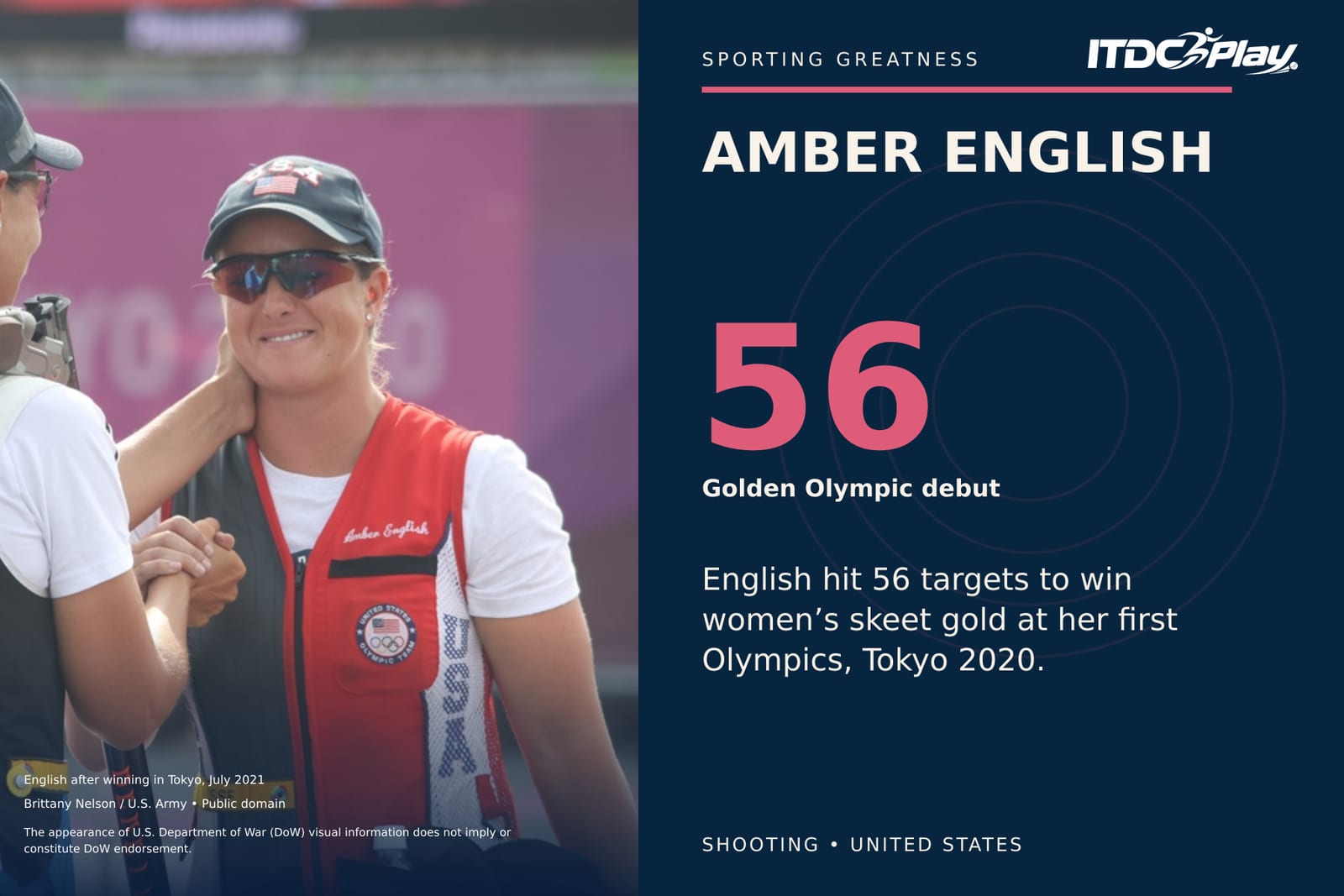
Brittany Nelson / U.S. Army
Amber English’s first Olympics ended at the top of the women’s skeet podium. On 26 July 2021, the American shooter hit 56 of 60 targets in the final at the Tokyo Games, setting an Olympic final record and defeating the defending champion, Italy’s Diana Bacosi, by one target.
The margin captures the nature of the achievement. After qualification and the successive eliminations of the final, the title remained close enough for one missed target to matter. English had to continue making accurate shots rather than assume that an earlier advantage would be enough.
Her qualification performance had already demonstrated consistency. She hit 121 of 125 targets across two days to enter the six-athlete final. The contest then moved to its separate final phase, where athletes were progressively eliminated until English and Bacosi remained in contention for gold.
Skeet requires shooters to respond to clay targets crossing their field of view from different stations. The challenge combines anticipation with controlled movement and accuracy. A target missed cannot be recovered later; the next attempt begins with the same immediate demand to recognise and execute.
For English, Tokyo was an Olympic debut rather than an introduction to elite competition. The United States Army’s contemporary account described her as a five-time World Cup medallist. She was also an Army reservist and a member of both its World Class Athlete Program and Marksmanship Unit, linking her international sporting career with a military support structure.
Her victory made her the second American woman to win Olympic skeet gold. That national distinction belonged alongside the immediate result, but did not replace it. The medal was earned by the specific performance of 56 successful hits in the final and the narrow advantage over an accomplished defending champion.
The Games retained the official name Tokyo 2020 although the competition took place in 2021. English’s gold therefore belongs to July 2021 in a chronological account. The record also describes the final format used at that time, rather than a timeless comparison across every version of the event.
What makes the story compelling is the combination of experience and first opportunity. English had competed internationally before, but an Olympic final was a new stage. She brought that preparation to a contest that remained unresolved until its closing targets and left with gold. The title was not the reward for simply reaching the Games; it was the result of maintaining her accuracy when the last remaining opponent could still deny her victory.



