


lensbug.chandru / Wikimedia Commons · CC BY 2.0
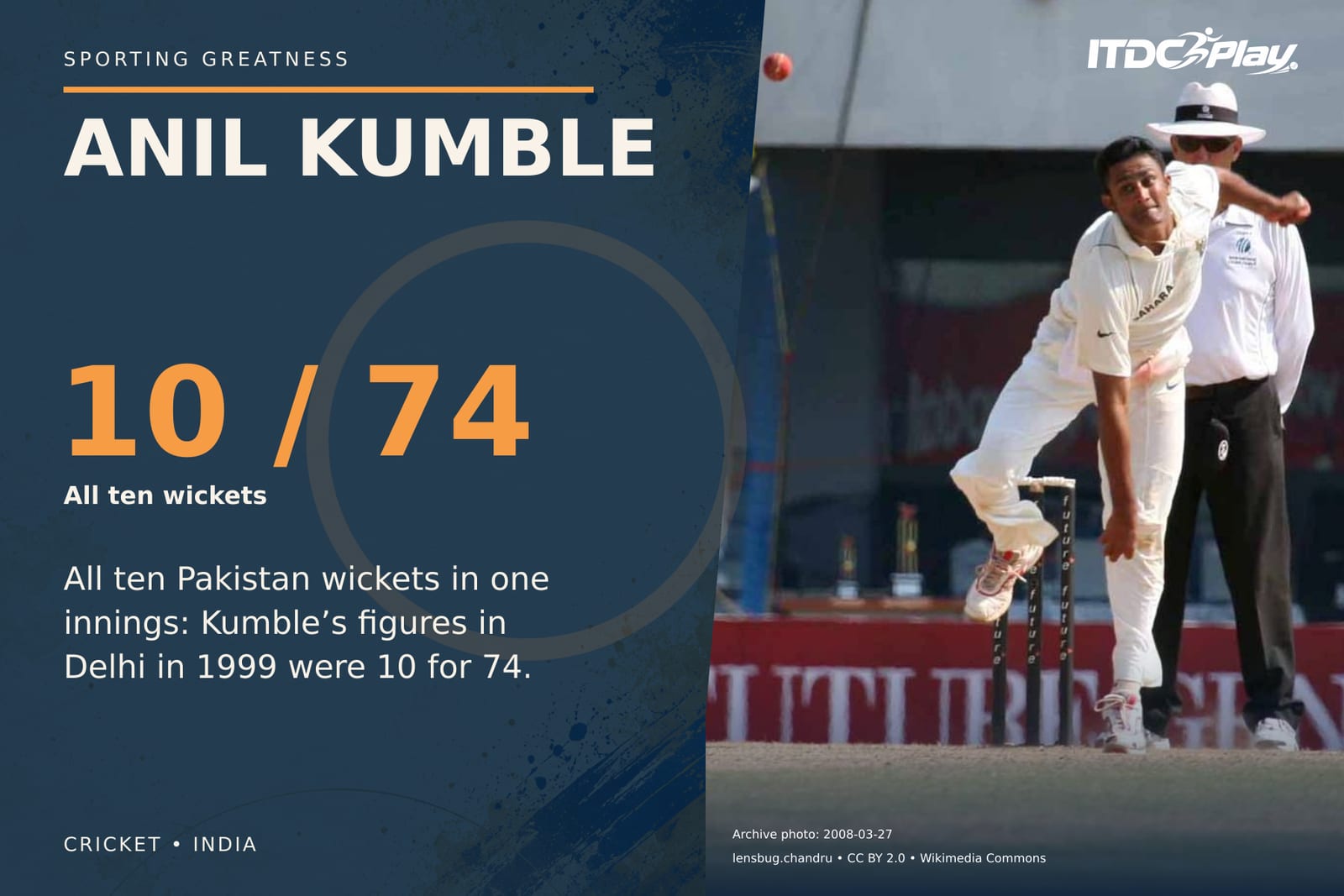
On 7 February 1999, Anil Kumble took all ten wickets in Pakistan’s second innings in Delhi, turning a promising chase into a landmark Indian victory.
Pakistan were 101 without loss when Anil Kumble began the sequence that would put his name beside one of Test cricket’s rarest achievements. By the end of the innings, every wicket belonged to him. At Delhi’s Feroz Shah Kotla on 7 February 1999, the Indian leg-spinner finished with ten for 74.
The second Test carried an immediate team objective. India needed victory to level the two-match series after losing a close contest in Chennai. They had set Pakistan 420 to win, but openers Shahid Afridi and Saeed Anwar had supplied a strong start. A large target alone had not secured the result.
Kumble broke through after lunch, dismissing Afridi and then Ijaz Ahmed from successive deliveries. The innings changed rapidly. Inzamam-ul-Haq and Mohammad Yousuf followed, and Pakistan’s position moved from an unbroken opening partnership to a struggle to contain the collapse.
Anwar remained an obstacle until Kumble induced a close catch. The bowler continued through the innings, taking advantage of pressure as well as the help available from the pitch. Pakistan’s batters had to negotiate pace through the air, changes in bounce and close fielders waiting for a mistake.
The final wicket was captain Wasim Akram, caught by VVS Laxman. Kumble’s complete analysis was 26.3 overs, nine maidens, 74 runs and ten wickets. He had already taken four wickets in Pakistan’s first innings, but it was the unbroken ownership of all ten in the second that made this performance exceptional.
Only Jim Laker had previously taken every wicket in a Test innings, achieving the feat for England against Australia in 1956. Kumble became the second bowler to do it. The distinction concerns an innings, not an entire match: taking ten wickets across two innings is a much more familiar achievement in Test cricket.
Even this intensely individual record was built within a team performance. Catchers completed dismissals, the batting had established a demanding target, and the victory served the wider purpose of levelling the series. Kumble supplied the extraordinary finishing act.
The enduring image of the Kotla afternoon is therefore inseparable from its cricketing context. A threatening opening stand was broken, an innings unravelled, and the scoreboard eventually credited one bowler with every dismissal. The figures 10 for 74 preserve the full extent of that transformation.




