


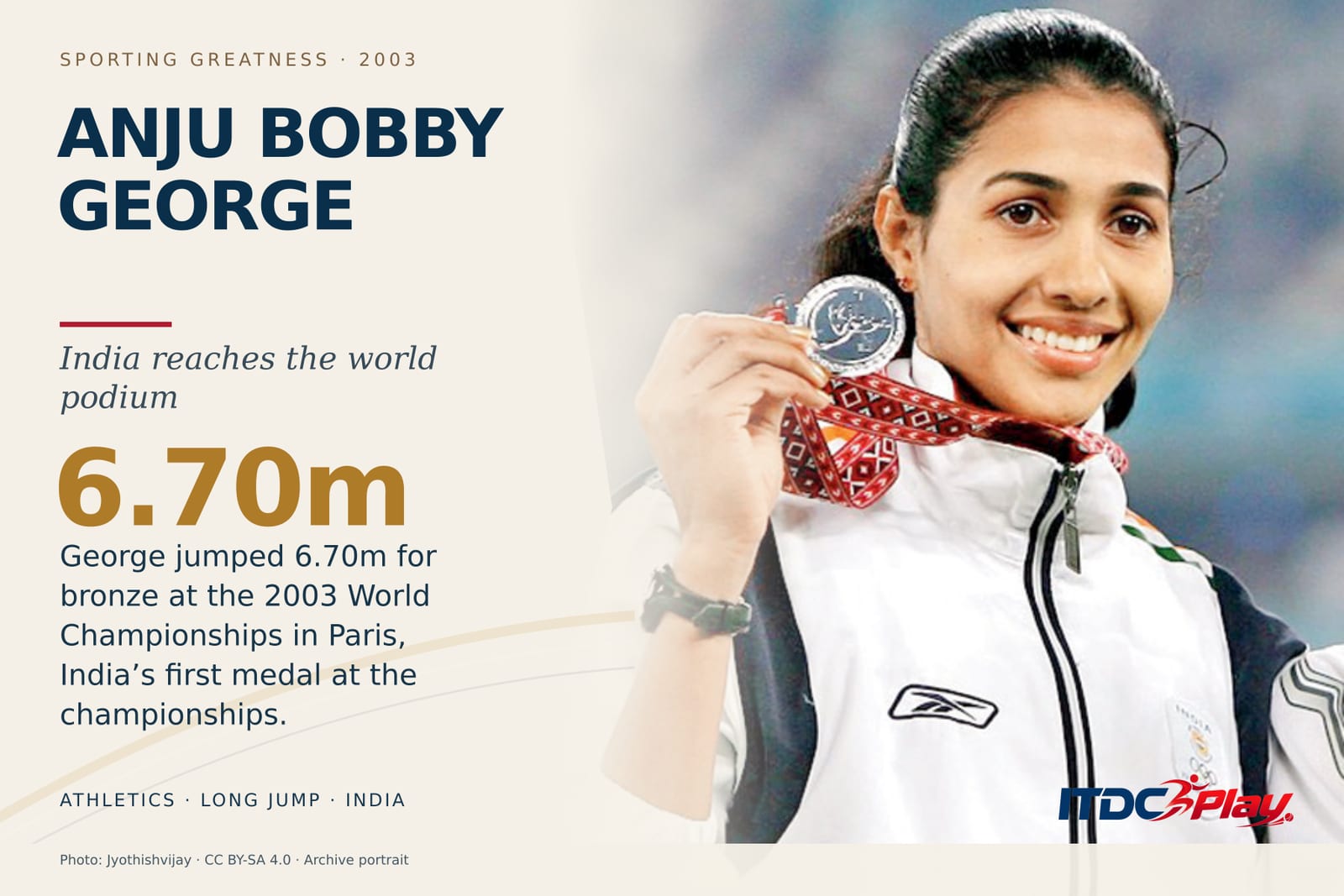
Jyothishvijay / Wikimedia Commons · CC BY-SA 4.0
Four centimetres separated Anju Bobby George from silver, but her bronze already represented a breakthrough for India. On 30 August 2003, she jumped 6.70 metres in the women’s long-jump final at the Stade de France in Saint-Denis, near Paris. It was India’s first medal at the World Athletics Championships.
France’s Eunice Barber won with 6.99 metres, while Russia’s Tatyana Kotova took silver with 6.74. George’s 6.70 placed her ahead of Britain’s Jade Johnson, whose best was 6.63. The seven-centimetre gap between third and fourth shows how little space can separate a historic podium finish from leaving without a medal.
George built her result across the competition rather than finding her best distance immediately. She opened with 6.61 metres, fouled her next two attempts and then recorded 6.56. Her fifth-round 6.70 became the mark that secured bronze; she finished with another valid jump of 6.62.
The sequence matters because long jump is not decided by averaging an athlete’s efforts. The best valid mark determines the placing. Fouls consume opportunities without adding a distance, and each later attempt must be made while rivals can still improve. George’s medal-winning performance emerged from that changing contest.
The official result identified 6.70 as her season’s best. It was not a world record, and it should not be described as one. Its importance lay in what the distance achieved at that championship: a place among the world’s top three and a first entry for India in the event’s national medal history.
Her career would include other substantial performances. At the Athens Olympics in 2004 she recorded 6.83 metres, listed by World Athletics as her personal best. The later, longer jump helps distinguish two different measures of sporting achievement. An athlete’s greatest distance and the performance that carries the largest historical meaning need not be the same.
Paris remains the central moment here. The result established that an Indian athlete could reach the podium at the outdoor world championships, where success required competing against a global field rather than a regional one.
There is no need to enlarge the claim beyond the evidence. George won bronze, not gold; her best effort was 6.70 metres; the date was 30 August 2003. Those precise facts are enough to describe a landmark evening for Indian athletics.




