


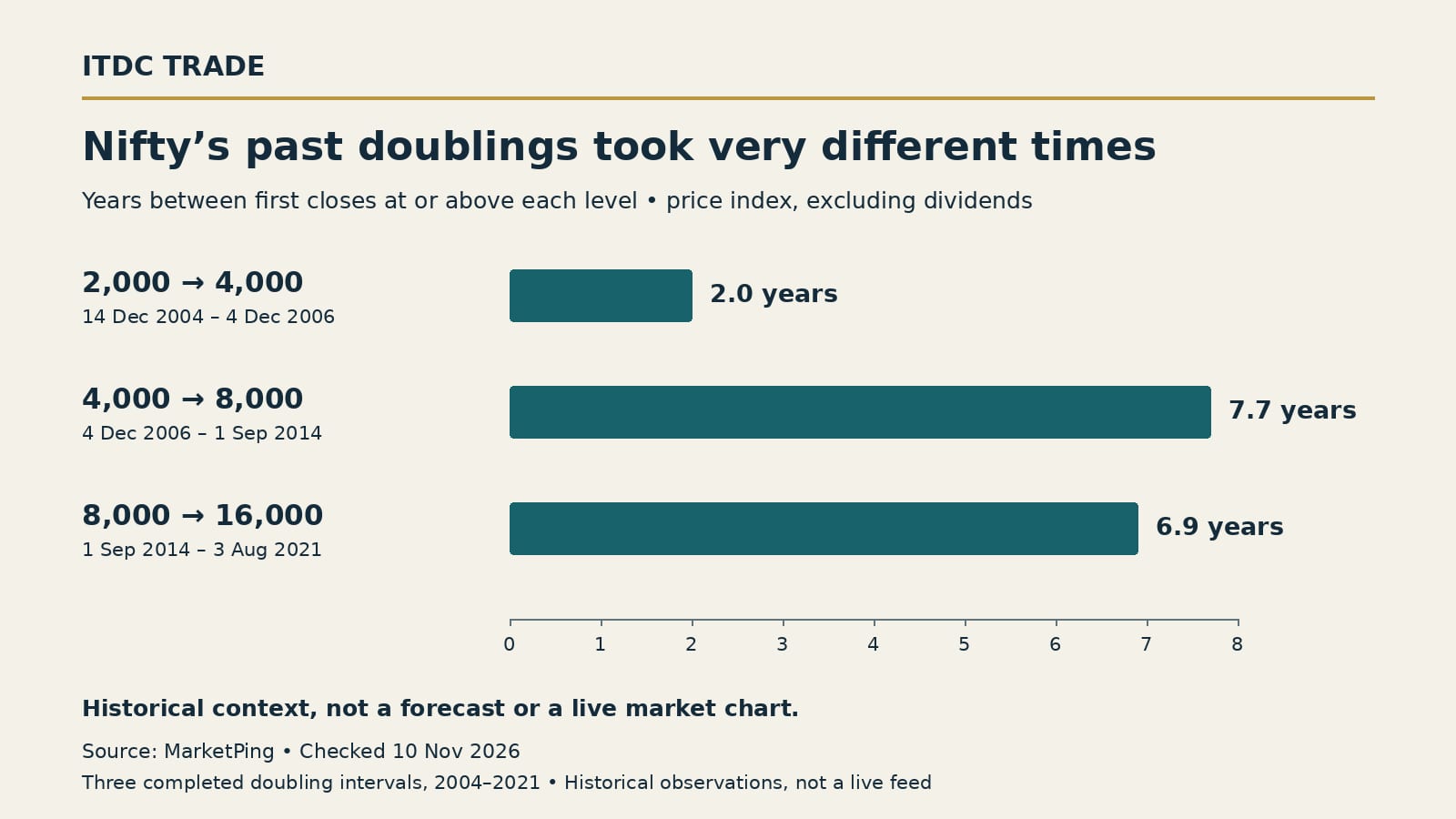
ITDC redraw from MarketPing, CC BY 4.0; source data date 10 November 2026
Indian equity markets were closed on Tuesday, 10 November 2026, for Diwali-Balipratipada. In the preceding session on Monday, 9 November, the Nifty 50 had risen 58.25 points, or 0.23%, to close at 25,044.65.
Public-sector banks and pharmaceutical shares helped the benchmarks finish higher after a volatile 9 November session. Upstox’s closing report recorded more declining than advancing shares across the NSE, a reminder that a small index gain can conceal a weaker day for many stocks. Technology shares were among the areas of weakness.
HDFC SKY’s 9 November report also identified easing crude prices as a support. Lower oil prices can reduce India’s import bill and some companies’ costs, but the benefit depends on the move lasting and on the rupee’s exchange rate. It does not guarantee another rise in shares.
The longer view also resists a simple forecast. MarketPing’s published historical chart records three completed Nifty doublings: 2,000 to 4,000 took about two years, 4,000 to 8,000 took 7.7 years, and 8,000 to 16,000 took 6.9 years. The accompanying redraw shows those 2004–2021 intervals. They measure the price index without dividends; past waiting times do not determine the next one.
IBJA’s 10 November morning benchmark put gold of 999 fineness at ₹1,42,420 per 10 grams and gold of 916 fineness at ₹1,30,457 per 10 grams. Silver of 999 fineness was ₹1,86,000 per kilogram. These Indian benchmarks exclude 3% GST and making charges. Under its Diwali schedule, IBJA issued only a morning rate for 10 November, with no evening rate.



