


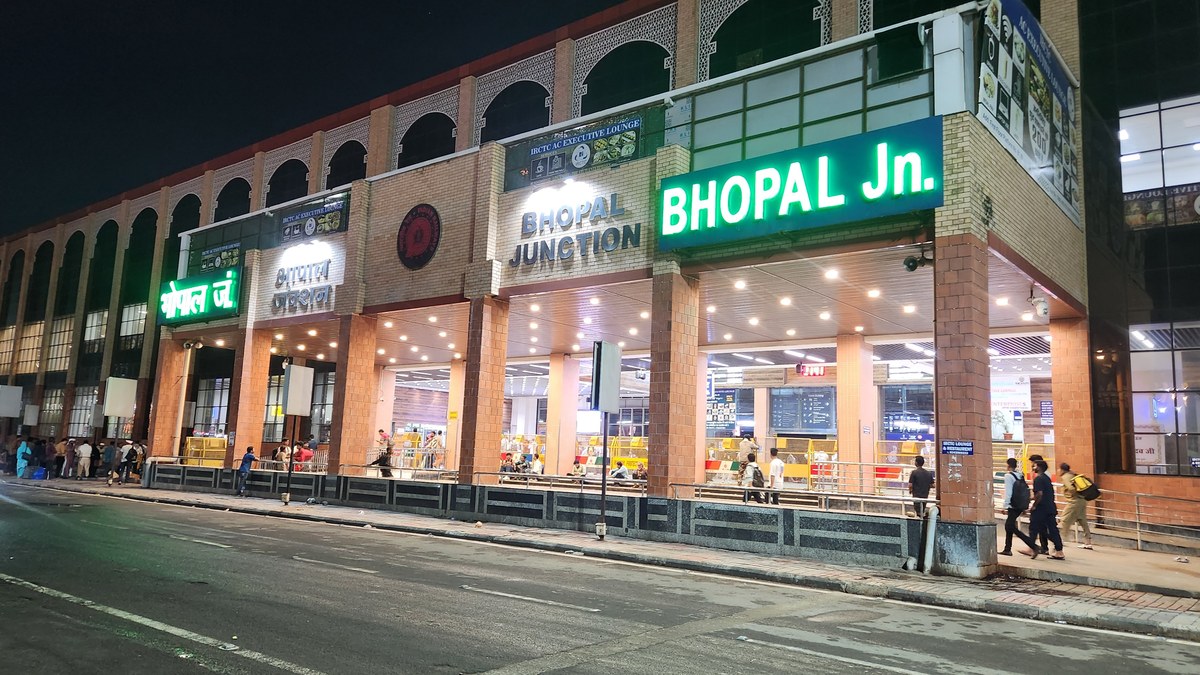
Photo: Amitbalani / Wikimedia Commons (CC0). Cropped. | फोटो: Amitbalani / विकिमीडिया कॉमन्स (CC0)। तस्वीर काटी गई है।
Diwali travel has pushed daily footfall at Bhopal railway station above one lakh, against about 60,000 on ordinary days. To manage that surge, West Central Railway has paired extra trains with a denser security grid that now leans on cameras as much as on personnel.
Senior DCM Saurabh Kataria said 13 artificial-intelligence cameras and five face-recognition cameras are active at the station. The face-recognition units, he said, are meant to spot offenders who may try to use the crowd as cover. About 30 security staff from the Railway Protection Force, Government Railway Police and the commercial wing are deployed each shift, including in holding areas. Entry points have been organised at platforms one and six so passengers move in and out in a more ordered way.
Announcements and special services are part of the same plan. Saturday reporting put festive specials linked to the rush at about 20 trains; the Bhopal Division had earlier announced 12 pairs of festival specials across a longer Puja-Diwali-Chhath window. Separate local reports this week described overcrowding even after extras and additional coaches, including unreserved passengers pressing into reserved coaches.
The connected point is the choice of tools. Festival demand is seasonal and familiar. What is newer at Bhopal station is the open use of AI crowd cameras and face matching beside the usual RPF lines. Officials present both as crowd control and as crime prevention. Face matches still need human follow-up; a camera alert is not itself proof of an offence.
For passengers, the immediate test is whether orderly entry points and extra trains ease the crush. For the city, the Diwali rush has also become a live trial of how far station security will rest on algorithmic surveillance.
Hashtags: #ApnaBhopal #Railways #Diwali #Surveillance #AI #Bhopal #BhopalRailwayAICameras #BhopalCity #BhopalStationDiwaliRush



