


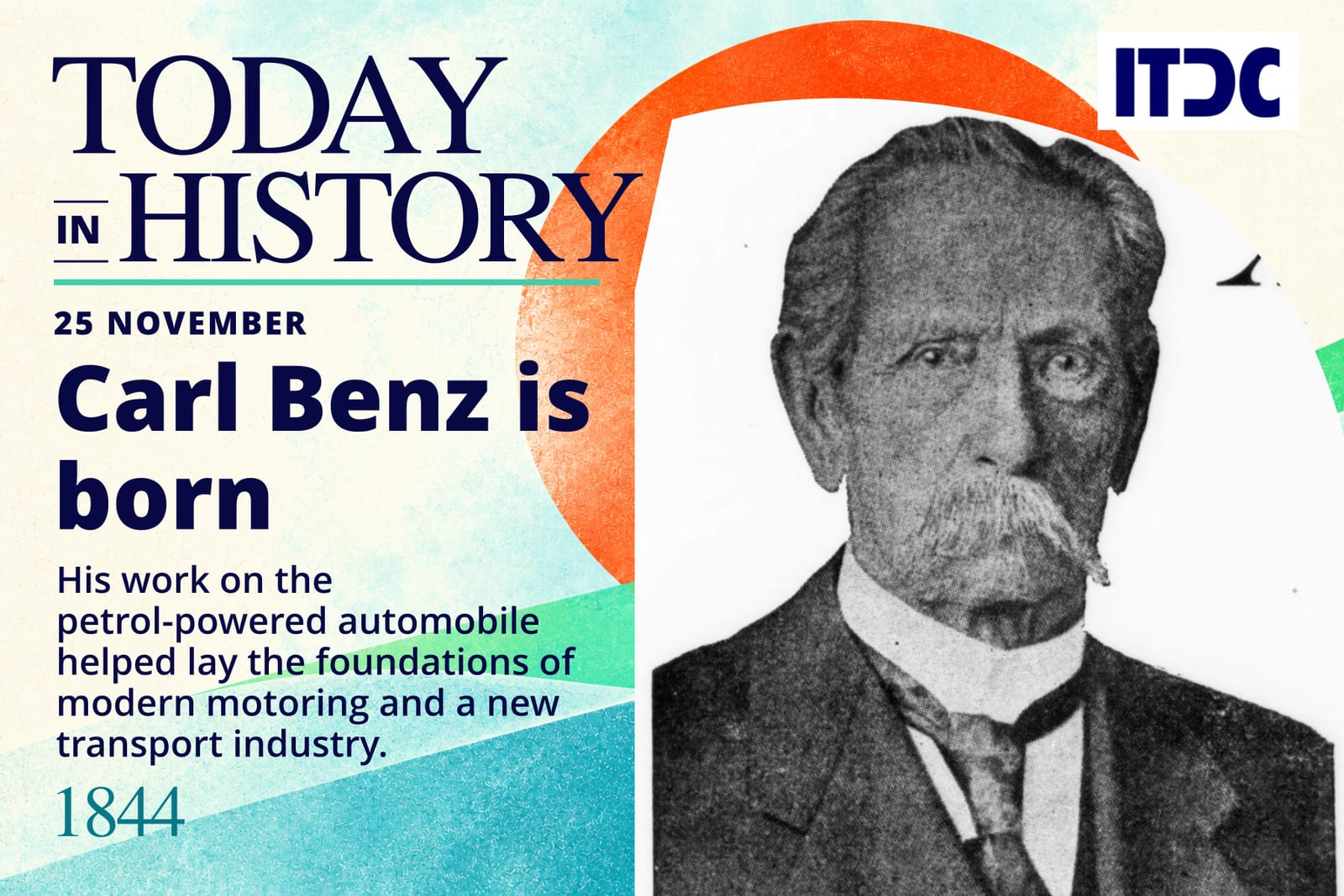
Automotive Industries, 13 April 1929 / Internet Archive
Carl Benz was born on 25 November 1844 in Mühlburg, now part of Karlsruhe in Germany. His work would help change the meaning of road travel, but the automobile emerged through years of engineering and business development rather than one effortless act of invention.
Benz studied at the Karlsruhe Polytechnic and gained practical experience before establishing a business in Mannheim in 1871. Work on engines occupied an important part of his early career. A later company, founded in 1883, provided a more secure base from which he could develop a motor vehicle.
His approach was to design the vehicle and its power source as an integrated machine. The result was the three-wheeled Patent Motor Car, powered by an internal-combustion engine. On 29 January 1886, he applied for the German patent associated with this landmark design.
The distinction matters. The history of self-propelled transport already included steam vehicles and other experiments. Benz’s achievement is best understood within the development of a practical petrol-powered automobile, rather than as the invention of every form of vehicle that could move without a horse.
A machine that could operate in a demonstration still had to prove itself on an ordinary journey. In 1888, Bertha Benz travelled from Mannheim to Pforzheim with their sons in a Benz motor car. The journey showed that the technology could carry people beyond a short test route and helped draw attention to its practical possibilities.
Bertha’s role belongs at the centre of the story. The German Patent and Trade Mark Office’s account emphasises her contribution to establishing confidence in the vehicle. Early motoring involved uncertainty about operation, maintenance and everyday usefulness; demonstrating a journey helped answer questions that a patent alone could not settle.
The success of the automobile depended on much more than a single engine. Steering, transmission, fuel supply and a workable chassis had to function together. It also depended on people willing to manufacture, buy, use and improve unfamiliar machines. Benz’s career illustrates this movement from an engineering idea towards an industry.
He continued in the motor business and later established another company with his sons. He died in 1929, after living to see road transport transformed beyond the small experimental vehicles of his earlier years.
Remembering his birth brings the process of innovation into view: technical persistence, financial support, practical testing and public confidence. The car became consequential because all these elements gradually came together.
Hashtags: #TodayInHistory #CarlBenz #BerthaBenz #AutomotiveHistory #ScienceTechnology #Karlsruhe #Germany #Carl #Benz #Built



