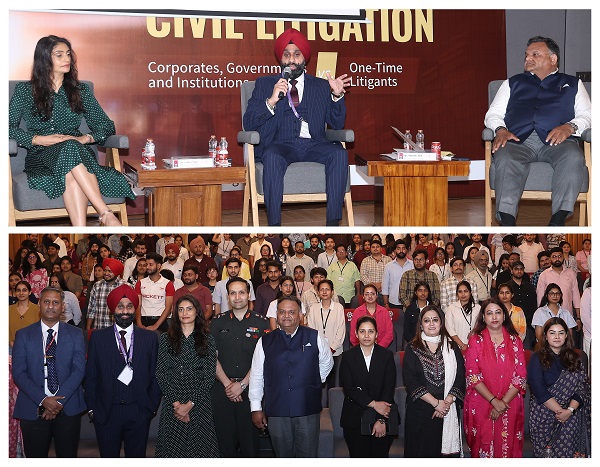
CNN Central News & Network–ITDC India Epress/ITDC News Bhopal: A distinguished panel of international lawyers, solicitors, arbitrators and prominent legal luminaries and scholars participated in a high-level panel discussion on ‘Rise of the Powerful Repeat Player in Civil Litigation: Corporates, Governments and Institutions vs One-Time Litigants’ organized by the Punjab and Haryana High Court in collaboration with Chandigarh University as part of India International Disputes Week 2026. The initiative was aimed at strengthening India’s position as a credible global hub for dispute resolution across litigation, arbitration and mediation to encourage institutional collaboration and cross-border legal engagement.
Chandigarh University hosted the panel discussion that brought together leading legal luminaries, practitioners and scholars who deliberated on emerging trends in civil litigation and dispute resolution. The discussions particularly highlighted the increasing dominance of institutional litigants including governments, corporations and public bodies in contemporary justice systems and examined the implications of this trend for individuals and one-time litigants. The discussion focused on how such ‘repeat players’ often accumulate greater legal expertise, advantages and institutional resources through frequent engagement with courts and tribunals while individual or one-time litigants find themselves at a systemic disadvantage.
The prominent among those who were present during the panel discussion were Lakhvir Singh, Solicitor at Alexander & Co Solicitors LLP, Nottingham (UK), Gurprit Mattu, Commercial Litigation Barrister and Mediator, London, Manish Jain Senior Advocate at the Punjab and Haryana High Court, Aman Pal, Senior Advocate at the Punjab and Haryana High Court and Prof (Dr) Ashutosh Hajela, Executive Director, University Institute Legal Studies (UILS). The panel was moderated by Amanat Kahlon, Assistant Professor, University Institute Legal Studies (UILS).
Speaking during the panel discussion, Lakhvir Singh, Solicitor at Alexander & Co Solicitors LLP, Nottingham, UK, said, “In jurisdictions like the UK, repeat or institutional litigants often develop a better understanding of how to manage litigation, particularly when it comes to mitigating risks and controlling the costs associated with legal proceedings. Because they engage with the system frequently, they are generally more aware of when it is sensible to proceed with litigation and when it may be more appropriate to resolve a dispute outside court. However, our system is largely governed by the Civil Procedure Rules and the protocols that operate within them, which are designed to create a structured and predictable process. These rules to a large extent help balance the system because they apply equally to both repeat litigants and one-time litigants, ensuring that while experience may provide some advantage, the procedural framework aims to make the process fairer and more manageable for all parties involved.”
“While institutional litigants may have greater financial resources, outcomes in courts are ultimately decided on the merits of the case, the evidence and the strength of legal arguments. Experience mainly matters at the pre-litigation stage, where repeat litigants better understand procedural nuances for example, a landlord with multiple properties is more likely to know the correct legal steps when a tenant defaults on rent, while a first-time litigant may unknowingly waive certain rights. However, once the matter reaches court, the judge decides the case strictly on law and evidence,” added Singh.
Gurprit Mattu, Commercial Litigation Barrister and Mediator, London said, “Early mediation can level the playing field because neither party has yet incurred heavy legal costs. In many commercial disputes, particularly shareholder disputes, prolonged litigation can damage the very business the parties are trying to protect. Over the past few years mediation in England has grown significantly mainly due to the potential cost implications that come with litigation. Even if a party wins a case, the court can order the losing party to pay a substantial portion of the winner’s legal expenses sometimes up to 70 to 80 percent along with interest. Because of these potential costs, parties increasingly consider mediation at a very early stage of the dispute often even before a case is formally filed in court.”