


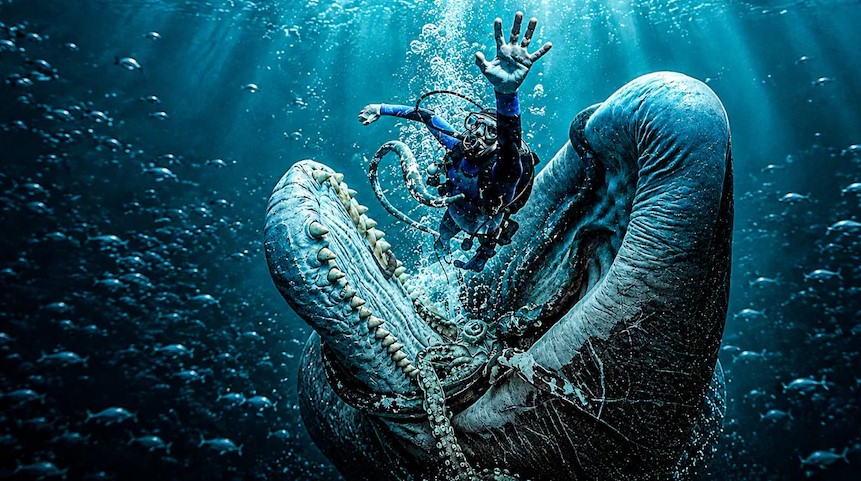
CNN Central News & Network-ITDC India Epress/ITDC News Bhopal: New Delhi. Humans have always been curious about the giant whales that live in the depths of the ocean. But what would happen if a person accidentally ended up inside a whale’s stomach? Could they stay alive there and find a way out?
Hollywood survival thriller Whalefall presents this question in a dramatic way. In the film, a young diver becomes trapped inside the stomach of a sperm whale and tries to save his life with limited oxygen. The film is based on Daniel Kraus’s 2023 novel of the same name.
However, there is a major difference between the film’s story and real science. According to scientists, a human reaching the stomach of a sperm whale would be an extremely unusual event. Even if it happened, surviving in those conditions would be extremely difficult.
Can a whale swallow a human whole?
The sperm whale is a giant toothed marine mammal. It mainly hunts squid and other sea creatures. It dives deep into the ocean in search of food. Its throat can be large enough that, in the case of a very large sperm whale, it may be physically possible for a human to pass through it. But that does not mean whales hunt humans.
According to marine life experts, sperm whales generally catch their preferred prey, and humans are not part of their natural diet. So far, there has been no reliably verified case of a sperm whale swallowing a human whole. The situation shown in the film is therefore closer to fictional adventure.
What would happen inside a whale’s stomach?
A sperm whale’s digestive system is divided into several parts. Different sections of its stomach crush, break down and digest food. The pressure of the stomach muscles could cause serious injuries to a human. After that, digestive acids and other chemical processes would create further dangers for the body.
According to comparative anatomist Joy Reidenberg, if a diver were wearing a special dry diving suit designed to protect the body from fluids, some parts of the body could get limited protection from stomach acid. But exposed parts of the body could be damaged. Even with a suit and equipment, complete safety would not be possible.
Could an oxygen tank save a life?
In the film, the diver has scuba equipment that allows him to breathe for a limited time. But an oxygen tank only helps with breathing; it does not protect against stomach muscles, digestive acids, injuries or other physical dangers. In addition, the diver would have to keep the mask and breathing equipment intact. If the equipment were damaged or the breathing system were disrupted, the situation could become even more serious. Therefore, having only an oxygen tank would not guarantee survival.
The danger increases in the deep sea
Sperm whales can dive to great depths in the ocean. In such an environment, water pressure is many times higher than at the surface. The human body and ordinary scuba equipment cannot remain safe for long at such depths without special protection. If the whale dived very deep, the diver would face the risk of severe pressure-related injuries and equipment failure. Marine life expert Shane Gero has also described the chances of survival in such a situation as extremely low.
What is the real scientific meaning of ‘whalefall’?
Interestingly, Whalefall is not only the title of the film but also a real term in marine science. When a whale dies and its carcass sinks to the ocean floor in the deep sea, the event is called a “whale fall.”
The whale’s massive body becomes a source of food and nutrients for deep-sea organisms. Small organisms, marine worms, crustaceans and other creatures feed on its remains. In this way, a dead whale can support a small ecosystem in the deep ocean for a long time.
How different are the film and science?
Whalefall shows viewers the struggle of a person trapped in an extraordinary situation. The film uses some scientific facts related to whale anatomy and the digestive system, but a human reaching a whale’s stomach and surviving there for a long time is an extremely unlikely real-life scenario.
Scientists say that in such a situation it would be extremely difficult for a person to breathe, avoid injuries and get out. Therefore, it is more appropriate to view the film as a science-inspired fictional thriller rather than as a real incident or a practical guide to survival.
Conclusion: If a human were trapped inside a whale’s stomach, the chances of survival would be extremely low. An oxygen tank or special suit could offer some limited protection, but they could not fully guard against the digestive system, physical pressure and dangers linked to the depths of the ocean.
Hashtags: #ScienceTechnology #Whale #SpermWhale #Whalefall #MarineScience #Bhopal #Science #Technology #Survival #Ocean



