


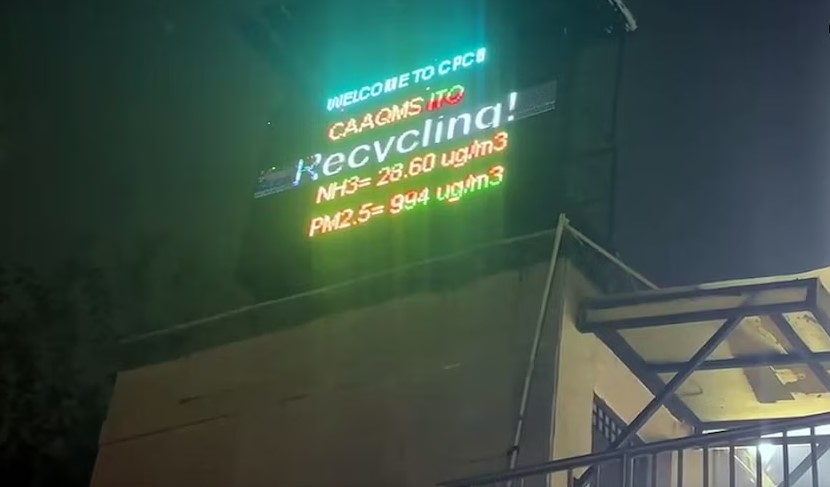
Air pollution rose sharply in Delhi after fireworks on Diwali night. Amid this, an Aaj Tak team visited air quality monitoring stations in the capital to assess the actual pollution situation. It emerged that when pollution levels were rising, data from several monitoring centres had stopped being available for some time. This has raised questions over the measurement of air quality and assessment of the real situation.
According to reports, monitoring stations in several areas, including RK Puram, Nehru Nagar, Mundka, Sonia Vihar and Dwarka, were not showing readings for some time after 9 p.m. Before the data became unavailable, the PM2.5 level at the RK Puram station had reached about 924 micrograms per cubic metre around 9 p.m. At the Jawaharlal Nehru University station too, the PM2.5 level was recorded at 786 micrograms per cubic metre at 11 p.m.
PM2.5 data unavailable at 25 monitoring centres
Congress leader Ajay Maken claimed that between 2 and 3 at night on Diwali, PM2.5 figures were not available at 25 of Delhi’s 39 monitoring centres. According to him, at the nine centres where data was available, the average PM2.5 level was 576 micrograms per cubic metre, 38.4 times higher than the World Health Organization’s 24-hour limit.
According to the Central Pollution Control Board, Delhi’s average AQI on November 8, the day of Diwali, was 376, which falls in the very poor category. On the morning of November 9, the AQI in Ghazipur was recorded at 418, in the severe category. Official confirmation is needed on the reasons for data not being available at the monitoring stations. Technical faults, power supply issues or disruption in data transmission could be possible reasons.
Hashtags: #ScienceTechnology #Bhopal #Diwali #Delhi #Pollution #AirQuality #Night #RealityCheck #Stations #DelhiPollutionRealityCheck



