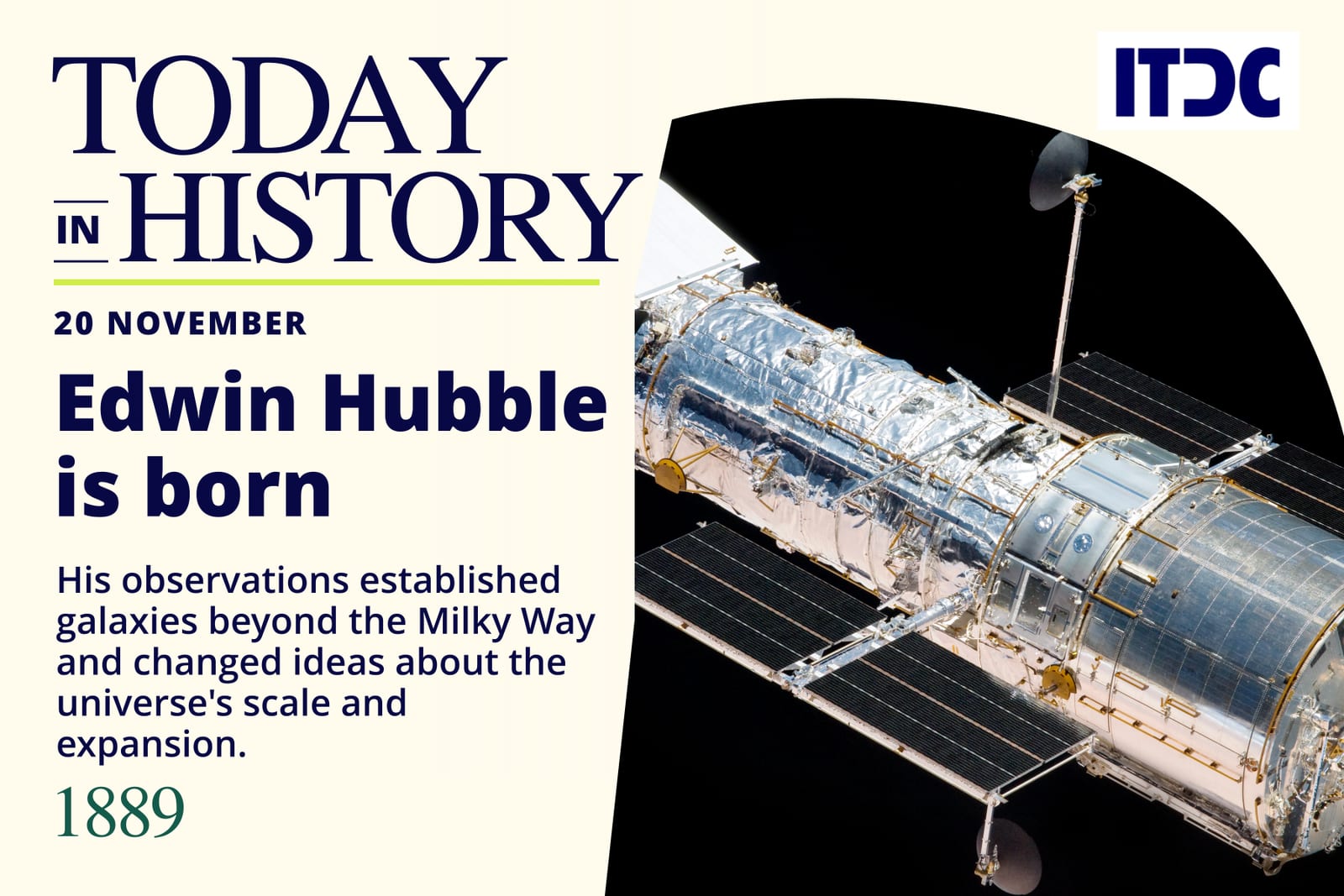
NASA / STS-125 crew
When Edwin Powell Hubble was born in Marshfield, Missouri, on 20 November 1889, astronomers could not yet establish the true distances of many faint, cloudy objects in the sky. Were these nebulae part of the Milky Way, or separate stellar systems far beyond it? Hubble’s observations would help resolve that question and transform the scale of the known universe.
His career took him to Mount Wilson Observatory in California, where the 100-inch Hooker telescope offered exceptional power to study distant objects. The instrument mattered because a faint patch that looked featureless through a smaller telescope could reveal individual stars in photographs made with a larger one.
In 1923, Hubble identified a Cepheid variable in the object then commonly called the Andromeda Nebula. Cepheids repeatedly brighten and fade. Henrietta Swan Leavitt’s earlier work had established a relationship between the length of that cycle and a star’s intrinsic brightness, giving astronomers a way to estimate distance.
By comparing a Cepheid’s expected brightness with how dim it appeared from Earth, Hubble could place Andromeda far outside the Milky Way. The discovery provided compelling observational evidence that our galaxy was one among many. A familiar smudge of light became a neighbouring galaxy, and the universe suddenly required a much larger map.
Another major result followed in 1929. Hubble compared estimates of galaxy distances with measurements of their radial velocities, inferred from their spectra. The pattern showed that more distant galaxies generally had larger recession velocities. This relationship became a central piece of evidence for cosmic expansion.
It was a collective achievement. Leavitt’s distance method, earlier spectroscopic measurements and the work of other observers and theorists were indispensable. Remembering those contributions makes the scientific story more revealing: a transformative conclusion emerged by bringing different kinds of evidence together, rather than from a single isolated insight.
Hubble also developed an influential system for classifying galaxies by their appearance. His name later travelled into orbit with the Hubble Space Telescope, launched in 1990. The telescope is a tribute to his work, not an instrument he personally used.
The lasting significance of his research lies in a change of perspective. The Milky Way ceased to define the limits of astronomy, and the universe could be studied as something with a history and measurable large-scale behaviour. Those questions grew from painstaking observations of light.