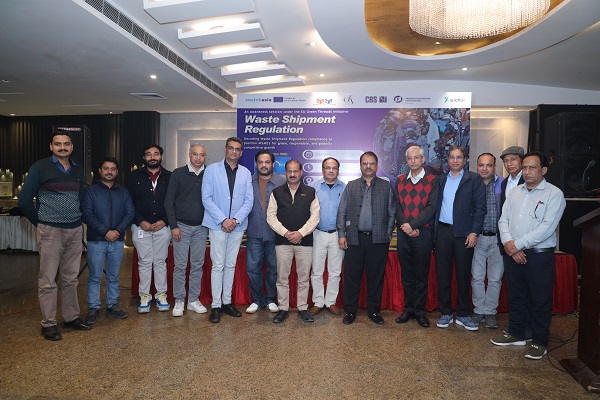
CNN Central News & Network–ITDC India Epress/ITDC News Bhopal: The second workshop under the EU Green Deal Awareness Series, organised as part of the SWITCH-Asia Green Threads Project, concluded successfully at Days Hotel, Panipat. The session brought together MSMEs from Panipat and Amroha for an in-depth understanding of evolving European Union sustainability expectations and their implications for India’s textile and home furnishing exporters. The workshop is jointly executed by the Foundation for MSME Clusters (FMC), Global Fashion Agenda (GFA), Friedrich-Naumann-Foundation, SIDBI, and Copenhagen Business School.
The event opened with remarks from Mr. Mukesh Gulati, Executive Director, FMC, who emphasised the urgency for MSMEs to align with global sustainability norms. “Sustainable fashion presents a Rs. 9-lakh-crore opportunity in the coming years, an opportunity that Panipat can easily tap into because of its immense potential. To build a collaborative ecosystem, we need strong linkages, partnerships, and cooperation from Panipat’s MSMEs so we can support each other. These projects are essential because sustainable fashion will soon become the norm. Understanding the CO₂ emissions of each garment and establishing traceability mechanisms will be critical. The European Union’s Green Deal is both a challenge and a tremendous opportunity. Our early preparedness will determine how strongly our MSMEs can compete in global markets.”
Ms. Harshitha Venati, Senior Impact Programme Manager, (GFA) provided a recap of Workshop #1, covering Ecodesign for Sustainable Products Regulation (ESPR) and Digital Product Passports (DPPs). She then followed with an insightful presentation on the EU Waste Shipment Regulation (WSR) and its potential implications for India’s textile exporters.
“Panipat has to ensure that there is traceability and visibility in their business processes and procurement to build trust with their EU partners,” she noted.
Mr. Bishesh Rajput (FMC) facilitated the workshop activity and led an open discussion where MSMEs expressed interest in more hands-on, cluster-specific sessions and smaller, focused group workshops.
Rajat Batra, Chief Executive Officer of Stenum Asia, delivered an insightful introduction to Resource Efficiency Solutions for Sustainable Production, highlighting practical approaches that MSMEs can adopt to enhance environmental performance and operational efficiency.
The formal closing remarks were delivered by Mr. Vinod Dhamija, President, Haryana Chamber of Commerce & Industries, Panipat, who highlighted the importance of proactive compliance. “Emerging EU regulations are reshaping global trade. Panipat’s MSMEs must prepare collectively to safeguard and strengthen their export competitiveness, by following the compliance and the chemical which is going banned is good for us and our future generation too,” he stated.
Dignitaries who attended the workshop included:
Mr. Anil Mittal, Secretary, Haryana Carpet Manufacturers Association
Parvinder kadiyan, Chairman, GATS Association
Their presence underscored the shared commitment of industry leaders to guiding MSMEs through sustainability-driven market transitions. The event concluded with a vote of thanks by Mr. Abhishek Naga (FMC), DGM, FMC who appreciated the active participation and reaffirmed FMC’s commitment to supporting the textile ecosystem on its sustainability and compliance journey.
The Green Threads Project, supported by the EU SWITCH-Asia Programme, aims to accelerate the transition of India’s textile and apparel sector toward more sustainable, circular, and resource-efficient production practices. As global markets – especially the European Union – tighten sustainability regulations, MSMEs face rising pressure to demonstrate compliance, transparency, and environmental responsibility across their supply chains.