


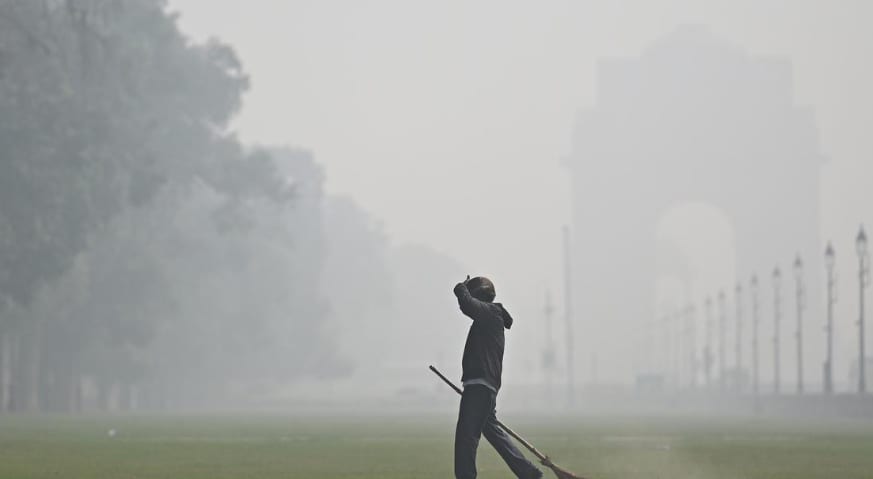
Firecrackers remained the largest identified contributor to Delhi's air pollution even after Deepavali, according to an assessment by the Indian Institute of Tropical Meteorology (IITM), Pune. The findings highlight how fireworks significantly increased the concentration of fine particulate matter (PM2.5), worsening the capital's already polluted air.
According to IITM's source-apportionment analysis, firecrackers accounted for 71.1 per cent of PM2.5 pollution between 1 a.m. and 9 a.m. on November 9, a day after Deepavali. Their contribution stood at 43.4 per cent on November 8, while it was only 5.6 per cent on November 7, before the celebrations.
The contribution subsequently declined to 29.8 per cent on November 10, although firecrackers continued to remain the largest identified pollution source. During the same period, vehicular emissions, secondary inorganic aerosols and secondary organic aerosols also contributed to the city's pollution burden.
The impact was particularly severe in several localities. Jahangirpuri recorded PM2.5 concentrations of 4,985 micrograms per cubic metre around 3 a.m. on November 9, while Nehru Nagar registered 2,808 micrograms per cubic metre.
Delhi's average Air Quality Index (AQI) stood at 299 on November 10 before deteriorating to 312 on November 11, placing the city in the very poor category.
The findings underline the environmental consequences of firecracker emissions and the need for effective pollution-control measures. Experts have stressed that controlling vehicular emissions, road dust, industrial pollution and fireworks is essential to improving Delhi's air quality.
Hashtags: #UttarPradeshState #Delhi #Firecrackers #Continue #Driving #Air #Pollution #Diwali #Remained #FirecrackersContinueDrivingDelhi



