CNN Central News & Network–ITDC India Epress/ITDC News Bhopal: Newspapers have not only been a medium for news but have also played a significant role in guiding society and advancing the freedom movement. Outside India, Hindi journalism has become the voice of identity and struggle for the Indian diaspora. Today, Indians are publishing hundreds of newspapers and magazines through digital platforms, giving Hindi a new global identity.
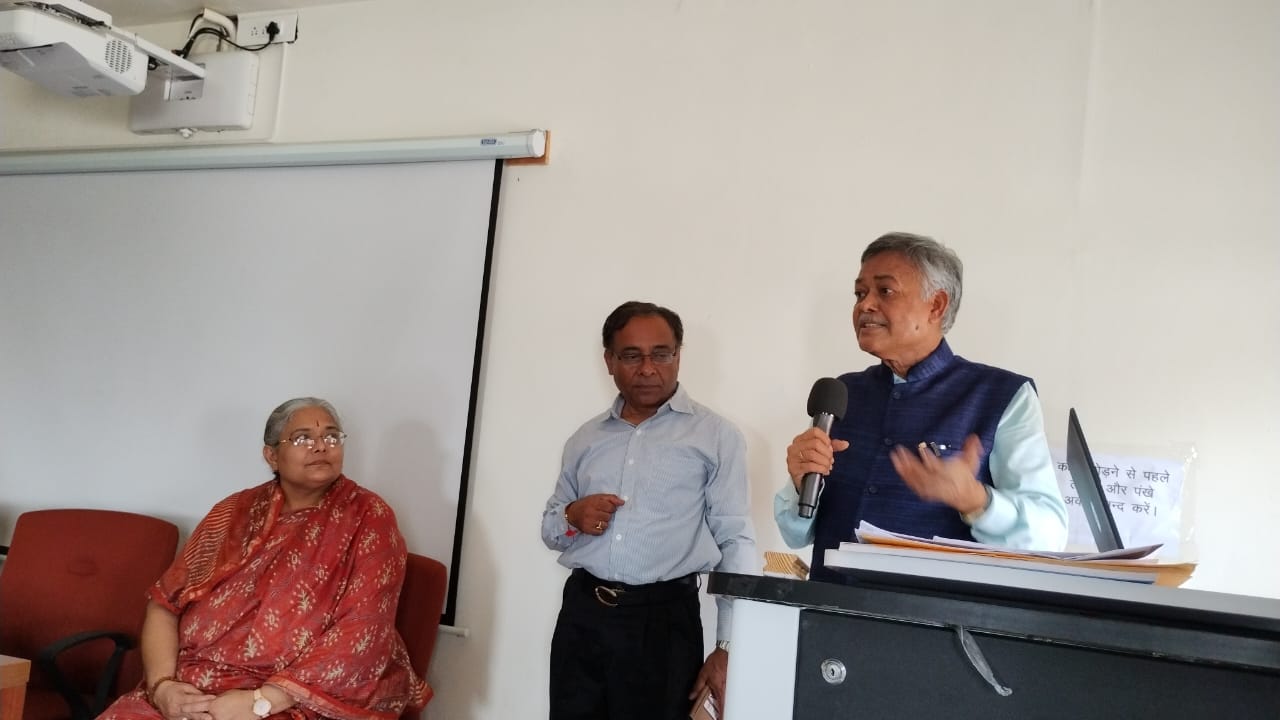
These views were expressed by Dr. Jawahar Karnavat, a scholar of global Hindi journalism and literature. He delivered a lecture on “Hindi Journalism on the Global Stage” at the Department of Journalism, Makhanlal Chaturvedi National University of Journalism and Communication, Bhopal, on 29 August. Dr. Karnavat has conducted in-depth research on Hindi journalism abroad. He presented compiled editions of newspapers and magazines published overseas and emphasized the need for thorough research on these publications.
He highlighted that Hindi journalism will complete 200 years in just two years and that overseas Hindi journalism has already completed 142 years. In 1883, Raja Rampal of Kalakankar, Uttar Pradesh, published the Hindostan newspaper from London. In 1903, the Indian Opinion, published in four languages from South Africa, had Mahatma Gandhi as its editor. The term Satyagraha was introduced to the world through this newspaper.
Dr. Karnavat noted that during the freedom movement, the Ghadar newspaper published abroad created such a stir that studying it could guide new generations. By 1913, Ghadar featured content in English, Hindi, Punjabi, Bengali, and other languages, with the slogan: “The power of the pen will be as effective as the cannonball.” He added that in Fiji, Hindi is the second official language, and daily newspapers in Hindi are published there. Similarly, countries where Indian diaspora settled—such as Mauritius, Guyana, and Trinidad & Tobago—have a large Hindi-speaking population, where new forms of Hindi are emerging.
Dr. Karnavat further explained that in the digital age, the Indian diaspora has given new energy to Hindi journalism through online magazines. Examples include Bharat Darshan (New Zealand), Sahitya Kunj (Canada), Anubhuti (India), and Setu (USA). He particularly noted that Japanese libraries hold nearly 80,000 Hindi books. In Russia, magazines like Soviet Land have played a key role in popularizing Hindi. Dr. Karnavat also exhibited handwritten letters and magazines brought from abroad.
The Head of Department, Rakhi Tiwari, addressing the students, said that the lecture would provide them a global perspective and inspire research in journalism. Prof. Shiv Kumar Vivek remarked that Dr. Karnavat’s work opens new dimensions of research in Hindi journalism.
#MCU #JournalismDepartment #HindiLanguage #GlobalHindi #LanguageStudies #CulturalImpact #Bhopal