


ITDC illustration
You step out of a shower and find that your reflection has disappeared. The mirror is there, and its silvered backing has not changed. A crowd of water droplets has come between your face and the image.
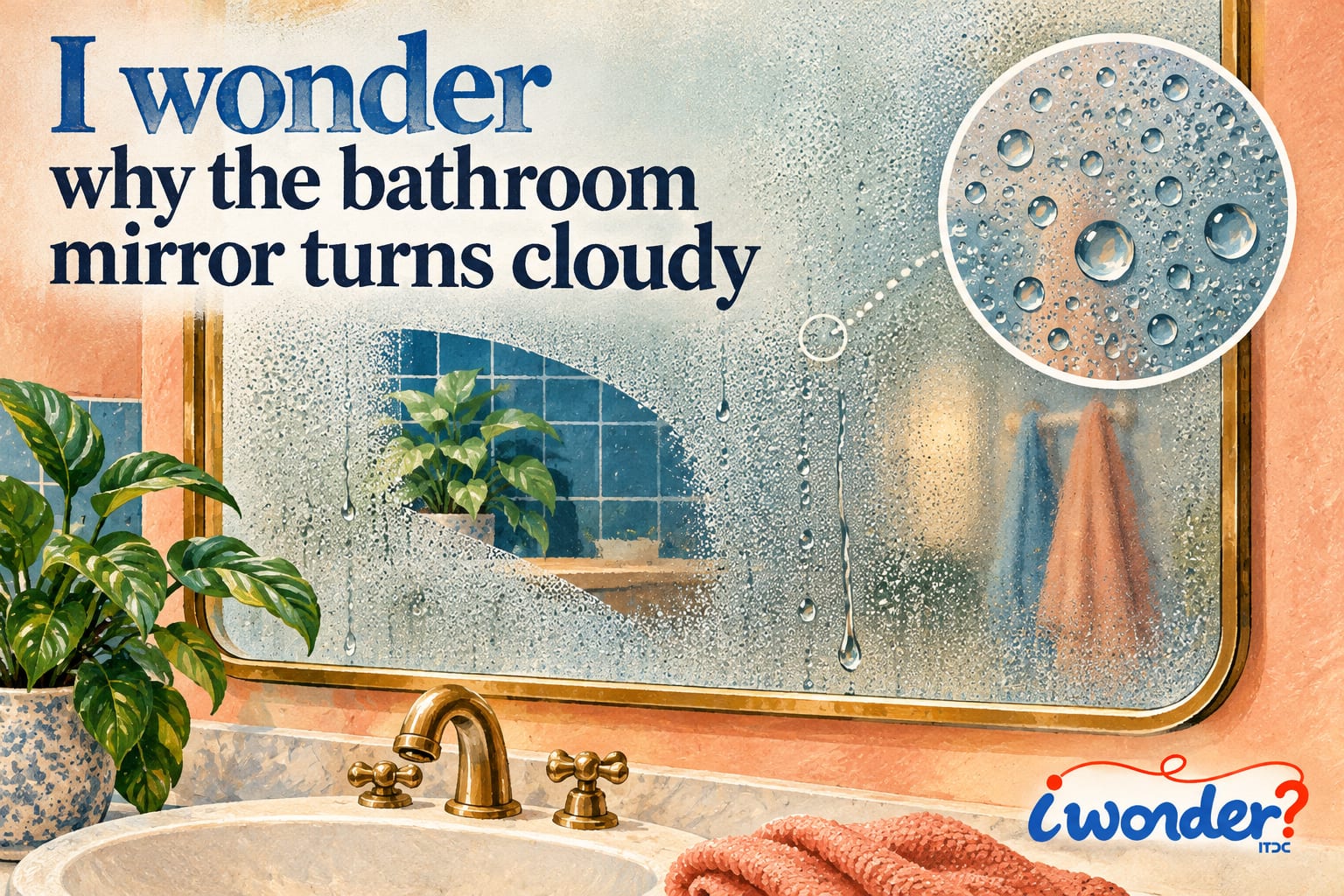
Warm shower water adds moisture to the bathroom air through evaporation. Water vapour itself is invisible. When that moist air meets a mirror that is cool enough, some vapour becomes liquid water on the glass. This change of state is condensation.
The important temperature is the dew point. For a given amount of water vapour in the air, it is the temperature at which the air becomes saturated. A surface at or below that temperature can collect condensation. A mirror need not feel icy to do this; it only needs to be sufficiently cool compared with the moist air around it.
Tiny droplets scatter and redirect light. Instead of a clean reflection, you see a blur. As droplets join into larger drops or streaks, the appearance changes again. Wiping a patch clears away the liquid, but new droplets may form if the same conditions remain.
This is the same basic reason a glass of cold water becomes wet on the outside. The water comes from the surrounding air, not from a leak through the glass. On a cool morning, grass can collect dew in a similar way.
A warmer mirror is less likely to fall below the dew point. Ventilation can also help by replacing moist bathroom air with drier air. Neither explanation requires the mirror to be dirty, although marks on its surface can affect how water gathers.
As the bathroom dries and the glass warms, the droplets evaporate and your reflection returns. The vanished face was a brief demonstration of water changing state, with the mirror serving as a convenient stage.



