


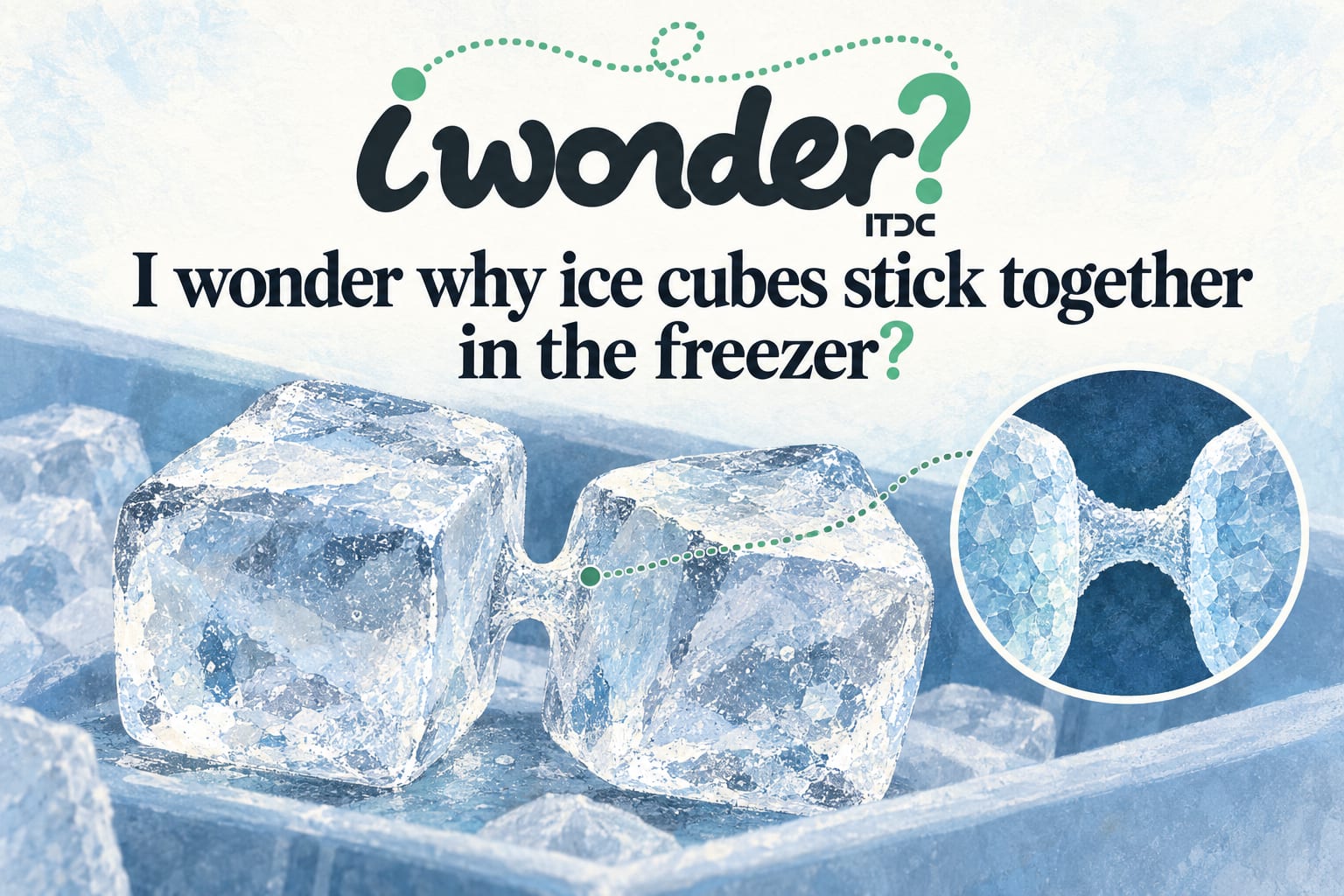
ITDC original artwork
An ice tray produces separate cubes, but the freezer's storage box can later contain one frozen lump. It seems puzzling that pieces already solid should be able to join. Their surfaces, however, are not as inactive as they look.
One route is simple. During warming episodes, a little ice at the surface can melt. If touching cubes share that liquid, cooling can freeze it into a bridge. Manufacturers describe this kind of melting and refreezing as a cause of clumping during some freezer defrost cycles.
The whole cube need not become liquid. A thin connection at the contact between two pieces can be enough to bind them. When several neighbours join, the result is a cluster that no longer pours freely from the container.
There is also a process called sintering, in which touching pieces develop a neck between them. Ice can rearrange material at its surfaces even without the entire mass melting. Under suitable conditions, water molecules leave one icy surface as vapour and settle onto another as solid ice.
Experiments with small ice spheres found this vapour transfer important in the growth of their connecting necks. The researchers worked under specified conditions, so that result should not be treated as a diagnosis of every freezer.
The distinction matters. Melting followed by refreezing and the joining of cold surfaces are different routes to a similar visible result. Saying that the weight of the cubes always melts their contact points would miss that variety.
Temperature changes, time, moisture and contact all help determine what happens in a particular ice bin. Without knowing those conditions, the frozen lump alone cannot reveal its history.
What looks like a collection of unchanging blocks is really a set of surfaces exchanging heat and sometimes material. Given the opportunity, separate cubes can acquire solid neighbours.
Hashtags: #IWonder #Ice #Freezer #Sintering #ScienceTechnology #Bhopal #Wonder #Why #Cubes #Stick



