


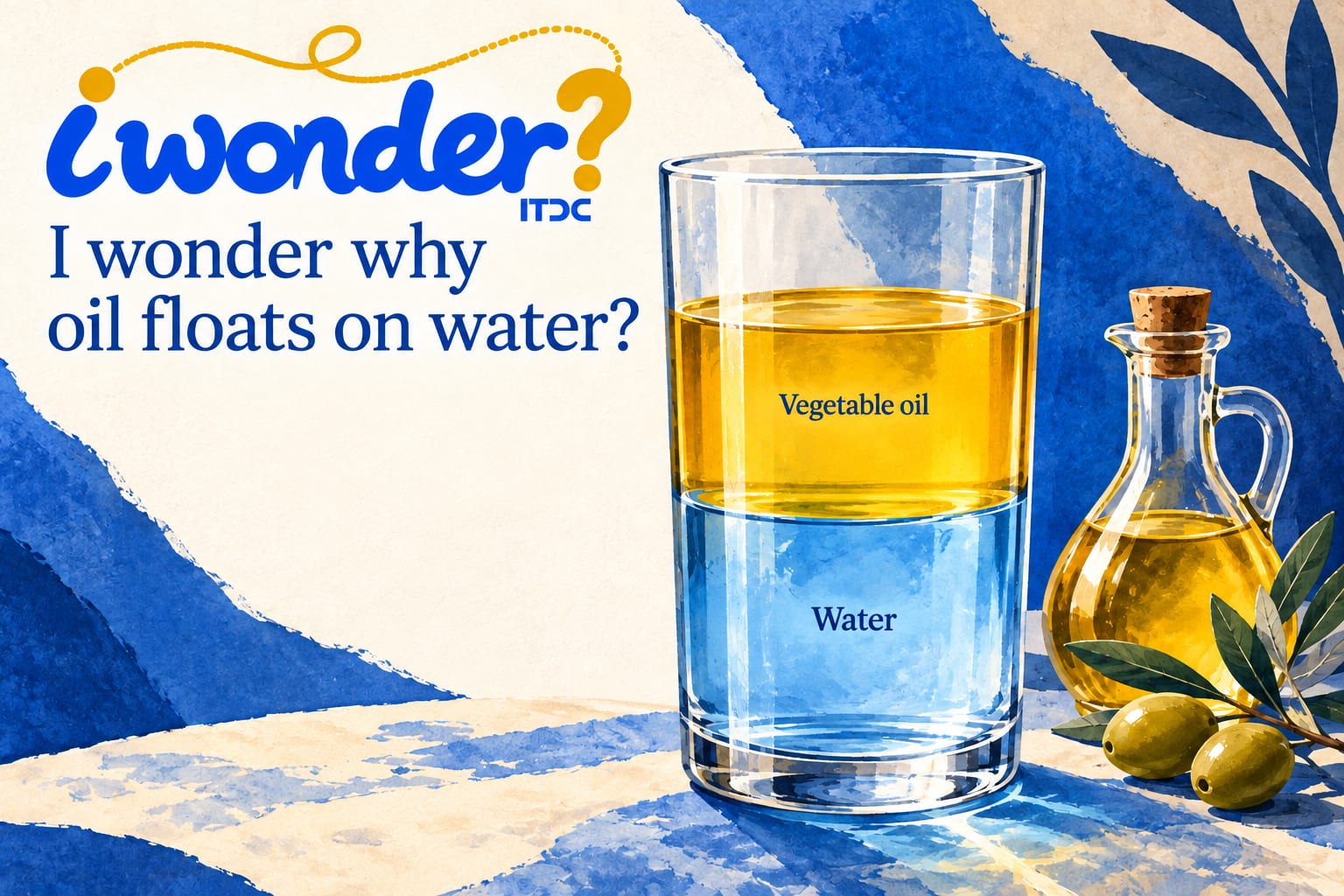
A spoonful of cooking oil spreads across water and settles on top. Shake the mixture, and the boundary briefly disappears into droplets. After a while, the two layers return. Two separate questions are hiding in this kitchen sight.
The first is why the oil is above the water. Vegetable oil is less dense than water. Density compares mass with volume: equal volumes of these liquids have different masses, with the oil having less mass.
That is more precise than saying oil is lighter. A large container of oil can weigh more than a cup of water. What matters for the layering is how much mass occupies the same amount of space.
The second question is why there are layers at all. Oil and water do not mix readily at the molecular level. Water molecules interact strongly with one another, while the molecules in cooking oil have a different electrical character. Combining them does not produce a uniform solution like dissolving a little sugar in water.
Shaking can break the oil into small droplets distributed through the liquid. That changes the appearance, but it does not make the two substances mutually soluble. The droplets can meet and merge, eventually rebuilding the upper layer.
Density explains which liquid sits above the other; their reluctance to mix explains why a boundary can form. Confusing those two ideas leaves half the observation unexplained.
Other ingredients can change the behaviour. A suitable emulsifier can help keep oil droplets dispersed, as happens in many foods. Such a mixture still differs from a molecular solution.
The explanation also needs a qualification: not every substance called an oil has exactly the same density. The familiar rule concerns ordinary cooking oils under everyday conditions. In that setting, the top layer is a useful lesson in both density and mixing.



