


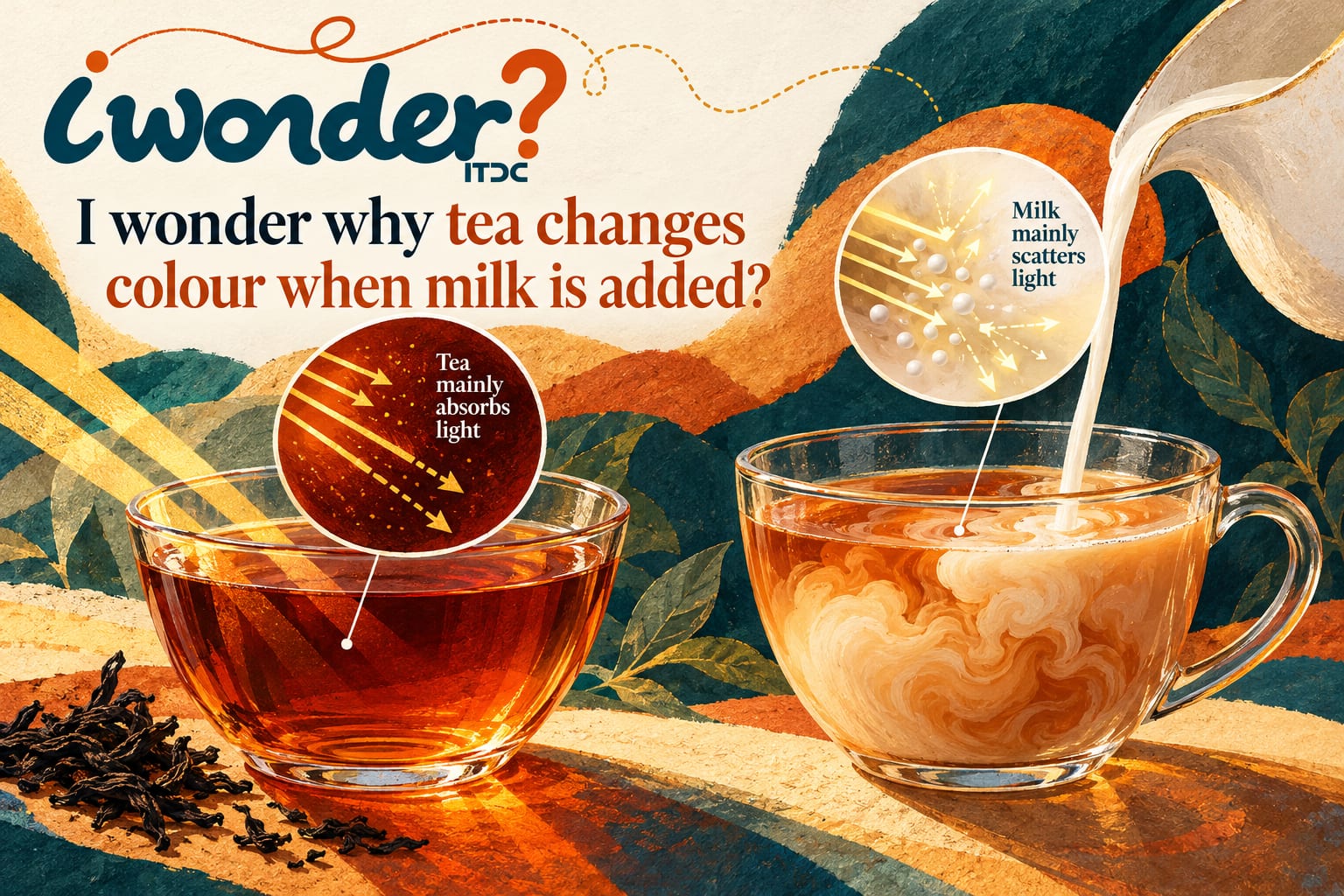
Watch milk curl through a glass of black tea. Pale ribbons spread into the amber liquid, then the whole drink becomes cloudy brown. The colour change is familiar, yet it reveals two different ways that matter handles light.
Tea contains substances that absorb some wavelengths of light more strongly than others. The light that remains gives a clear cup its brown appearance. How dark it looks depends partly on the tea's concentration and how far light travels through it.
Milk adds a different optical effect. Its suspended particles, including fat droplets and protein structures, scatter light in many directions. Instead of much of the light passing straight through, some is redirected back towards your eyes. This scattering helps milk look white and opaque.
Mix the two, and absorption and scattering work together. Tea still absorbs light, while milk redirects it along new paths. The result usually looks lighter and less transparent than the tea. The tea's coloured substances have not simply disappeared because the liquid has changed appearance.
Researchers exploring the appearance of translucent liquids have used mixtures of tea and milk to investigate this problem. They distinguish a liquid's absorbing component from its scattering component, while recognising that the effects interact in a real mixture.
That interaction is why colour cannot be understood only as mixing two paints on a chart. The amount of milk, the concentration of tea, the lighting and the depth of the liquid all affect what reaches the observer.
Nor is a pale cup necessarily a complete guide to flavour. Appearance, concentration and the experience of tasting are related, but they are not interchangeable measurements.
The swirling ribbons offer a view of the process before everything mixes. A splash of milk changes the routes that light can take, and your eyes report a different cup.



