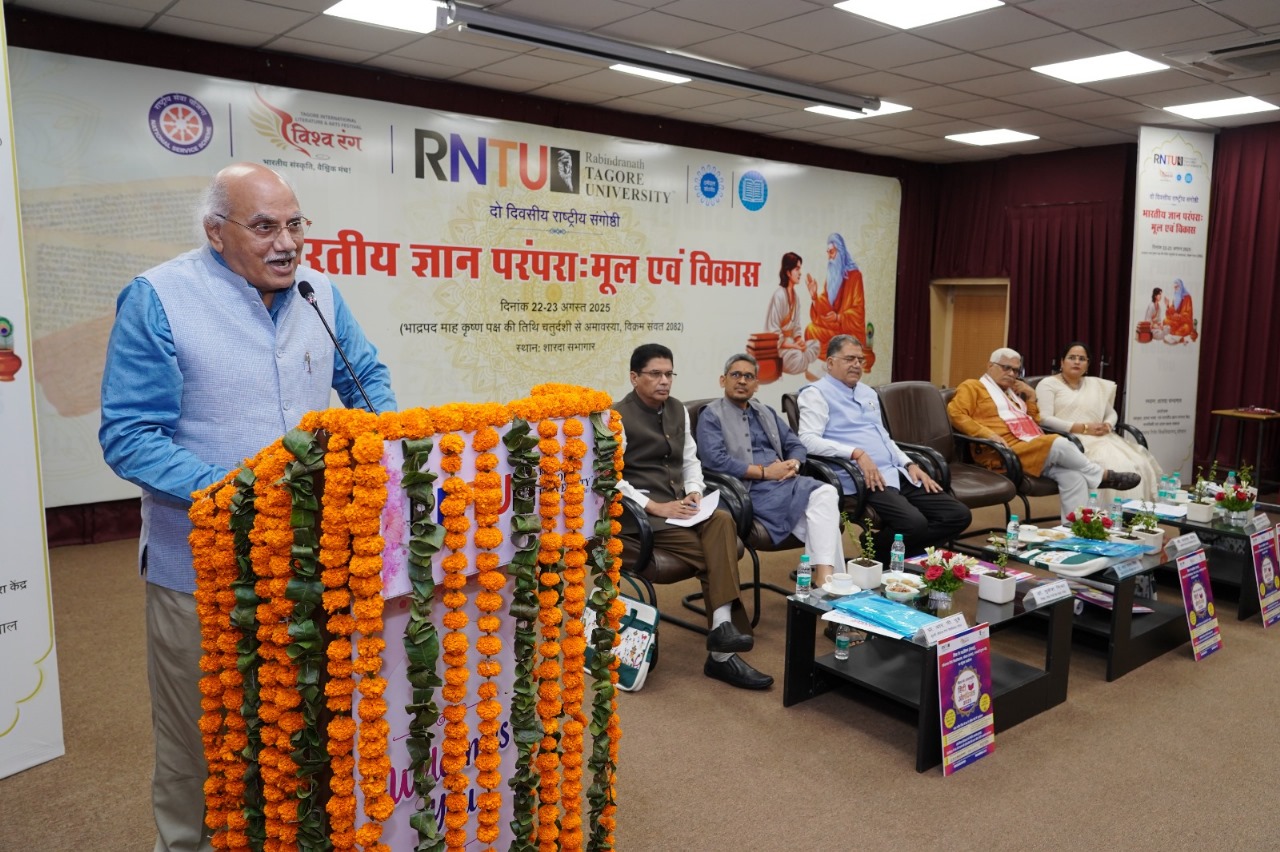
CNN Central News & Network–ITDC India Epress/ITDC News Bhopal : At Rabindranath Tagore University (RNTU), Bhopal, the Faculty of Humanities and Liberal Arts and the Centre for Sanskrit, Oriental Languages, and Indian Knowledge Tradition jointly organized the inaugural session of the National Seminar on “Indian Knowledge Tradition: Roots and Development.” The session, held at the university’s Sharda Auditorium, featured distinguished scholars sharing their insights on the foundations and continuous evolution of India’s intellectual heritage.
The seminar was presided over by Chancellor Santosh Choubey, with Dr. Bharat Sharan Singh (Chairman, Private University Regulatory Commission, Madhya Pradesh) as the Chief Guest. Eminent speakers included Prof. Girishwar Mishra (Former Vice-Chancellor, Mahatma Gandhi International Hindi University, Wardha), Mukesh Mishra (Director, Dattopant Thengadi Research Institute, Bhopal), and Supriya Pathak (Associate Professor, Mahatma Gandhi International Hindi University, Wardha).
Savita Singh Parihar, Associate Professor of History at RNTU, who also served as the seminar coordinator, expressed her views on Indian knowledge traditions, while Visakha Rajurkar Raj conducted the proceedings.
Chancellor Santosh Choubey highlighted that the ultimate aim of Indian knowledge tradition is Brahma Gyaan (knowledge of the Absolute). Referring to Acharya A. C. Majumdar’s work, he emphasized that this tradition is rooted in the pursuit of absolute truth, and Indian philosophy has illuminated the paths to truths that modern science now reaches through experiments.
Prof. Girishwar Mishra remarked that Indian knowledge tradition is a continuous stream with roots tracing back to pre-Vedic civilizations. He noted the vital role of the oral tradition (Shruti) in preserving the Vedas and emphasized its holistic vision, moving from the individual to the collective.
Dr. Bharat Sharan Singh pointed out that the essence of the National Education Policy (NEP 2020) lies in Indian knowledge traditions, which he described as the foundation for reconstructing the educational system and shaping the future of India.
Vice-Chancellor R. P. Dubey welcomed the guests and stated that the essence of Indian knowledge lies in the principles of relativity and duality, concepts even validated by Einstein in his Unified Field Theory.
Dr. Mukesh Mishra clarified that Indian knowledge tradition is not merely tradition or knowledge but is deeply connected to verbal and cultural practices. He stressed the need for new academic efforts to study the neglected domain of oral traditions.
Dr. Supriya Pathak emphasized the importance of folk traditions and indigenous knowledge in understanding Indian knowledge systems. She also highlighted the necessity of re-examining knowledge traditions through the lens of women’s discourse to better grasp their depth and inclusivity.
On this occasion, the university also released the newsletter Campus Mimansa and unveiled the poster for the upcoming Hindi Olympiad.
The session concluded with a vote of thanks by Registrar Sangeet Johri, who expressed gratitude to all guests, speakers, organizers, and participants, stating that the scholars’ perspectives offered new insights into the roots and development of Indian knowledge traditions.
#IndianKnowledgeTradition #NationalSeminar #CulturalHeritage #IndianPhilosophy #EducationEvent #KnowledgeSystems