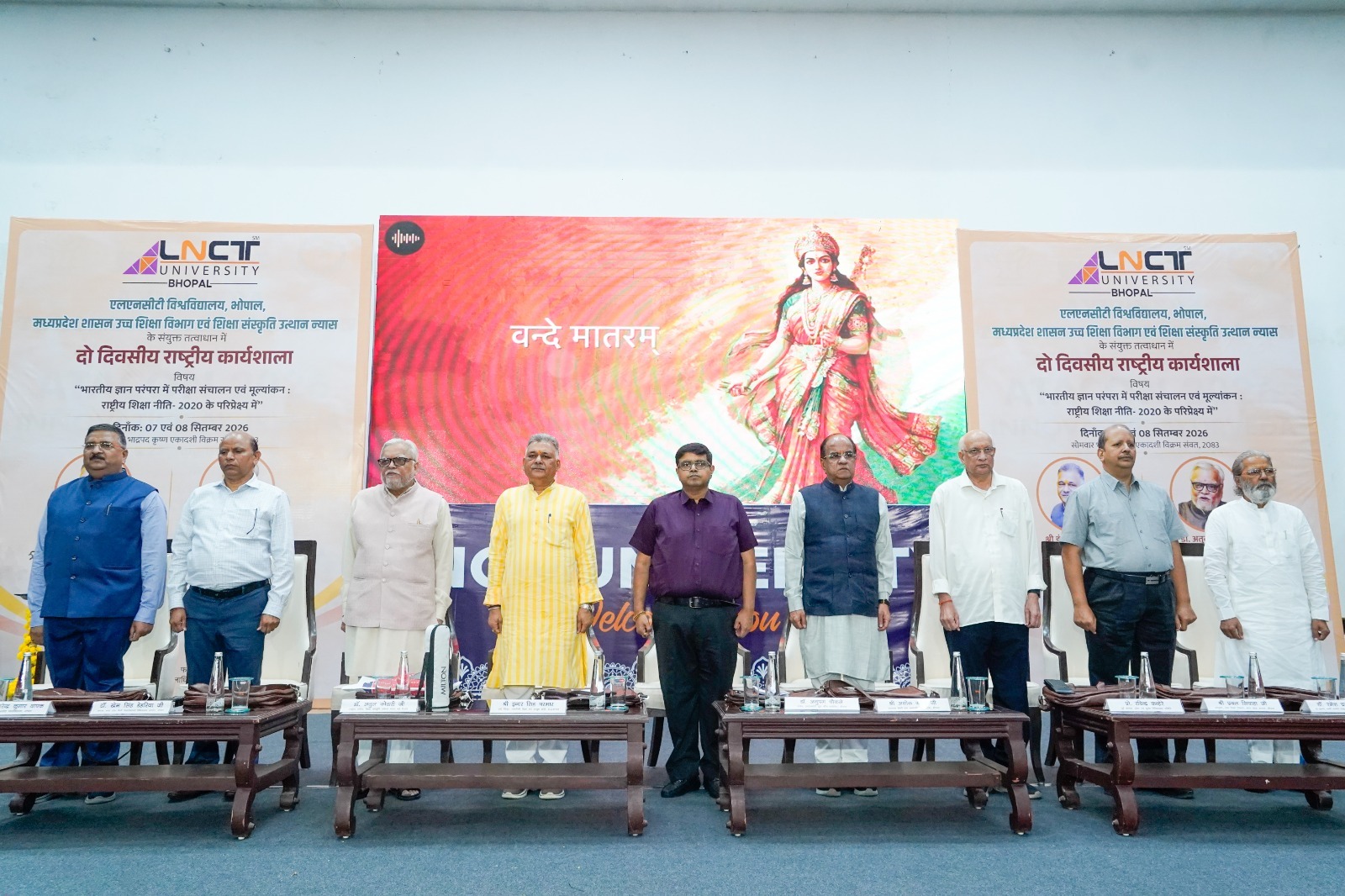
CNN Central News & Network-ITDC India Epress/ITDC News Bhopal: A national workshop on “Examination Conduct and Evaluation in the Indian Knowledge Tradition” in the context of the National Education Policy-2020 was organised at LNCT University under the joint aegis of the Higher Education Department of the Madhya Pradesh government and Shiksha Sanskriti Utthan Nyas, New Delhi. The workshop was held under the guidance and leadership of LNCT Group Secretary Anupam Chouksey.
Madhya Pradesh Higher Education, Technical Education and AYUSH Minister Inder Singh Parmar was present at the inaugural session. The programme began with lamp lighting, Saraswati Vandana and Vande Mataram. Guests on the dais were welcomed with shawls and coconuts. In the inaugural session, LNCT University Vice-Chancellor Prof. Dr Narendra Kumar Thapak highlighted the rich tradition of the Indian education system and the need to connect modern examination and evaluation systems with the Indian knowledge tradition in the context of the National Education Policy-2020.
In his special address, Higher Education Minister Inder Singh Parmar emphasised the need for coordination between Indian values and modern technologies. He said the examination system should not be limited only to assessment, but should be made more practical, relevant and effective. He underlined the need to give a new direction to the examination and evaluation system by linking the core spirit of the Indian knowledge tradition with modern technological systems.
Khemsingh Dehariya shared views on the practical applications of the Indian knowledge system. Higher Education Commissioner Prabal Sipaha and Madhya Pradesh Hindi Granth Akademi Director Ashok Kadel underlined the importance of policy reforms in higher education and transparent evaluation processes. Atul Kothari stressed making the examination system more practical and relevant through the integration of Indian values and modern technology. Dinesh Dave proposed the vote of thanks for the inaugural session.
In the technical session on the first day, Ramesh Chandra Bhardwaj, former Vice-Chancellor, Maharshi Valmiki Sanskrit University, Mundri, Kaithal, Haryana, delivered a lecture on “The Philosophical Basis of Education, Examination and Evaluation in the Indian Knowledge Tradition”. Prof. Chandra Charu Tripathi, Chairman, National Institute of Technical Teachers’ Training and Research, Bhopal, presented his views on “Continuous and Comprehensive Evaluation: Assessment of Practical, Skill-Based and Experimental Examinations”. The session was chaired by Prof. Ravindra Kanhere.
The workshop discussed subjects including the concept of examination and evaluation, the guru-shishya tradition, competency-based evaluation, continuous and comprehensive evaluation, question-paper setting, evaluation tools based on the Indian knowledge tradition, conduct of examinations through digital media, and transparent, fair and student-centred evaluation.
In the final phase of the first day, a research paper presentation session was held under the charge of Anu Shrivastava, in which teachers and research scholars presented papers. On the second day, experts shared views on subjects including the role of evaluation in admission and student selection, digital examination and evaluation, various dimensions and types of evaluation, holistic personality development and character building, student evaluation in the gurukul tradition, and an Indian examination-evaluation model for Viksit Bharat-2047. Controllers of examinations, assistant controllers of examinations, researchers, educationists and subject experts from universities across India participated in the workshop. The message of the workshop was: “Not just from examination to result, but from examination to personality building.”
Hashtags: #MadhyaPradesh #Bhopal #LNCTUniversity #IndianKnowledgeTradition #NEP2020 #NationalEducationPolicy2020 #ExaminationEvaluation #HigherEducation #IndianKnowledgeTraditionWorkshop #MadhyaPradeshState