


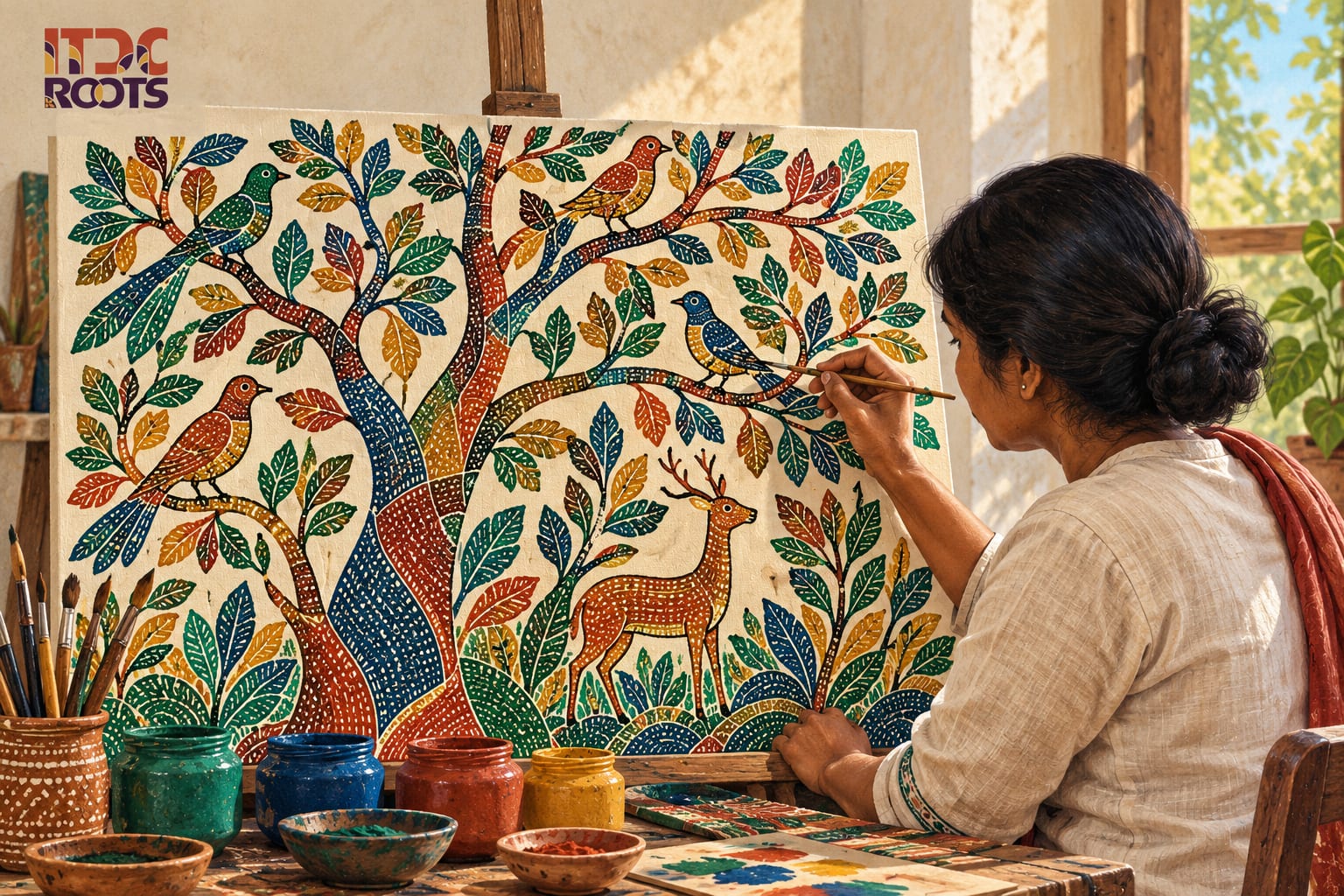
A bird’s outline may identify the subject of a Gond painting; the pattern inside it can identify something more personal. Rows of dots, curves or repeated strokes are part of the painter’s vocabulary. Looking closely changes the question from what tradition this belongs to, to who made it.
The contemporary painting associated with Patangarh owes much to Jangarh Singh Shyam, a Pardhan artist whose experiments helped establish the practice often called Jangarh Kalam. His work on paper and canvas drew on community narratives while developing a distinctive visual language. Museum scholarship cautions against treating that language as an unchanged style shared by every Gond community across centuries.
This history makes the small marks important. In the book Signature, published by Tara Books, Pardhan Gond artists explain the patterns they have chosen for their work. The collection includes Bhajju Shyam and Durga Bai alongside younger painters. Their accounts connect repeated marks with everyday experience, labour and imagination. A pattern can carry an individual explanation even when it appears, at first, to be decoration.
The filled surface also changes how a creature or tree is perceived. A flat shape becomes active through many small movements of the brush or pen. Repetition establishes a rhythm, but differences in spacing and direction keep the eye moving. The outline and its interior work together; neither is incidental to the picture.
Patangarh’s association with this practice is therefore a story of artists, teaching and innovation as well as cultural inheritance. Jangarh’s relatives and apprentices developed careers of their own, and later painters continued to extend the possibilities of the medium.
A useful way to approach such work is to begin with the maker’s name, then study the marks. Within one animal, branch or wing, an artist’s chosen pattern turns a shared subject into a particular painting.



