


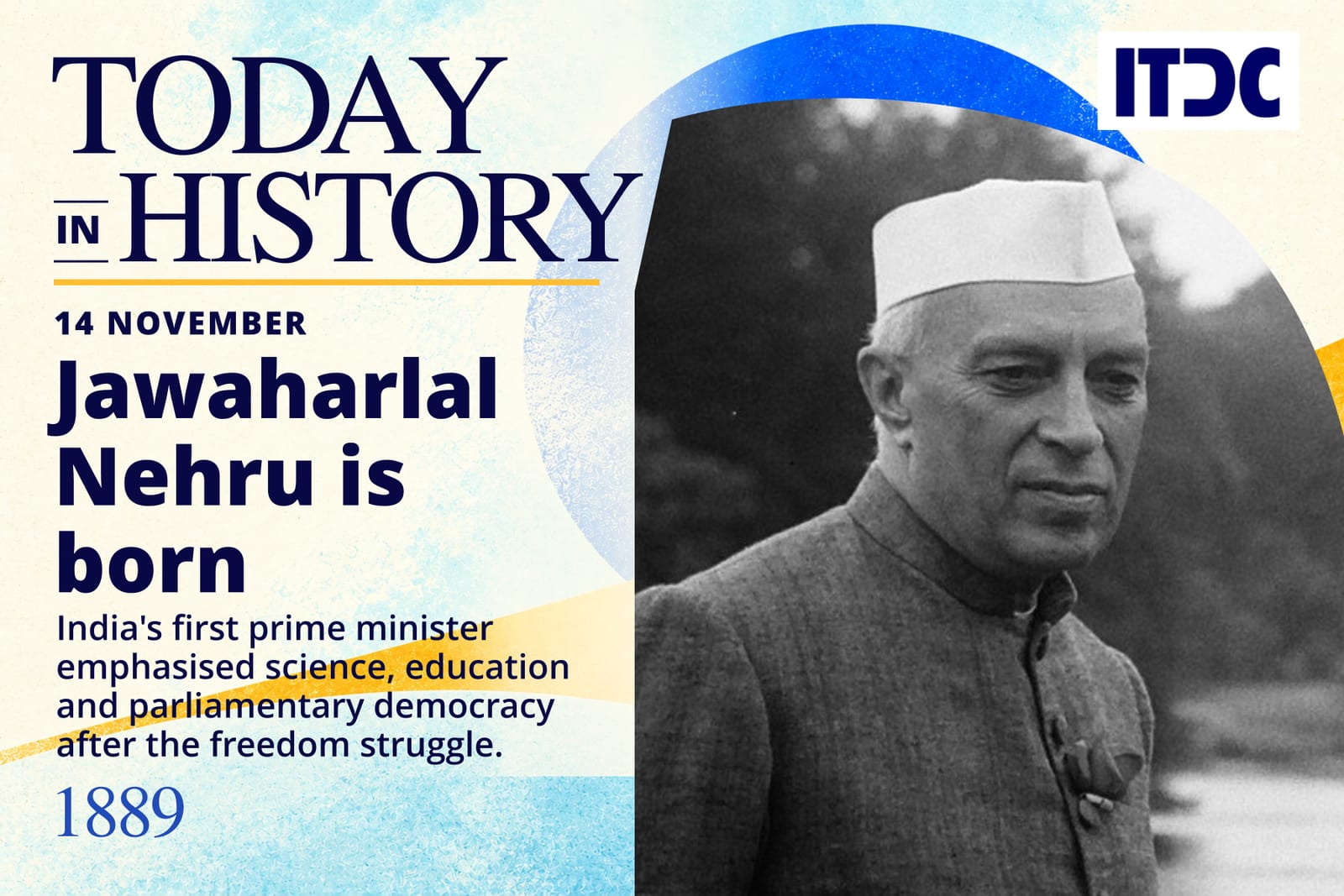
Harry Pot / Anefo, Nationaal Archief · CC0
Jawaharlal Nehru was born in Allahabad, now Prayagraj, on 14 November 1889. His life would span a major transformation in Indian history: from a country under British rule to a republic attempting to govern itself through democratic institutions. As independent India’s first Prime Minister, he faced the demanding transition from opposition to responsibility.
Nehru received his early education at home before studying in England, including at Harrow and Cambridge. After legal training, he returned to India in 1912. Political activity gradually drew him into the national movement, and his first meeting with Mahatma Gandhi in 1916 became an important influence.
The freedom struggle exposed him to concerns beyond the professional world into which he had been born. He organised a peasant march in Pratapgarh in 1920 and was imprisoned during the Non-Cooperation Movement. His political development combined participation in Indian campaigns with an interest in anti-colonial struggles elsewhere.
On 15 August 1947, he became Prime Minister. Independence was accompanied by Partition and violence, while the new state faced the longer tasks of economic development, social change and institution-building. Political freedom did not by itself supply the means to meet those needs.
Institutions for a changing country
Nehru gave considerable importance to scientific research, higher education and technical training. Institutions established during his premiership included new centres of medical and technological learning. These were collective achievements, involving ministers, scientists, administrators and educators, rather than the work of one leader alone.
His advocacy of a scientific temper concerned more than laboratories. It treated enquiry and evidence as resources for addressing economic and social problems. That aspiration sat alongside an emphasis on parliamentary government and the practical work of maintaining a democratic political system.
In foreign affairs, Nehru helped shape non-alignment: an effort to preserve independent judgement rather than automatically join either of the principal Cold War blocs. The approach operated in a difficult international environment and did not remove the dangers of conflict. The war with China in 1962 brought a severe crisis and searching criticism of his government’s policies.
Nehru remained Prime Minister until his death on 27 May 1964. His long tenure makes his record central to debates about the choices made in the republic’s early years.
A birthday commemoration is most useful when it opens that record to examination. Nehru’s significance lies in both the institutions and ambitions he helped establish and the difficult questions his period in office leaves about development, democracy and the exercise of state power.




