


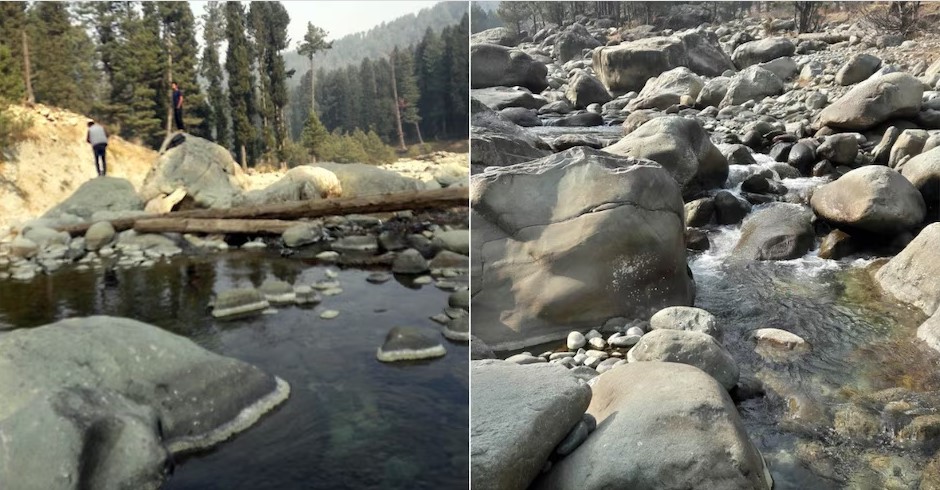
CNN Central News & Network-ITDC India Epress/ITDC News Bhopal: Srinagar. The impact of climate change in the Kashmir Valley is now clearly visible on water resources and drinking water supply. Glaciers in the Pir Panjal range are shrinking rapidly, the pattern of winter snowfall is changing, and snow has begun melting earlier than before. This is affecting the flow of the Doodh Ganga river, an important source of drinking water for more than two lakh people in Srinagar.
According to a study published in 2024, the total area of 122 glaciers in the Kashmir basin of the Pir Panjal region was about 25.7 square kilometres in 1980. By 2020, it had reduced to nearly 15.9 square kilometres. This means the total glacier area declined by about 38 percent over four decades. The findings have raised serious concerns over the future of climate-sensitive, snow-dependent water resources in the Himalayan region.
The Doodh Ganga river originates from glaciers near the Tattakooti peak in the Pir Panjal range. It passes through areas of Budgam and Pulwama before reaching Srinagar and later joining the Jhelum river. Glaciers, snow and springs in its upper catchment play an important role in maintaining the river’s flow.
Due to climate change, reduced winter snowfall and rising temperatures are causing snow to melt earlier. Earlier, snow accumulated in winter would melt gradually during spring and summer, maintaining water availability from April to July. Now, early snowmelt and extended dry spells can deepen the water crisis in summer.
Water shortages in the upper areas of Srinagar that depend on the Doodh Ganga are affecting daily life. Local residents say regular tap water supply is often disrupted in summer. Some families have installed additional storage tanks to collect water, while others depend on alternative water sources.
According to Anbreena Anjum, superintending engineer in the Jal Shakti Department, the Doodh Ganga water treatment plant has a capacity of 45.5 million litres per day. The plant supplies drinking water to more than two lakh people in Srinagar. When the flow of raw water in the river declines, the department has to rely on alternative pumping arrangements.
The water crisis is not limited only to reduced availability. Long dry spells reduce river flow, while intense rainfall and cloudburst-like events can increase the amount of soil and silt in the water. This affects the operation of water treatment plants and, at times, supply has to be stopped as a precaution.
A departmental official said Kashmir recorded around 80 percent less rainfall than normal in 2024, when the Doodh Ganga faced a severe shortage of raw water. The example shows that changing rainfall patterns can directly affect drinking water systems.
Growing construction in the Doodh Ganga catchment and changes to the river’s natural channels are also being seen as a challenge. In Srinagar, concrete structures, parks and other construction on parts of an old stream channel have affected natural drainage. During the floods of September 2014, problems related to water flow and inundation in low-lying areas had also come to the fore.
Experts say long-term water management is needed to deal with the effects of climate change in Kashmir. Monitoring glaciers and catchments, conserving water, protecting natural waterways and developing alternative sources of drinking water are considered essential. Promoting rainwater harvesting and water reuse will also be important.
The shrinking of Kashmir’s glaciers is not merely an environmental change; it is an issue linked to future drinking water security. If changing patterns of snowfall, temperature and rainfall continue to have an impact, ensuring water availability for populations dependent on rivers such as the Doodh Ganga may become even more challenging.
Hashtags: #ScienceTechnology #KashmirGlaciers #Srinagar #WaterCrisis #ClimateChange #DoodhGanga #Science #Technology #SrinagarWaterCrisis #PirPanjal



