


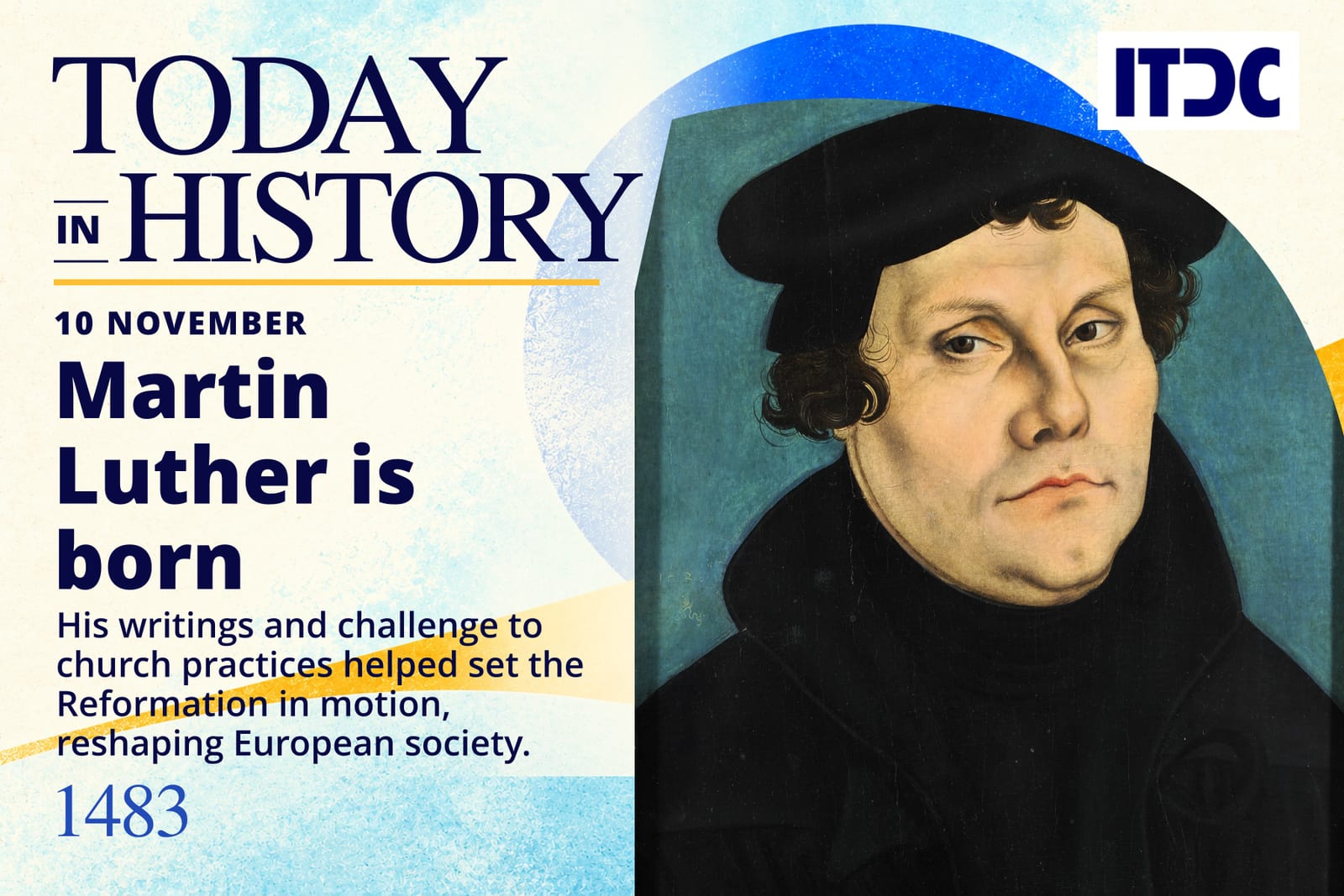
Lucas Cranach the Elder (1528), public domain; ITDC card
Martin Luther was born in Eisleben on 10 November 1483, into a family seeking opportunity in the mining region of central Germany. His parents soon moved to Mansfeld. The child born during that brief stay in Eisleben would become one of the most consequential and contested figures in European religious history.
Luther’s later career unfolded within a Christian world in which the authority of the Church shaped much of public and private life. An Augustinian monk and university theologian, he became increasingly critical of practices and teachings he believed could not be justified through scripture.
In 1517, his Ninety-five Theses challenged the handling of indulgences, which were connected to the Church’s teaching about the remission of punishment for sin. What began as a theological dispute expanded into a fundamental conflict about religious authority. The familiar image of a lone man changing Europe with a hammer is less useful than the documented history of arguments being written, circulated, answered and taken up by others.
Ideas in print
Printing helped those arguments reach audiences far beyond a university debate. The German Historical Museum emphasises the new possibilities for communication created by print, through which reforming ideas and Luther’s German Bible spread. Religious controversy was no longer confined to the places where it began.
The confrontation intensified. Luther was excommunicated in 1521 and appeared before the imperial assembly at Worms, where he refused to withdraw his position. His dispute with ecclesiastical authorities had become a matter involving the emperor and the political order as well.
Translation was another part of his influence. His German New Testament appeared in 1522, followed by the complete Bible in 1534. This work helped make scriptural language available to a wider German-reading public, although Luther was not the first person to translate the Bible into German.
The Reformation cannot be explained by one individual alone. Other reformers, rulers, printers and communities shaped its course. Luther was central to that transformation, but its outcomes extended beyond his own intentions.
A responsible account must also acknowledge his hostility towards Jews, particularly in his later writings. Modern Lutheran bodies have explicitly repudiated those statements. His historical importance does not require overlooking their harm.
The anniversary of his birth is thus an invitation to examine a complicated legacy rather than repeat a simple celebration. From Eisleben to Wittenberg and Worms, Luther’s life shows how arguments about faith could alter institutions, language and political relationships, while leaving difficult questions for later generations.




