


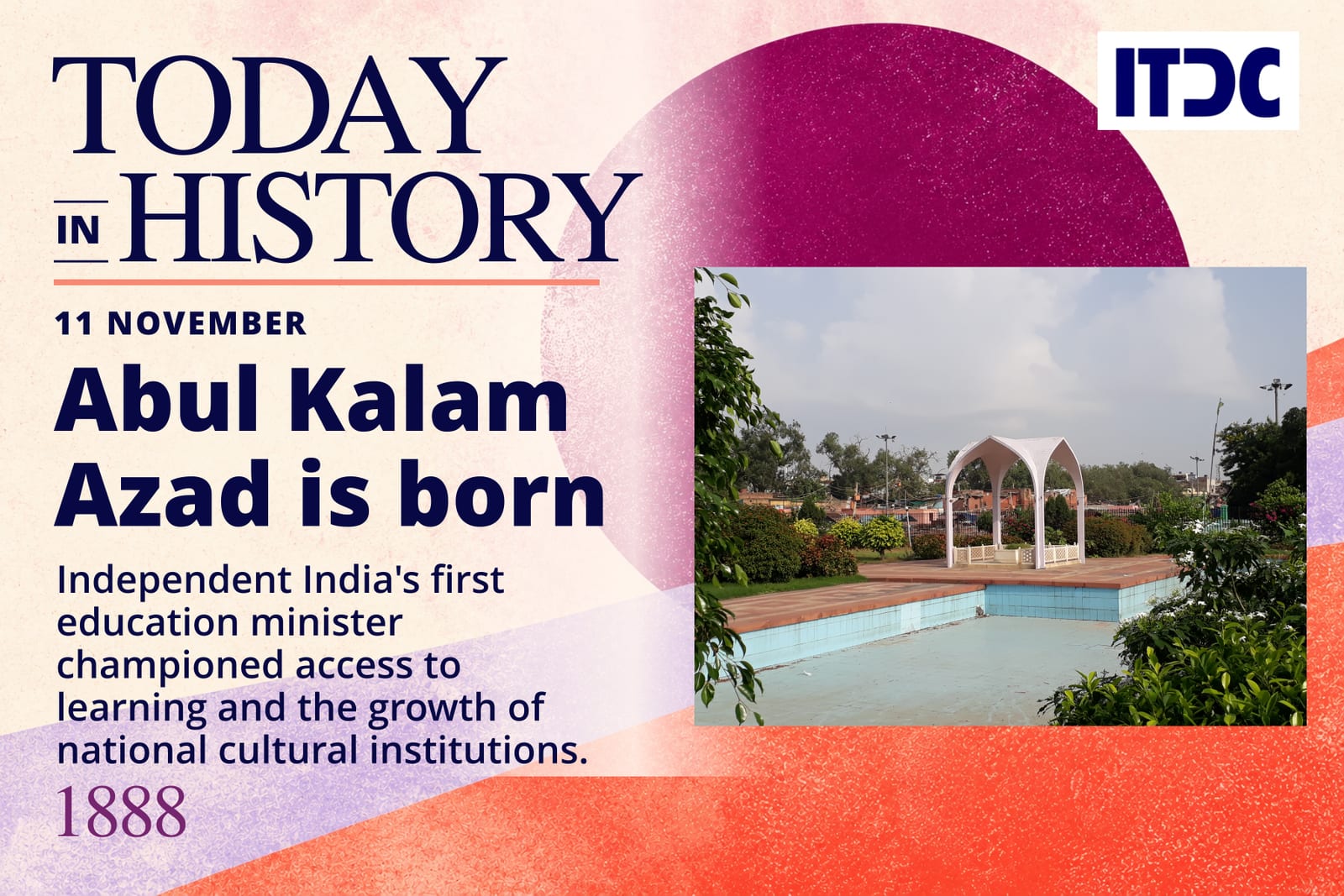
Pinakpani / CC BY-SA 4.0
When India became independent, political freedom brought an immense educational task into view. The country needed schools, teachers, universities and technical expertise, but also a clear idea of whom education should serve. Maulana Abul Kalam Azad, born in Mecca on 11 November 1888, became independent India’s first Education Minister and one of the people responsible for answering that question.
Azad was a scholar, writer and leader of the freedom movement before he entered the new government. His learning drew on several languages and intellectual traditions. That background helped shape an understanding of education broad enough to include literature and culture alongside science and professional training.
The transition from colonial rule to self-government required more than changing the names of institutions. Educational opportunity was deeply unequal. Expanding access meant considering children outside school, women and girls denied opportunities, adults who could not read and communities distant from established centres of learning.
Azad argued for education as a national responsibility. Government accounts of his work record his support for free and compulsory education for children up to fourteen, vocational learning, agricultural education and technical training. He also pressed for comparable opportunities across differences of caste, creed, location and sex.
Breadth as well as expertise
Higher education and technical capacity were essential to a country seeking economic development. Yet Azad did not treat the training of specialists as a substitute for general education. The two had to support each other: skilled institutions needed a wider educational base, and ordinary citizens needed the knowledge to participate in a changing society.
Culture belonged within this programme. The Indian Council for Cultural Relations was established in 1950, and the national academies for music and performance, literature and the visual arts took shape during his ministerial years. These institutions reflected the belief that national development involved cultural life as well as industry.
Building such a system was a collective undertaking, involving governments, educators and institutions. It would be misleading to credit one minister with every educational achievement of the period, just as it would be misleading to suggest that universal access was achieved during his lifetime. His importance lies in the priorities he helped establish.
Azad served until his death in 1958. His birthday is observed in India as National Education Day, linking remembrance to a continuing public responsibility.
The date asks a question still worth examining: does an education system merely produce qualifications, or does it make learning available to the people who need it? Azad’s career placed access, breadth and public purpose at the centre of that debate.




