CNN Central News & Network-ITDC India Epress/ITDC News Bhopal: Through communication technology, the medical world is now performing many remarkable feats. Services of good doctors are now available even in small villages and towns. People in remote areas no longer need to travel thousands of kilometres for treatment of diseases. Robotic surgeons sitting in cities are extending the benefit of their expertise to villages. All this is becoming possible through telecommunication technology.
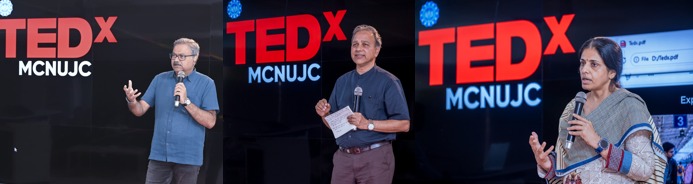
Dr Priya Bhave Chittawar, an expert speaker at a TED Talk session organised at MCU, made these remarks. Speaking on the theme “Surgery Without Borders”, Dr Bhave shared several interesting details. She spoke about the world’s first telesurgery and the latest modern changes taking place in India’s medical sector. She said that however far we may advance, technology cannot replace a doctor’s experience, discretion and ability to take decisions during surgery. Even so, the robotic work being done in India is a matter of both wonder and pride.
Giving an example, she said that if a soldier is injured on a remote border where a doctor cannot reach immediately, surgery is possible through a drone camera. Dr Priya also responded to questions from the students present in the audience. Replying to one question, she said doctors are now connecting through social media platforms and giving patients information on treatment and terminology in simple words. However, she added, patients also have a responsibility to try to understand medical terminology, because with AI it has now become easy to know everything.
In the second session of the programme, Professor Diwakar Shukla spoke on “Indian Art of Storytelling”. He said that a great deal of knowledge is not required to tell any story. India has thousands of ways of storytelling. Indians live stories in their everyday lives, and these stories never end. Thousands of stories can be found in the people, culture and art of this country. Even the rangoli or alpana made daily in Indian homes contains stories.
He said Indian stories are highly relevant. The patterns found in Indian arts have their own distinct historical sequence. Citing the example of Warli art, he said that on close observation one can see human activities and the naturalness of nature in it. The traditions and symbols visible in it are created by folk artists and women.
Professor Shukla said Indian art has its own distinctive beauty. People are often told to visit their villages, understand them and observe the culture there, because this helps them understand many things. By experiencing all this, one can easily learn the art of telling stories. Watching things unfold teaches us many lessons. In this context, he said, young people prefer mentoring over formal lectures and feel better with it.
Referring to the Ramayana and the Mahabharata, he said these narratives contain many stories within them, and every story is completely different. This is why many versions of the Ramayana and the Mahabharata exist not only in India but across the world. He said India’s knowledge tradition is vast and rich, and is embedded in our consciousness. He said that the way listeners to fasts and the stories associated with them also become characters in those narratives is an effect of India’s art of storytelling.
Describing tribal cultures as distinctive, he said Indian culture is extremely powerful. If people understand and know it, they can also know the stories connected with it. Today, commercial media is telling stories inspired by India’s folk tales. Speaking about the art of storytelling, he said it must be remembered that if a story is artificial, listeners and those trying to understand it will not enjoy it. Every story must be true, and events should appear in their natural form within it.
In another session, senior journalist Manish Dixit spoke on “A Reporter’s Responsibility in Search of Truth”. He said no news item walks up to a journalist on its own. A lot of effort has to be made for news. He said that even if a news item comes to you on its own, it must be examined and its facts verified in depth. It is necessary to understand deeply the processes connected with the subject on which one wants to report. Reporting without understanding facts and processes puts the credibility of both the journalist and the institution at stake.
Dixit said sources have great importance in journalism. Therefore, a journalist should take care of sources and win their confidence. No source is small or big, and sources should be developed continuously.
Speaking on learning the tools of journalism, he said confirmation of facts in news is essential. Many times, facts should be cross-checked. Journalists should do stories that they remember, or stories that become memorable. He said a journalist should work continuously and learn to use different tools. At times, journalists should also reflect on the ways they ask questions. A journalist should focus on their work rather than on what people say about it.
He said journalists should work on curiosity rather than CTC. A journalist’s work and stories are what take them forward. Citing examples of stories related to budgets, administration and politics, he said that even while working with enthusiasm, one must keep the outcome in mind. Addressing journalism students, he said a journalist should work on curiosity rather than CTC.
He also said journalists should work patiently on good stories. They should keep working on their skills, sources and credibility. Challenges certainly arise in journalism, and sometimes legal challenges also arise. Therefore, while doing stories, journalists should keep documents related to the relevant facts with them. The essence of journalism, he said, is that one should have information and documents related to it.
Dixit said social media is a major source of news and competition in this field has increased significantly. Therefore, there is a need to work a great deal on one’s skills. Instead of rushing after exclusive stories in haste, it is better to work hard and produce a better story.
On the occasion of the TED Talk at the university, Vice-Chancellor Vijay Manohar Tiwari congratulated the department and said that such innovation in association with an international platform is exemplary. Registrar P. Shashikala delivered the welcome address. The sessions were conducted by Dr Jaya Surjani. Heads of departments and faculty members were also present. The programme was coordinated and the vote of thanks to the guests was proposed by Dr Pavitra Srivastava, head of the Department of Advertising and Public Relations.
Hashtags: #MadhyaPradesh #Bhopal #MCU #TEDTalk #Journalism #Telemedicine #Storytelling #IndianCulture #RoboticSurgery #ManishDixit