CNN Central News & Network-ITDC India Epress/ITDC News Bhopal: Indian scientists have developed a new metal-free porous material that could offer a lower-cost alternative to platinum catalysts used in clean-energy technologies such as zinc-air batteries and hydrogen fuel cells. The material, developed by researchers from the S.N. Bose National Centre for Basic Sciences, Institute of Nano Science and Technology and SRM University, Amaravati, is designed to improve oxygen reduction reactions that are critical for energy conversion.
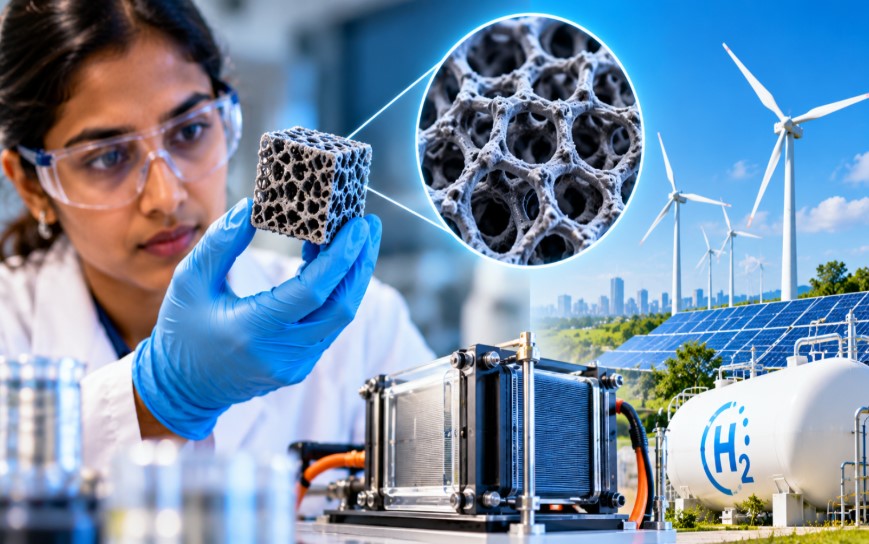
The material, named TTT-DHTD, is made from abundant elements including carbon, sulfur, nitrogen and hydrogen. Its ultra-porous, honeycomb-like structure provides active sites that help oxygen molecules attach and undergo reactions needed to generate electricity.
Researchers tested TTT-DHTD as an air-electrode catalyst in zinc-air batteries and found that it achieved about 96% of the performance of commercial platinum catalysts. It also maintained its performance for 120 hours of continuous operation during laboratory testing, according to the researchers.
Zinc-air batteries are being explored for energy storage because they use zinc, an abundant and relatively inexpensive material, while drawing oxygen directly from the atmosphere. However, their performance depends significantly on efficient oxygen electrochemistry, an area where platinum catalysts are commonly used.
The research team used advanced computational simulations to understand how the material's molecular structure creates favourable sites for oxygen reactions. The findings were published in the journal Science Advances.
The researchers said the development could eventually contribute to more affordable and sustainable energy-storage and fuel-cell technologies. However, further research and real-world testing will be needed before the material can be considered for large-scale commercial applications.
Hashtags: #ScienceTechnology #Bhopal #Metal #Free #Material #Could #Cut #Costs #Clean #MetalFreeMaterialCould