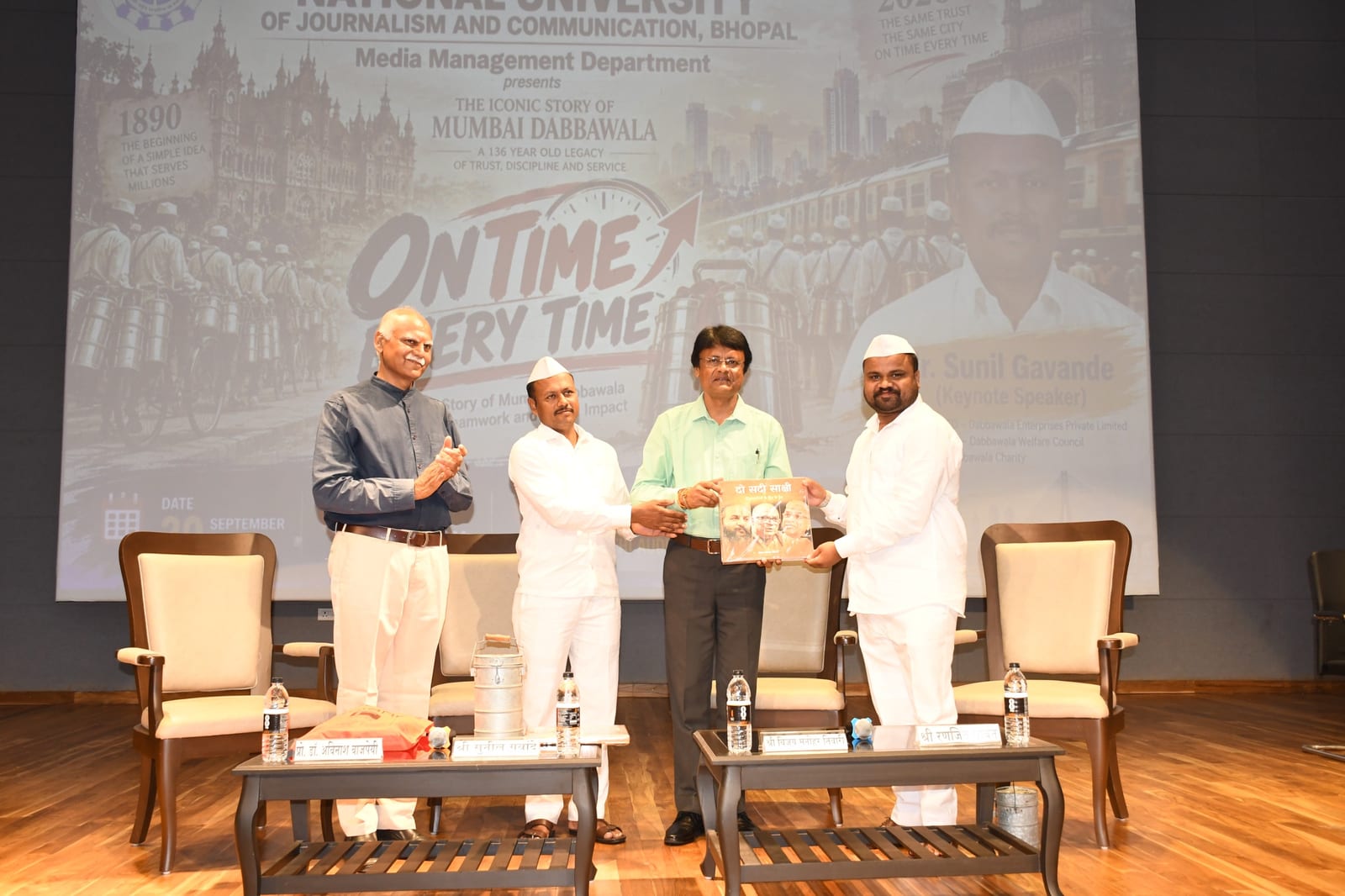
CNN Central News & Network-ITDC India Epress/ITDC News Bhopal: “For us, work is worship. Every customer is a form of God for us. Whatever the time or circumstance, we do our work with full dedication. In Mumbai, nearly 5,000 of our dabbawalas have been delivering food to lakhs of people for the past 136 years. More than a century has passed, but our work continues without even a small mistake. The smiles of customers satisfied with our service are our real certificates,” said Sunil Gawande, Director and CEO of Mumbai Dabbawale Enterprise Private Limited.
Gawande was speaking as the chief guest at a special lecture organised by the Management Department of MCU. Beginning his address, he said education is very necessary. “Just as a bird cannot fly without wings, a human being also cannot do much without education. Most of us dabbawalas are either very little educated or almost illiterate, but we know how to do business. We know business management. This is why almost the fourth generation of dabbawalas is also working in this profession today,” he said.
He said that 136 years ago in Mumbai, a Parsi banker engaged a person to bring food from his home to his office and return the empty tiffin, paying him a fixed monthly amount for the work. Inspired by this, Madhu Havaji Bachche started a dabbawala service in 1890 with 35 dabbawalas. Today, dabbawalas provide services within a 60 to 70 km radius in Mumbai and deliver tiffins to 2 lakh customers.
Every dabbawala travels by bicycle, so the carbon footprint is also zero. From an organisational point of view in business, there has never been a strike in this organisation. Gawande said a dabbawala team generally has 20 to 30 people. This team collects the food tiffin from a customer’s home, delivers it to the customer and then returns the empty tiffin to the home.
Gawande said Prince Charles visited India in 2003 and met the dabbawalas. After this, the story of Mumbai’s dabbawalas received global attention. He also narrated the story behind the formation of Dabbawala Enterprises Private Limited in 2017, with the aim of doing welfare work for dabbawalas. In this company, from the Chief Executive Officer to the Managing Director, all are dabbawalas. In other words, every dabbawala is a shareholder in the company. He said that during natural disasters, the dabbawala organisation also comes forward to support the country. Their future plans include starting a global food company.
On the occasion, university Vice-Chancellor Vijay Manohar Tiwari said dabbawalas deliver 2 lakh tiffin boxes to exactly the right person with only a minor error margin. This is an excellent example of timely and disciplined work in an enterprise run by Indians. He said it is an important lesson in management that can be very useful for students. Tiwari said everyone should understand the work of dabbawalas, which is based on good teamwork. Time management is the most important element in it. He said it is truly a tremendous success story of Mumbai.
Ranjit, another speaker from Dabbawala Enterprise, spoke on the success of dabbawalas and their management principles. He said, “We keep the price of our service very low. Our company does not have a large corporate office. Our branding is our hard work, honesty and error-free service.” He said their supply chain system has no match. This is why there are Six Sigma studies on Mumbai’s dabbawalas, and many management institutions around the world, including Harvard Business School, have conducted case studies on them.
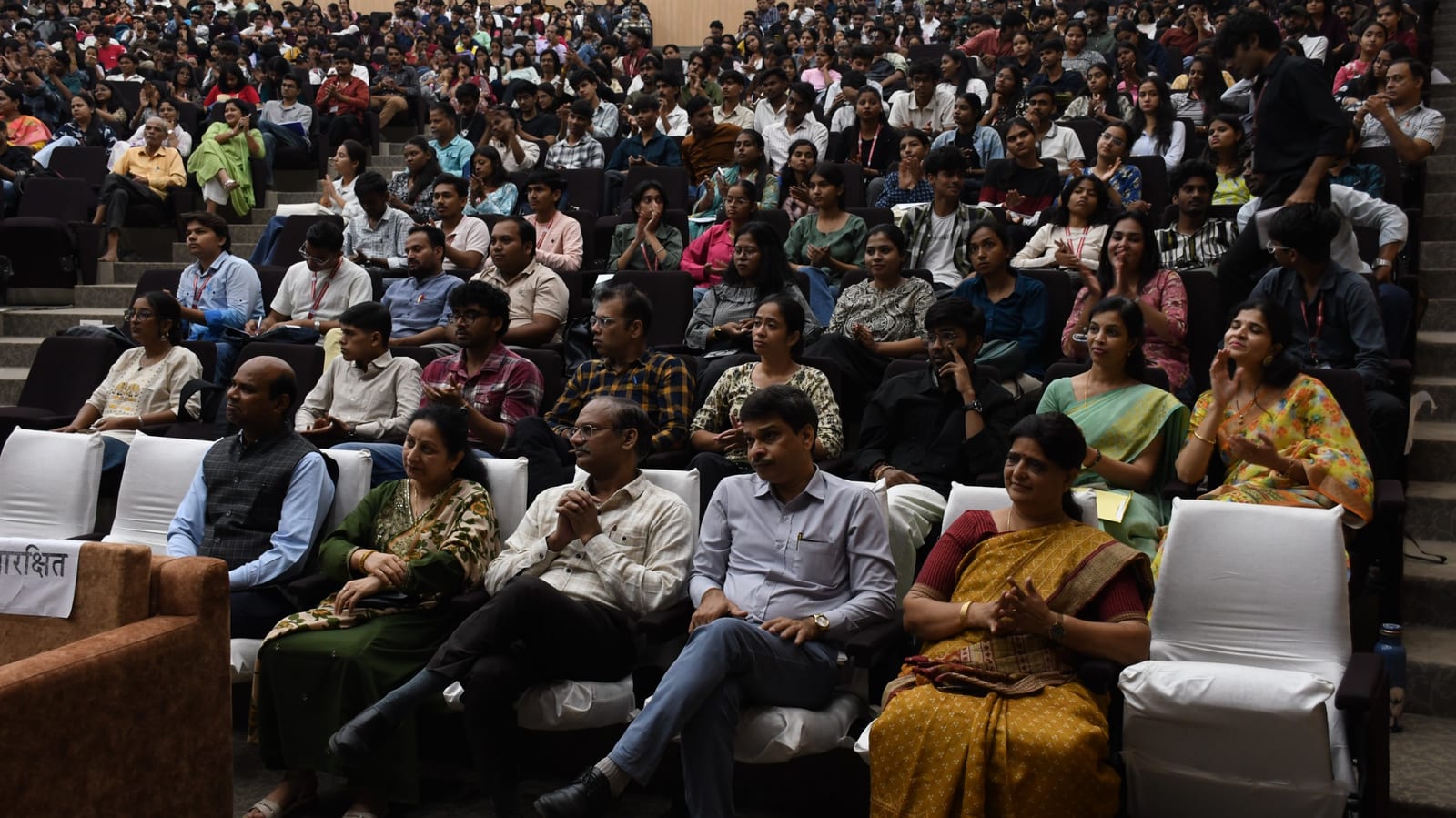
The programme was coordinated by Head of the Management Department Dr. Avinash Vajpayee. Students and teachers from all departments were present on the occasion.
Hashtags: #MadhyaPradesh #Bhopal #MCU #MumbaiDabbawalas #Management #SunilGawande #VijayManoharTiwari #ManagementLecture #DabbawalaEnterprise #MumbaiDabbawalas136Year