


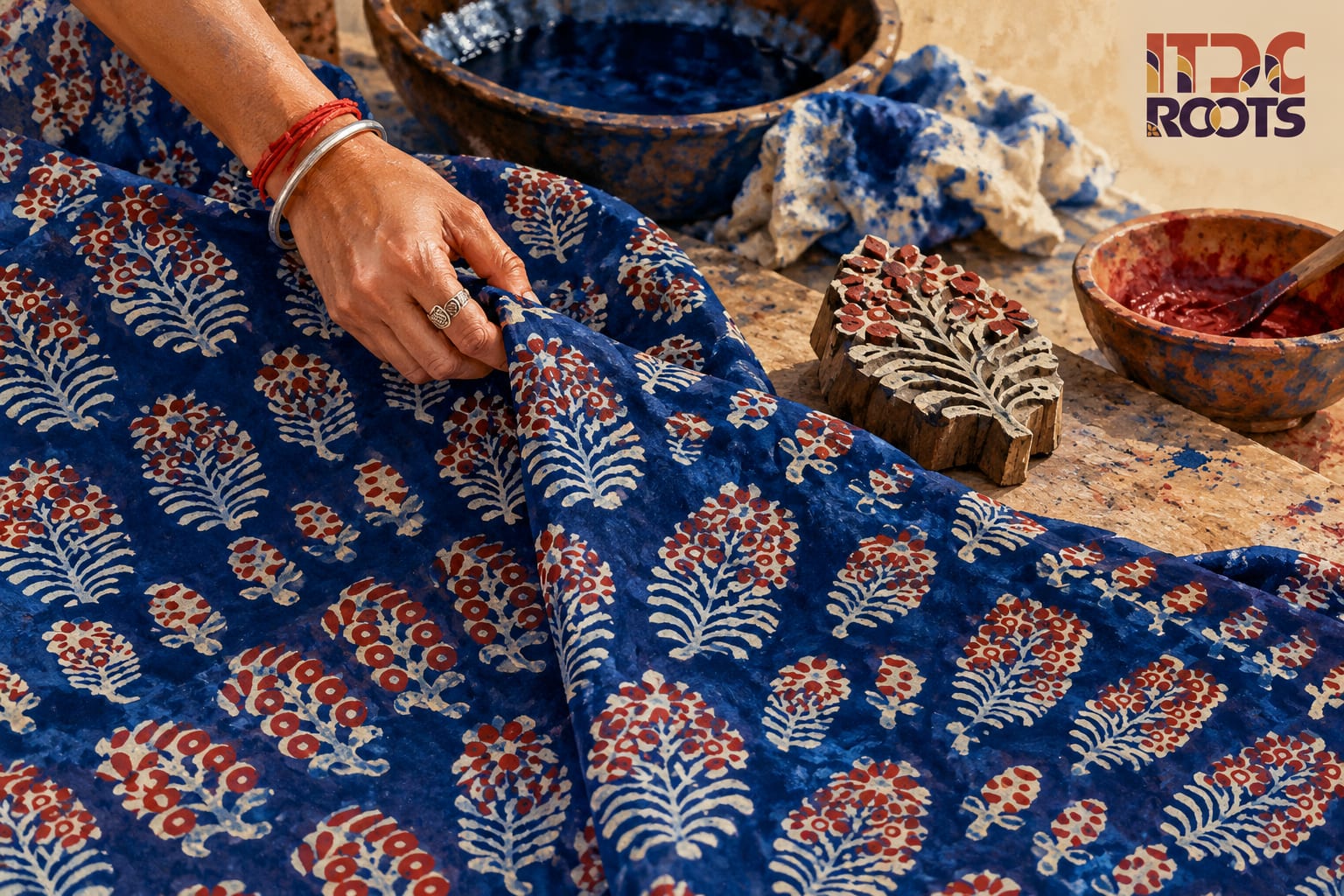
Nandna cloth can be recognized through a group of named patterns rather than an unlimited catalogue of designs. Amba recalls the mango, mirchi the chilli, and champakali a flower bud. Repeated across dark cloth, these familiar forms belong to a printing tradition associated with Tarapur and neighbouring Ummedpura in the Neemuch region.
Their apparent simplicity hides a demanding process. A Craft Revival Trust study documents sets of carved wooden blocks used to build a complete motif. The printer does more than repeat one finished picture. Different impressions must meet correctly as the fabric moves through successive stages of printing, resisting and dyeing.
The study records blocks commissioned from makers in Pethapur, Gujarat. Printers supply the designs, while specialist carvers translate them into tools. Nandna therefore carries a relationship between workshops in different places: the textile’s local identity depends partly on skills exchanged across a wider craft network.
Its customers also helped shape its character. Historical documentation connects the cloth with skirts and shoulder coverings worn by Bhil and Bhilala women. Dark grounds and repeated motifs were part of clothing used in ordinary life as well as on significant occasions. Accounts associate particular patterns with stages of life or gifts between siblings, though those practices should not be treated as rules followed by every wearer today.
The work involves repeated handling of the same length of fabric. Indigo and other colour treatments must be coordinated with the areas protected by resist. A pleasing repeat is consequently both a visual design and the outcome of a planned sequence.
Describing Nandna simply as blue floral cloth misses that distinction. Its identity lies in named motifs, specialized tools, remembered customers and the printer’s ability to carry a pattern through several transformations. The amba on the finished textile is also a record of those decisions.



