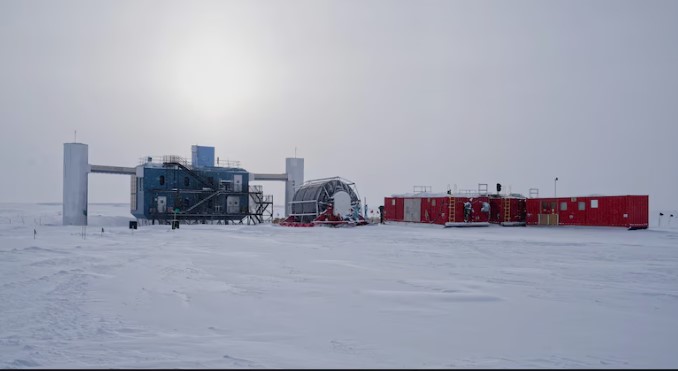
CNN Central News & Network-ITDC India Epress/ITDC News Bhopal: The 2026 Nobel Prize in Physics has highlighted how the frozen depths of Antarctica have been transformed into a powerful tool for exploring the universe. Belgian-American physicist Francis Halzen received the prize for his decisive contributions to the IceCube Neutrino Observatory and the discovery of high-energy neutrinos of astrophysical origin.
Located at the South Pole, the IceCube observatory uses nearly a cubic kilometre of clear Antarctic ice as a giant neutrino detector. Thousands of light sensors installed deep beneath the surface detect tiny flashes produced when neutrinos occasionally interact with matter.
Neutrinos are electrically neutral particles that interact extremely weakly with matter. Vast numbers pass through the Earth and human bodies without leaving a trace. Their ability to travel long distances without being significantly deflected or absorbed allows scientists to use them as messengers from distant cosmic events.
Halzen proposed using South Pole ice to detect neutrinos in 1988, an idea that eventually led to the development of IceCube. The completed observatory has enabled researchers to identify high-energy neutrinos originating from beyond the Solar System and investigate some of the universe’s most energetic environments.
The discovery has opened a new avenue for astronomy because neutrinos can provide information that conventional light-based observations cannot always reveal. Researchers can use the direction and energy of detected neutrinos to investigate their cosmic sources and study extreme astrophysical phenomena.
IceCube’s scientific work is continuing, with upgrades aimed at improving the observatory’s sensitivity and the accuracy of neutrino measurements. Scientists are also exploring the possibility of a much larger IceCube-Gen2 detector.
Hashtags: #ScienceTechnology #Bhopal #Nobel #Physics #2026 #Antarctic #Ice #Opens #Window #NobelPhysics2026Antarctic