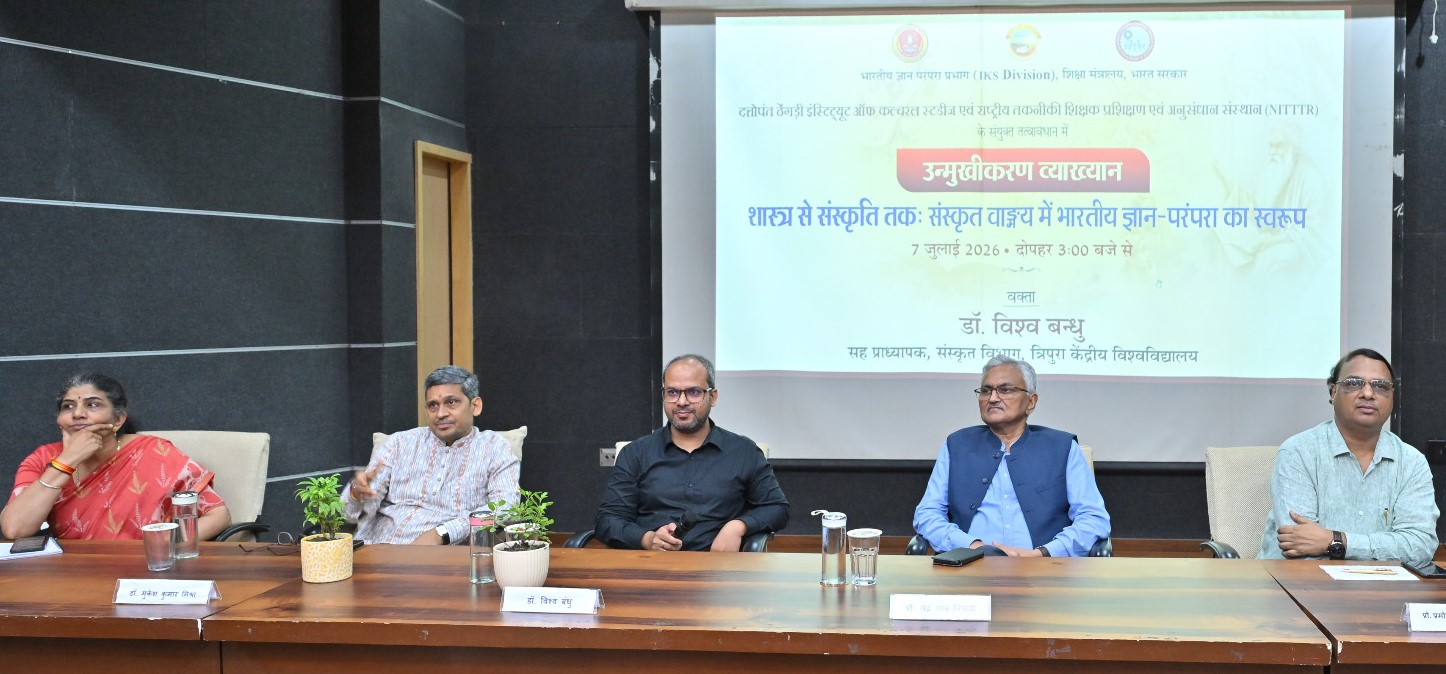
CNN Central News & Network-ITDC India Epress/ITDC News Bhopal: A one-day orientation lecture on “From Shastra to Culture: The Form of the Indian Knowledge Tradition in Cultural Literature” was organised jointly by the Dattopant Thengadi Research Institute, under the Indian Knowledge Tradition Department, Ministry of Education, Government of India, and the National Technical Teachers Training and Research Institute.
The keynote speaker, Dr. Vishwabandhu, Associate Professor in the Department of Sanskrit at Tripura Central University, began his address with a saying of Mahakavi Kalidasa and highlighted the responsibility of an educated person. He said true knowledge of a subject does not lie merely in receiving it through the senses, but in assimilating it at the level of experience and taking it to one’s disciples and society.
Discussing the fundamental questions of the Indian knowledge tradition, Dr. Vishwabandhu explained the interrelationship between “Shastra” and “culture”. He said Shastra and culture are not separate from each other, but complementary and inseparable. In the present time, he said, any attempt to separate Shastra from culture is not academically appropriate, because culture originates from Shastra and society builds its way of life on that basis. He clarified that Shastras provide authenticity to folk life, customs and social conduct.
Vishwabandhu specifically dispelled the misconception that “parampara” means “tradition”. He said the English word “tradition” conveys a fixed and static form, whereas in the Indian context parampara is a continuously evolving, changing and renewed process. Citing examples of Maharshi Panini, Maharshi Valmiki and various acharyas, he said the Indian knowledge tradition has always had continuous dialogue, reconsideration and development of principles. Every acharya expanded knowledge according to his time, and this is how parampara was formed.
He said that in the Indian knowledge tradition, what is ancient is Sanatan. The Atharvaveda also contains reference to this concept of Sanatan. He said Shastras are always compared to a river, because like a river, Shastras also flow continuously and keep providing life-giving direction to society.
Highlighting the Indian method of research, he said the Shastra through which the originality of the world is understood is philosophy. He emphasised the importance of fundamental questions such as “what, by what and narration” in the research process, and said Mimamsa is established as a strong methodology in the Indian research system. The Indian knowledge tradition is not limited to one perspective, but is enriched by diverse viewpoints and multidimensional thinking.
Speaking on the Indian view of women, he said the Indian tradition does not treat woman merely as a subject of discourse, but accepts her as the fundamental basis of creation. He said the sixty-four Yoginis are the conceptualisation of the sixty-four sounds of Sanskrit. He said patriarchal existence itself is born from the mother. The creative point of this universe is woman. All existence has expanded from maternal power, and this is the core sentiment of Indian thought.
Dr. Mukesh Kumar Mishra, Director of the Dattopant Thengadi Research Institute, said the Indian knowledge tradition is not limited only to Sanatan texts, but represents the entire literary corpus of Indian culture. He said that at a time when the country is moving towards a new intellectual discourse, ancient literature is being reread and re-evaluated. He expressed concern that over the past few decades people have moved away from their mother tongues and original languages, as a result of which they are also moving away from their roots and Indianness. He said that if literature and texts from 200 years ago are studied seriously, the real understanding of the Indian life-view and cultural consciousness will be obtained.
At the closing of the programme, Dr. C. C. Tripathi, Director of the National Technical Teachers Training and Research Institute, said in his address that the greatest need of the present time is the serious study of original texts, Shastras and India’s knowledge wealth. He said that due to Western influence, Indian society is gradually moving away from its cultural roots. If an self-reliant nation with self-awareness is to be built, he said, it is necessary to study the original sources of the Indian knowledge tradition and re-establish them in practical life.
In the question-answer session held after the lecture, various questions were raised, which the keynote speaker addressed in detail.
The guests present on the dais included Prof. Alpana Trivedi, Dr. Mukesh Kumar Mishra, Dr. Vishwabandhu, Dr. Chandra Charu Tripathi and Dr. P. K. Purohit.
In the end, Prof. Alpana Trivedi expressed gratitude to the guests, speakers, participants and all collaborators associated with the event. She said such lectures based on the Indian knowledge tradition do not remain confined to intellectual discourse, but become the basis for the revival of the Indian perspective in society and the world of education. She expressed hope that such programmes would continue to be organised in the future and would play an important role in connecting the Indian knowledge tradition with education, research and social life.
Faculty members, researchers, students and a large number of educationists attended the programme.
Hashtags: #MadhyaPradesh #Bhopal #IndianKnowledgeTradition #Shastra #Culture #DattopantThengadiResearchInstitute #NationalTechnicalTeachersTraining #IndianKnowledgeTraditionOrientation #MadhyaPradeshState #Desksource