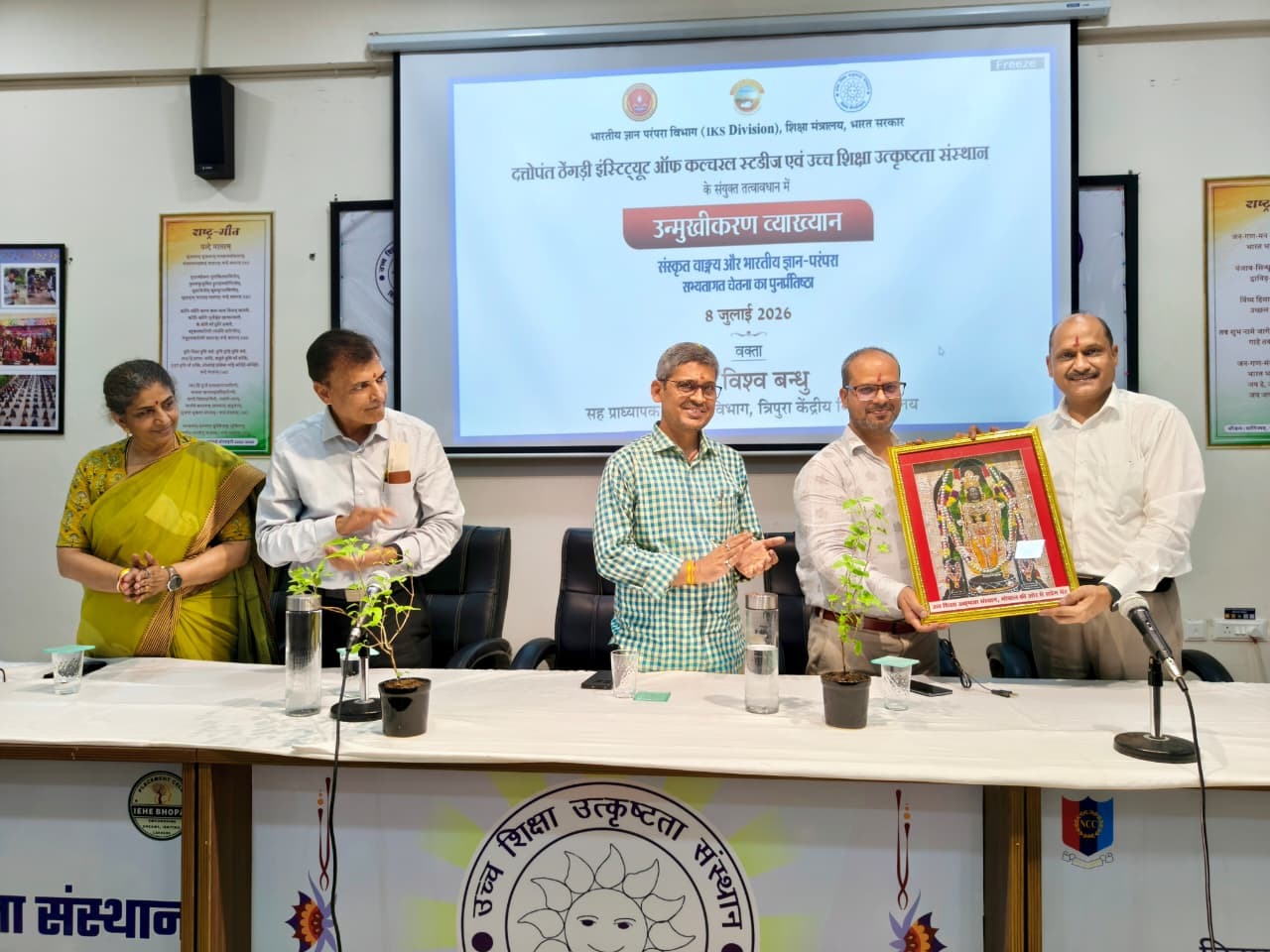
CNN Central News & Network-ITDC India Epress/ITDC News Bhopal: An orientation lecture on “Sanskrit Literature and Indian Knowledge Tradition: Re-establishing Civilisational Consciousness” was organised with the support of the Department of Indian Knowledge Tradition, Ministry of Education, Government of India, jointly by the Dattopant Thengadi Research Institute and the Institute for Excellence in Higher Education, Bhopal.
Dr. Vishwabandhu of Tripura University attended the programme as the keynote speaker. The guests on the dais included Dr. Mukesh Kumar Mishra, Prof. Alpana Trivedi, Dr. Pragyesh Agrawal and Prof. Pragya Nayak.
At the beginning of the programme, Dr. Mukesh Kumar Mishra, director of the Dattopant Thengadi Research Institute, explained the concept of the Indian knowledge tradition and said that the vast repository of Indian knowledge is contained in Sanskrit texts and Indian literature. He said there is a need to re-establish this stream of knowledge and to restore the Indian knowledge system before society in its true form. He said India is not merely a geographical entity, but a civilisation that has remained continuously illuminated by knowledge. The meaning of “Bharat” itself is connected with light and knowledge; the land constantly engaged in knowledge is Bharat, he said.
Dr. Mishra said that in the present times, academic thinking has for a long period been influenced by Western discourse, because of which the original form of the Indian knowledge tradition could not be adequately understood. He expressed confidence that the National Education Policy 2020 would become an important medium for re-establishing education rooted in Indian ethos and would provide the new generation an opportunity to connect with its cultural and intellectual roots.
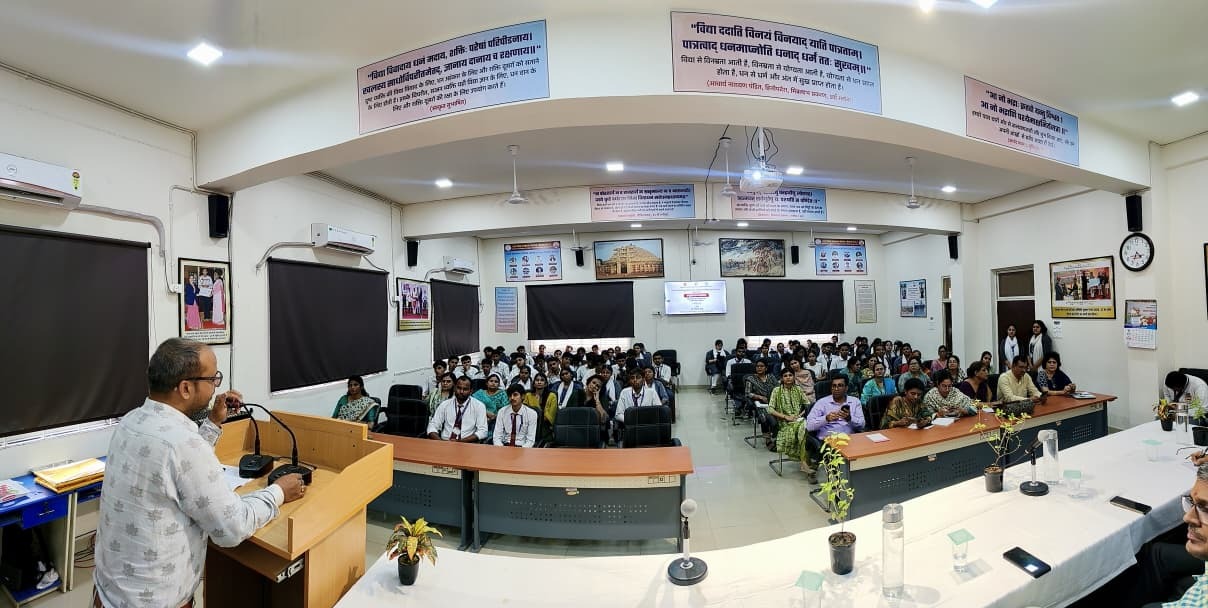
Keynote speaker Vishwabandhu spoke in detail on the Indian guru-shishya tradition, moral values and the Indian view of life. Referring to the ideas of Mahakavi Bhavabhuti, he said that in Indian culture nature is seen not merely as a resource, but as a conscious entity. Through the concept of Vandevi, he underlined the humanised form of nature and said that only a person whose character, conduct and moral life are pure and noble can make use of the forest.
He said the fundamental objective of Indian education is not merely the acquisition of knowledge, but the building of noble character. According to Mahakavi Bhavabhuti, a creative personality is one whose speech is gentle, behaviour is humble, character is spotless and whose conduct is the same both within and outside. Such a person alone becomes entitled to make proper use of the resources of society and nature.
Explaining the guru-shishya relationship, Vishwabandhu said the role of the guru is to transmit knowledge, but the spirit in which knowledge is received depends entirely on the curiosity, humility and eligibility of the disciple. If a student has a genuine desire to learn and purity of conscience, only then will knowledge be reflected in his life as light.
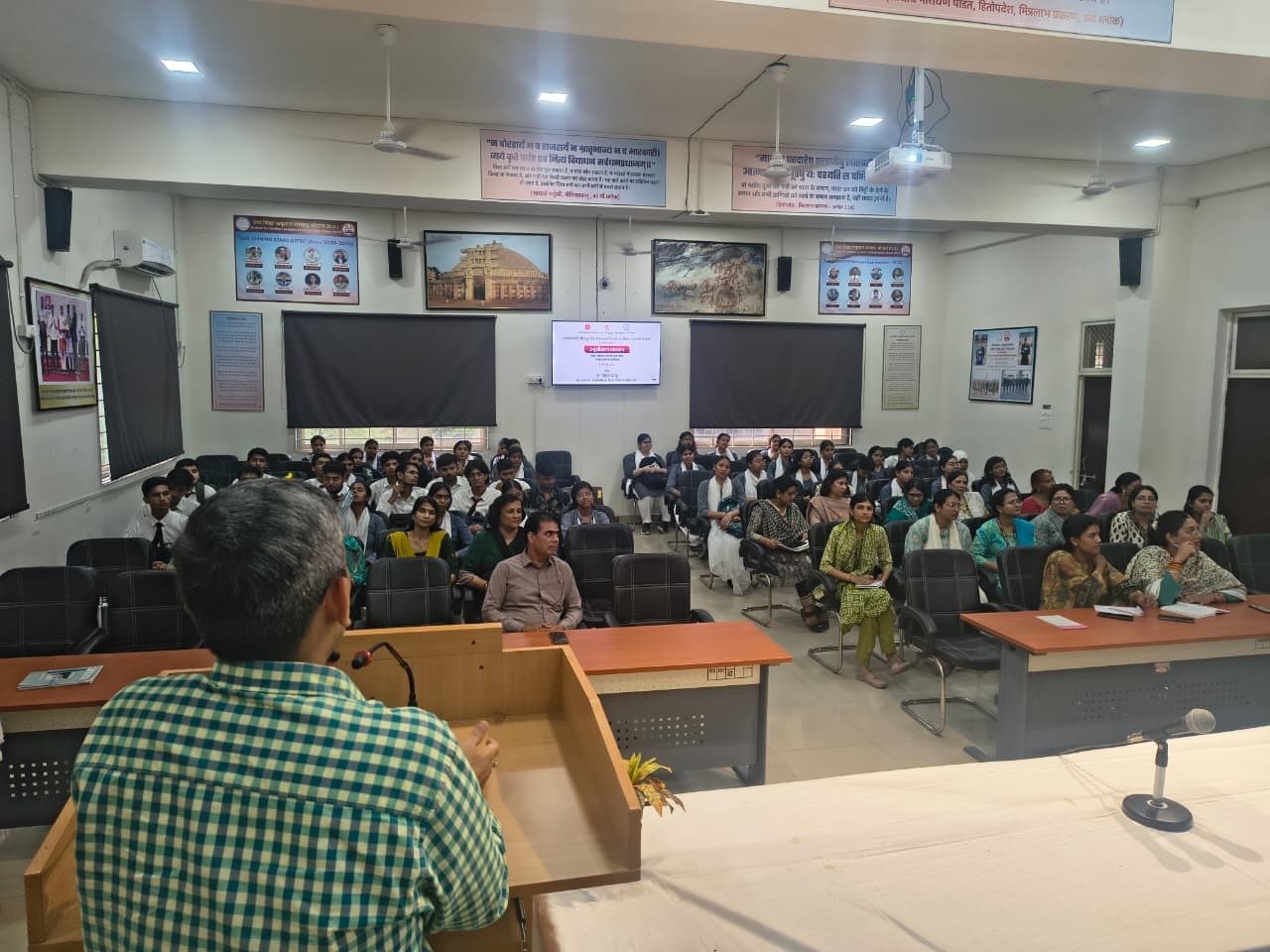
He further said that knowledge is itself luminous. It is not merely information, but a consciousness that illuminates a person’s inner being. Every nation has its own original knowledge tradition and cultural consciousness, in accordance with which its texts, philosophy and life values develop. The European perspective defines national identity on the basis of one language, one government and one culture, whereas India’s concept of nation is based on cultural unity embedded in diversity. Despite many languages, traditions and ways of life, India is a living nation bound by the thread of self-consciousness.
Dr. Pragyesh Agrawal, director of the Institute for Excellence in Higher Education, presented his views on personality development among students through episodes from the Mahabharata. He said the real progress of any student depends on curiosity, wisdom, moral values and a constant desire to learn. He urged students to draw inspiration from the Indian knowledge tradition and enrich their personalities with the ideals of knowledge, character and service.
A large number of students and faculty members were present at the programme.
Hashtags: #MadhyaPradesh #Bhopal #SanskritLiterature #IndianKnowledgeTradition #NEP2020 #DattopantThengadiResearchInstitute #InstituteForExcellenceIn #NationalEducationPolicy2020 #OrientationLectureOnSanskrit #MadhyaPradeshState