


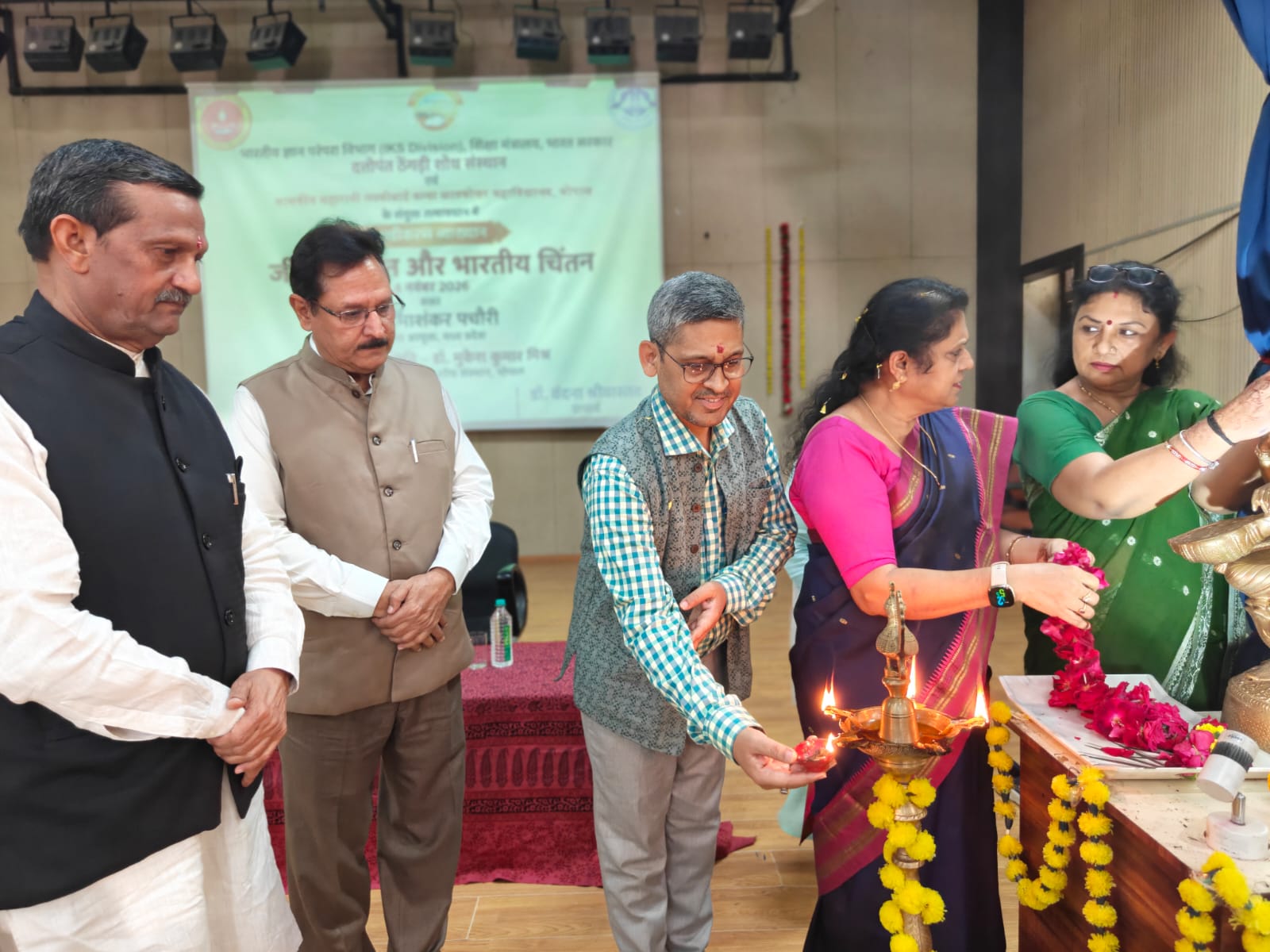
CNN Central News & Networks / ITDC India ePress / ITDC News /Agencies/ Bhopal: Indian sages laid emphasis on harmony between abhyudaya and nihshreyas. Along with material progress in life, spiritual development is also necessary. Control over the mind and the practice of patience are essential for life management. By imbibing these principles of Indian thought, a person can give a meaningful direction to life. These views were expressed by Madhya Pradesh Information Commissioner Umashankar Pachauri at MLB College on Wednesday.
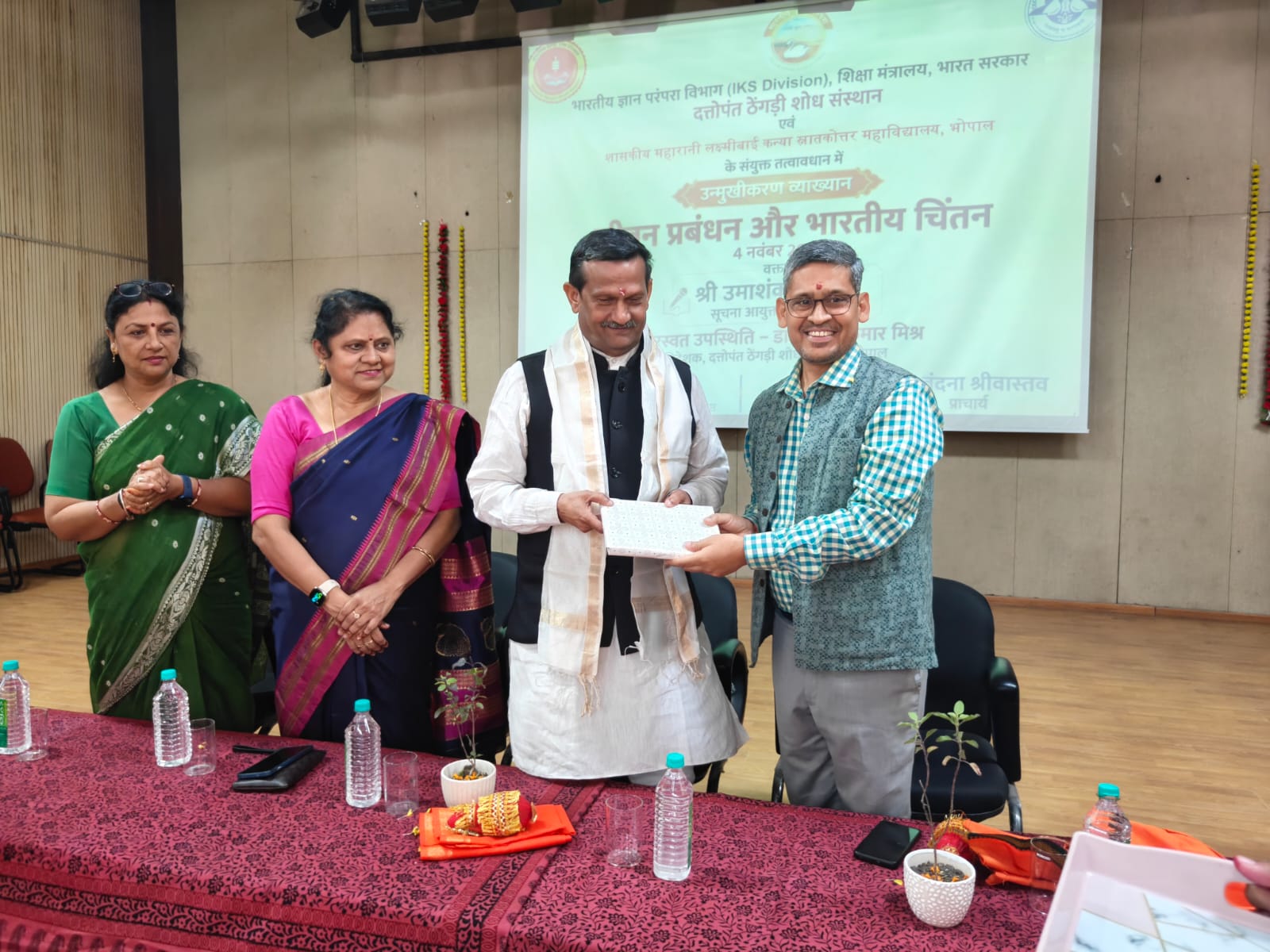
An orientation lecture on “Life Management and Indian Thought” was organised jointly by the Dattopant Thengadi Research Institute and Government Maharani Laxmibai Girls Postgraduate College, Bhopal, in collaboration with the Indian Knowledge Tradition Cell, Ministry of Education, Government of India. Madhya Pradesh Information Commissioner Umashankar Pachauri attended the programme as the keynote speaker.
The programme was chaired by the college principal, Vandana Srivastava. On the occasion, Dattopant Thengadi Research Institute director Dr. Mukesh Mishra and Hamidia University Head of Geography Prof. Alpana Trivedi were also present as special guests. The programme was conducted by the college’s Head of Hindi Department, Prof. Sudhir Sharma.
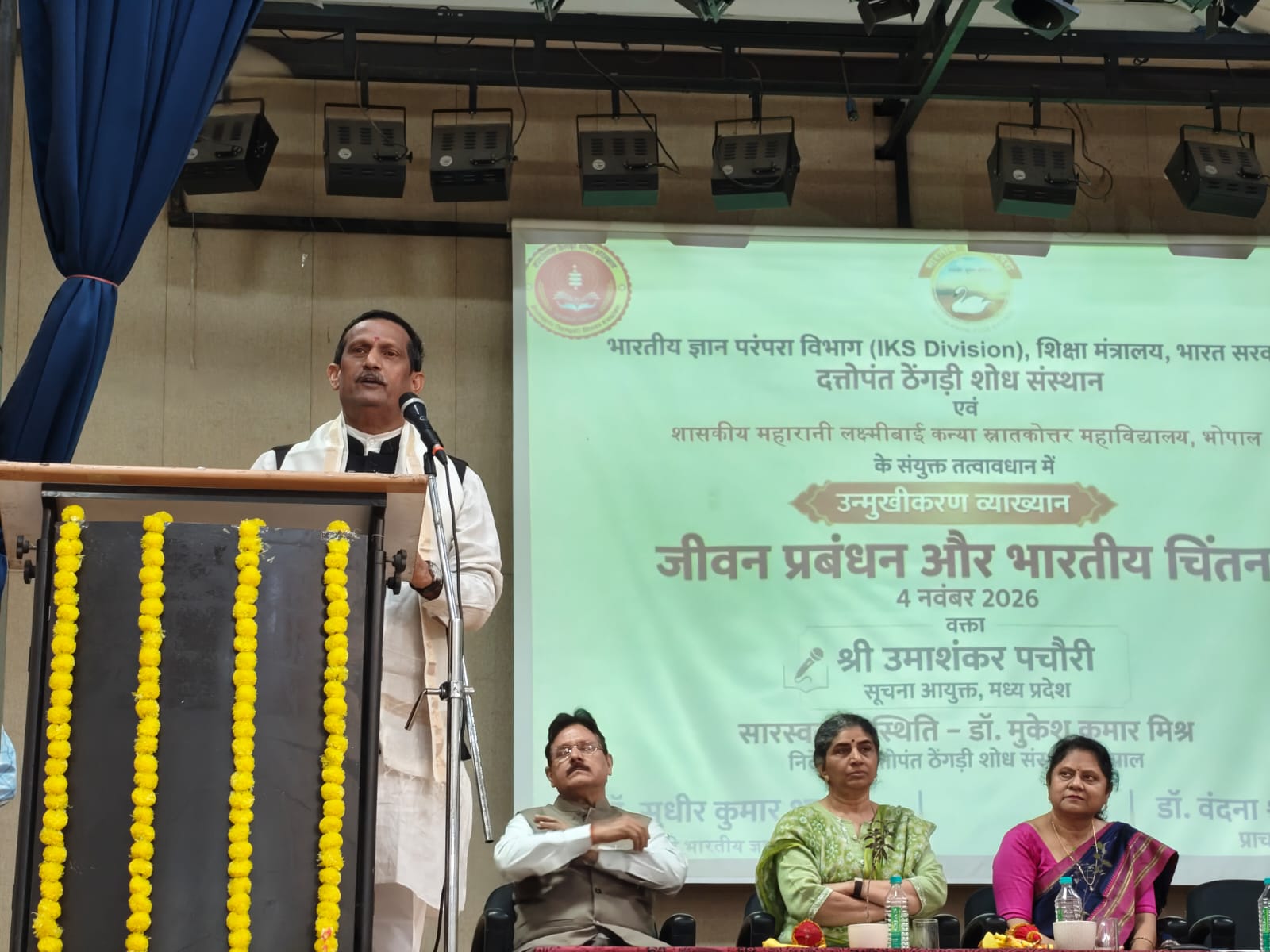
In his lecture, Umashankar Pachauri described the Indian tradition of thought as the basis of life management and said that “Sat, Chit, Anand” is our real nature. Indian sages have reflected deeply on the human mind, life and its holistic development. He said a lecture is not an ordinary event. Behind even one meaningful sentence lies a person’s entire life and years of discipline. In the Indian knowledge tradition, sages devoted their entire lives to a single subject and provided knowledge to society.
Speaking on life management, he said that in Indian thought, the mind is considered the greatest power. The mind is the worst master in the world and also the best servant. When the mind takes a person in the wrong direction, it becomes the cause of his downfall, but when the mind is directed properly, 100 percent results can be achieved. From the perspective of life management, an unsuccessful person is manmukhi, led by the mind, and a successful person is gurumukhi, guided by the guru. Therefore, becoming gurumukhi from manmukhi is the first principle of life management.
Referring to the guru-shishya tradition, Pachauri narrated the episode of Mata Parvati’s penance and the guidance of Maharshi Narad. He said Mata Parvati obeyed her guru’s command, undertook severe penance and attained Lord Shankar. Similarly, Lord Ram had also surrendered his mind at the feet of Maharshi Vashishtha. Without faith in the words of the guru and dedication to him, happiness and accomplishment cannot be attained. Reverence and dedication towards the guru are an important foundation of the Indian view of life.
Pachauri also referred to the role of acharyas in the Indian knowledge tradition and cited the example of the naming ceremony. With reference to Maharshi Vashishtha, he said the scriptures mention a thousand years of penance for each letter of the alphabet. When the letter “Ra” was reached, light emerged, and in the course of this discipline the significance of the name Ram came to the fore. Through this episode, he said that in the Indian tradition, long-term discipline and reflection have played a role behind knowledge and values.
He also explained principles of life management through Hindi counting. According to him, the feeling of “rah” teaches one to bow and to pause. Respect for parents and acharyas, and the feeling of seeing divinity in every person, are part of Indian thought. Referring to “Vidya Dadati Vinayam,” he said humility, patience and the ability to listen have special importance in life. In Indian thought, the age after 50 is considered the time of vanaprastha. He said the mind travels very far, to places where the body cannot reach. Therefore, it is necessary to teach the mind patience and discipline.
He said that in the present age, every child is an independent unit. It is not proper to bind all children into one curriculum or system, because the same system cannot be applied to two children. The objective of education should not be only to complete the curriculum, but to shape a person’s life and remove his deprivation. He said one should regard parents and the guru as divine and shape one’s life through their values.
On the occasion, Principal Prof. Vandana Srivastava said the lives of our elders were based on the principle of “simple living, high thinking.” Life is not easy; it has to be made better. For this, long-term life management is necessary. She said today’s youth need life management. In the Indian tradition, there has been a rich tradition of treatment through household resources and the use of medicinal plants, which needs to be adopted.
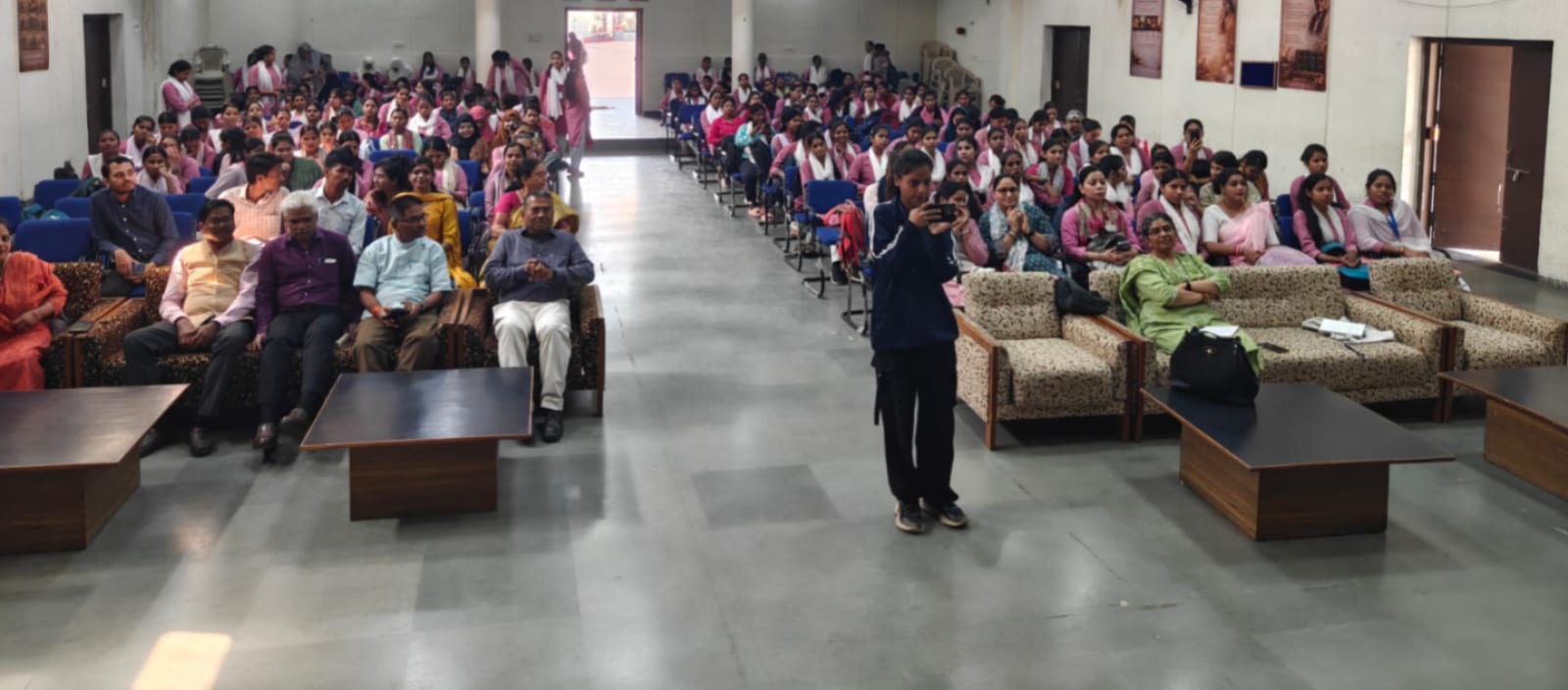
A large number of teachers and students were present at the programme. At the end, National Service Scheme in-charge Bhavana Thakur proposed the vote of thanks.
Hashtags: #MadhyaPradeshState #Bhopal #IndianKnowledgeTradition #LifeManagement #IndianThought #UmashankarPachauri #OrientationLecture #MLBCollege #LifeManagementLectureOn #भारतीय



