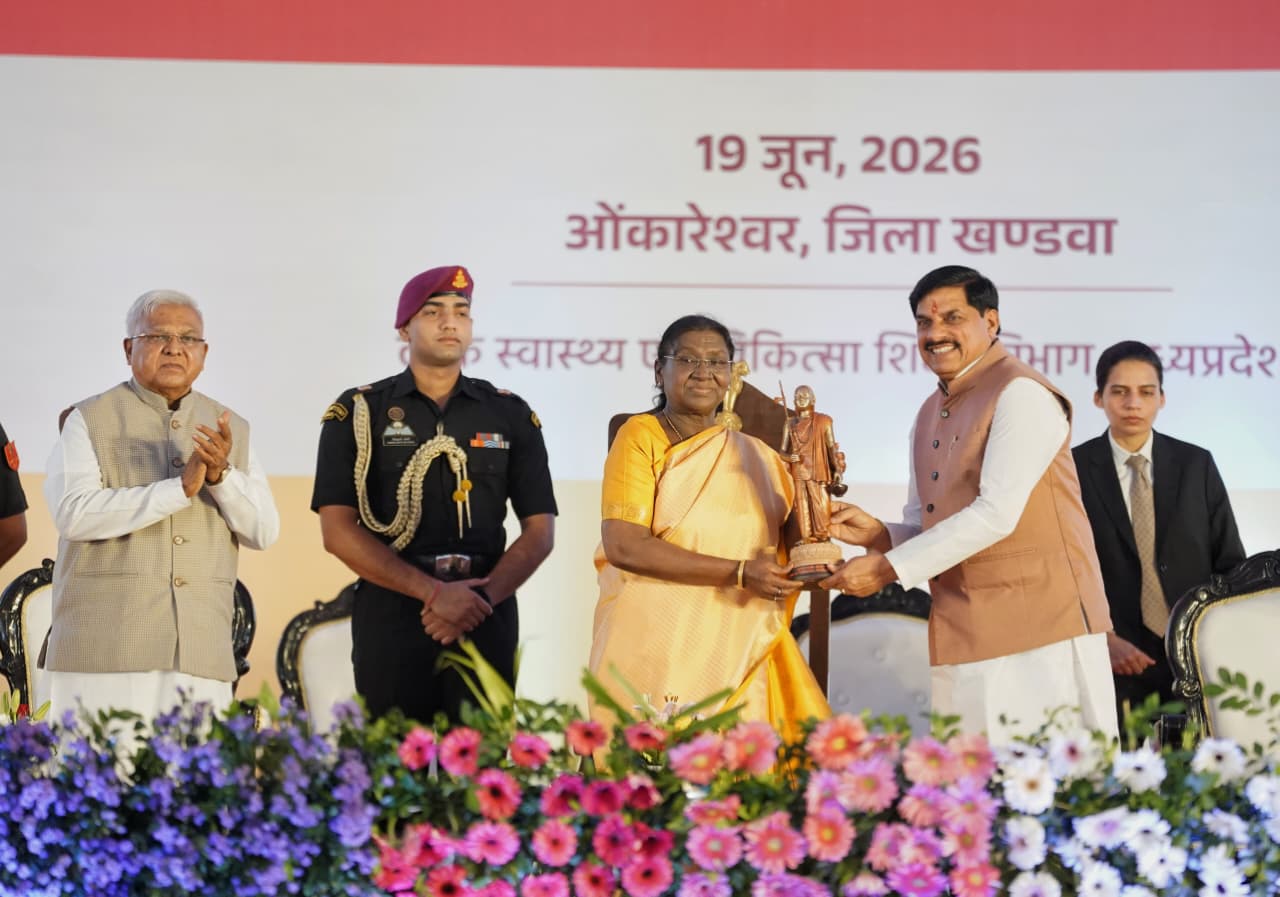
CNN Central News & Network – ITDC India Epress / ITDC News, Bhopal: On the occasion of World Sickle Cell Day, the organization of this special program is a meaningful effort toward addressing a significant public health challenge. I appreciate everyone associated with this initiative. I commend the Government of Madhya Pradesh for the multidimensional achievements it has attained under the National Sickle Cell Anaemia Elimination Mission. It is gratifying that the screening target, one of the major goals set before the nation during the launch of the National Mission in 2023, has been achieved ahead of schedule.
These remarks were made by President Droupadi Murmu while addressing the state-level program organized on June 19 on the occasion of World Sickle Cell Day. The event was held at Omkareshwar in Khandwa district under the National Sickle Cell Anaemia Elimination Mission-2047. President Murmu inaugurated the program by lighting the ceremonial lamp. The event was attended by Governor Mangubhai Patel and Chief Minister Dr. Mohan Yadav.
The program commenced with the national song Vande Mataram and the national anthem Jana Gana Mana. A short film focusing on Sickle Cell Anaemia and awareness videos were also screened. Representatives of Gram Panchayats and officials who performed exceptionally under the National Sickle Cell Anaemia Elimination Mission-2047 were felicitated during the event.
Screening Target Achieved Ahead of Schedule
President Murmu said that she had been informed that the target of screening 70 million people, from newborns to individuals up to 40 years of age, had been accomplished. She described this as a remarkable achievement and one of the largest genetic disease screening initiatives in the world. Madhya Pradesh has made a significant contribution to this accomplishment, with more than 12.5 million people screened in the state so far. Most of them have also been provided with genetic counseling cards.
She noted that the Government of India has taken the challenge of Sickle Cell Disease very seriously and adopted a comprehensive approach over the past few years. Nearly three years ago, Prime Minister Narendra Modi launched the National Sickle Cell Anaemia Elimination Mission from Shahdol, Madhya Pradesh. The initiative reflected not only the government’s commitment but also a visionary approach to addressing every dimension of this challenge.
Scientific and Social Research Behind the Mission
President Murmu stated that the mission was launched for the first time in the country as a joint model of the Union Ministry of Health and Family Welfare and the Ministry of Tribal Affairs. The issue was not viewed merely as a health concern but also as a tribal health issue, a challenge related to genetic awareness, preventive healthcare, and behavioral change.
She was informed that extensive scientific and social studies formed the basis of the mission. Institutions such as ICMR, Tribal Health Research Institutes, AIIMS, NHM, WHO, and various state governments conducted research on different aspects of the disease. These studies indicated that around 20–25 million people in India may be carriers of the Sickle Cell gene, while millions suffer from the active disease. The highest prevalence is found in the tribal belt of central India, where many families have been affected for generations without even knowing the name of the disease.
Research also revealed that the prevalence of Sickle Cell Disease in tribal regions is several times higher than in the general population. Consequently, for the first time in India, a nationwide campaign integrating public health, tribal welfare, genetic science, and digital monitoring was launched. States participating in the mission across 17 states have shown active involvement and commitment.
Key Pillars of Disease Elimination
President Murmu said she was impressed by the vision of the mission and highlighted its three major dimensions:
Large-scale awareness generation and pre-marital genetic counseling.
Extensive screening for early disease detection.
Ensuring comprehensive management and continuity of healthcare services.
From a public health perspective, she noted that this is the first time such a large-scale genetic screening program is being conducted in the country alongside digital tracking. As a result of mission-mode screening, approximately 250,000 people with Sickle Cell Disease have been identified, and over 2 million carriers have been detected.
She emphasized the importance of understanding the challenge posed by such a large number of carriers. Since carriers generally do not exhibit symptoms, they often remain unaware of the disease’s future implications and the possibility of passing it on to their children.
Commendable Healthcare Initiatives
President Murmu expressed satisfaction that both the Central and State Governments have undertaken significant efforts not only to identify patients and carriers but also to ensure their proper healthcare. She was informed that in Madhya Pradesh, point-of-care testing facilities have been expanded up to the Ayushman Arogya Mandir level for affected individuals, pregnant women, and newborns.
Under the “Swasth Nari, Sashakt Parivar Abhiyan” conducted from September 17 to October 2 last year, Madhya Pradesh set a record by screening over 400,000 women for Sickle Cell Disease. Large-scale screening of students is also underway, and tribal students are being connected with counseling, treatment, and healthcare services.
Continuous screening is being conducted in remote and inaccessible tribal areas through mobile medical units. She further noted that the “Sickle Mitra” initiative, launched on the previous World Sickle Cell Day, has trained representatives of government and non-government organizations, voluntary groups, and NCC cadets to spread awareness, assist patients, and connect them with government health services.
Congratulating all government and non-government institutions involved, President Murmu expressed confidence that with the collective efforts and active participation of all states, India would achieve its national goal of eliminating Sickle Cell-related diseases well before 2047. Since Madhya Pradesh has the largest tribal population in the country, she expressed hope that the state would continue setting new benchmarks in tribal development and wished everyone a bright future.
Madhya Pradesh Sets a Record Under the Mission
Chief Minister Dr. Mohan Yadav said that under the guidance of Governor Mangubhai Patel, Madhya Pradesh has set a record in implementing the National Sickle Cell Anaemia Elimination Mission-2047 launched by Prime Minister Narendra Modi. The success of the mission will help secure future generations.
He stated that the presence of President Droupadi Murmu at Omkareshwar on World Sickle Cell Day 2026 has inspired and encouraged the people of the state. The government is working with determination to eliminate Sickle Cell Anaemia and is simultaneously focusing on four major fronts.
So far, 13.2 million people have been screened in the state. Pregnant women are being identified and provided counseling and treatment. Genetic counseling is being conducted, and Sickle Cell Cards are being distributed to safeguard future generations. More than 3,700 Sickle Mitras, including NCC cadets, are strengthening awareness campaigns.
The Chief Minister affirmed that Madhya Pradesh is committed to eradicating Sickle Cell Anaemia completely from the state.
Expansion of Medical Infrastructure
Dr. Yadav highlighted the significant growth in medical infrastructure and medical education. He noted that while only five medical colleges existed in the state over a span of 55 years under previous governments, the total number has now risen to 32 medical colleges. He emphasized that substantial progress has been achieved in both healthcare and education.
Commitment to Health and Tribal Welfare
The Chief Minister said that many diseases continue to affect future generations due to lack of awareness. The state government is working with full commitment for Scheduled Castes and Scheduled Tribes through the PM JANMAN Yojana.
He mentioned that the government is advancing development on all fronts, including establishing a university in Khandwa named after Krantisurya Tantya Mama. Cabinet meetings have been held in honor of tribal heroes such as Rani Durgavati and Raja Bhabhut Singh. Museums dedicated to Badal Bhoi in Chhindwara and Raja Shankar Shah–Raghunath Shah in Jabalpur have also been inaugurated.
To preserve tribal cultural heritage, the Bhagoria festival has been granted the status of a state festival, and girls’ hostels have been named after tribal heroes. The welfare and holistic development of tribal communities remain a top priority of the government.
Continuous Efforts Underway
Deputy Chief Minister and Minister for Public Health and Medical Education Rajendra Shukla stated that Madhya Pradesh has performed exceptionally well under the National Sickle Cell Anaemia Elimination Mission-2047. Prime Minister Narendra Modi launched the mission from Shahdol in 2023 to eradicate Sickle Cell Disease, and the efforts of Governor Mangubhai Patel have further accelerated its implementation.
So far, 13.2 million people in tribal-dominated districts have been screened, making Madhya Pradesh a leading state in Sickle Cell screening. Under the leadership of Chief Minister Dr. Mohan Yadav, the state has set a target of 16 million screenings by the end of 2026.
He added that Sickle Cell screening cards are now being matched before horoscope matching in marriage discussions, and awareness campaigns are being conducted across the state to ensure that no one unknowingly becomes a carrier of the disease.
Hashtags: #NationalIndia #Bhopal #Desksource #President #Murmu #Praised #DeskSource #State #Government #Achievement