


Varaha dominates Cave 5 at Udayagiri, but the smaller figures around him explain the scale of the event. Rows of gods and sages witness Vishnu, shown with a boar’s head and human body, raising the earth goddess from the waters. The surrounding assembly makes the rescue a cosmic occasion.
The sculptor has placed the earth goddess near the god’s tusk, small against his powerful body. Below and beside him, other figures occupy ordered registers. Following these details slows the eye: the panel is not only an enormous central image, but a narrative distributed across the rock face.
Udayagiri’s inscriptions provide a historical setting for this religious imagery. Near Cave 6, a Sanskrit record dated to year eighty-two of the Gupta era, corresponding to 401–402 CE, names Chandragupta II and a subordinate ruler of the Sanakanika family. The damaged inscription preserves a relationship between local patronage and imperial authority. It is evidence that can be read alongside the sculpture without pretending that every figure carries an identifying label.
Scholars have interpreted the Varaha scene as resonating with Gupta ideas of kingship: divine rescue offered an image of restoring order and protecting the world. That is a historical interpretation, not a statement carved beneath the relief. Its strength lies in considering the imagery together with the inscriptions and the wider sacred landscape.
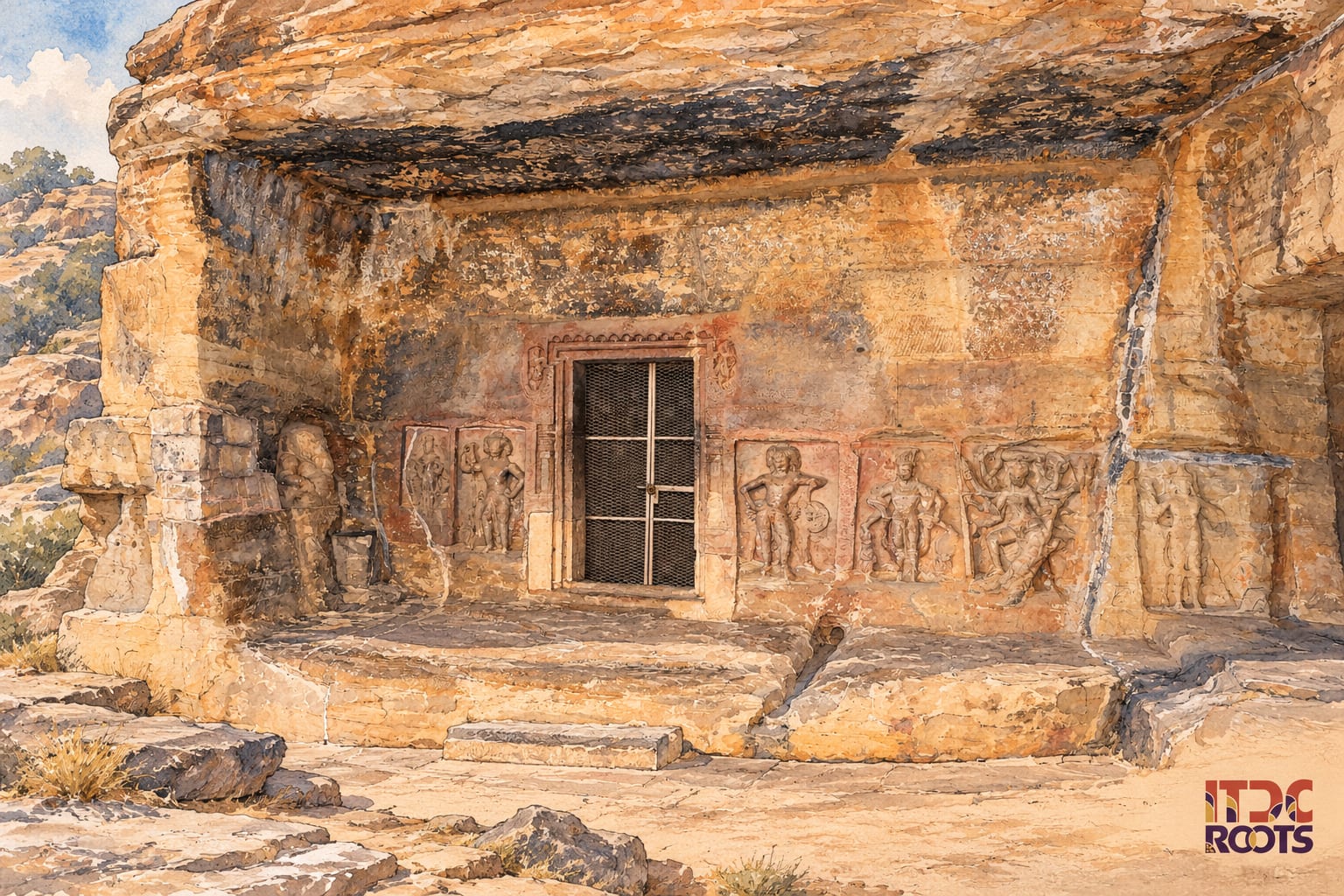
The hill contains other forms of worship as well. Shiva shrines and a Jain cave prevent the site from being reduced to one image or a single religious programme. Natural rock, excavated chambers and carved facades were adapted into a varied group of sanctuaries.
The Varaha panel remains its commanding sight. Yet its quieter witnesses matter. They establish the world being saved, while the nearby inscription brings a different gathering into view: rulers and patrons whose names survived in stone.



