CNN Central News & Network-ITDC India Epress/ITDC News Bhopal: The inaugural session on the second day of a three-day national seminar organised at Rabindranath Tagore University (RNTU) to mark 200 years of Hindi journalism was held at Sharda Auditorium on Friday. The programme began with a sitar recital by Aniruddh Joshi. In the session on “Contemporary Hindi Journalism: Tradition, Change and Future”, senior journalists, literary figures and academicians from across the country spoke in detail on the glorious tradition of journalism, present challenges and future possibilities.
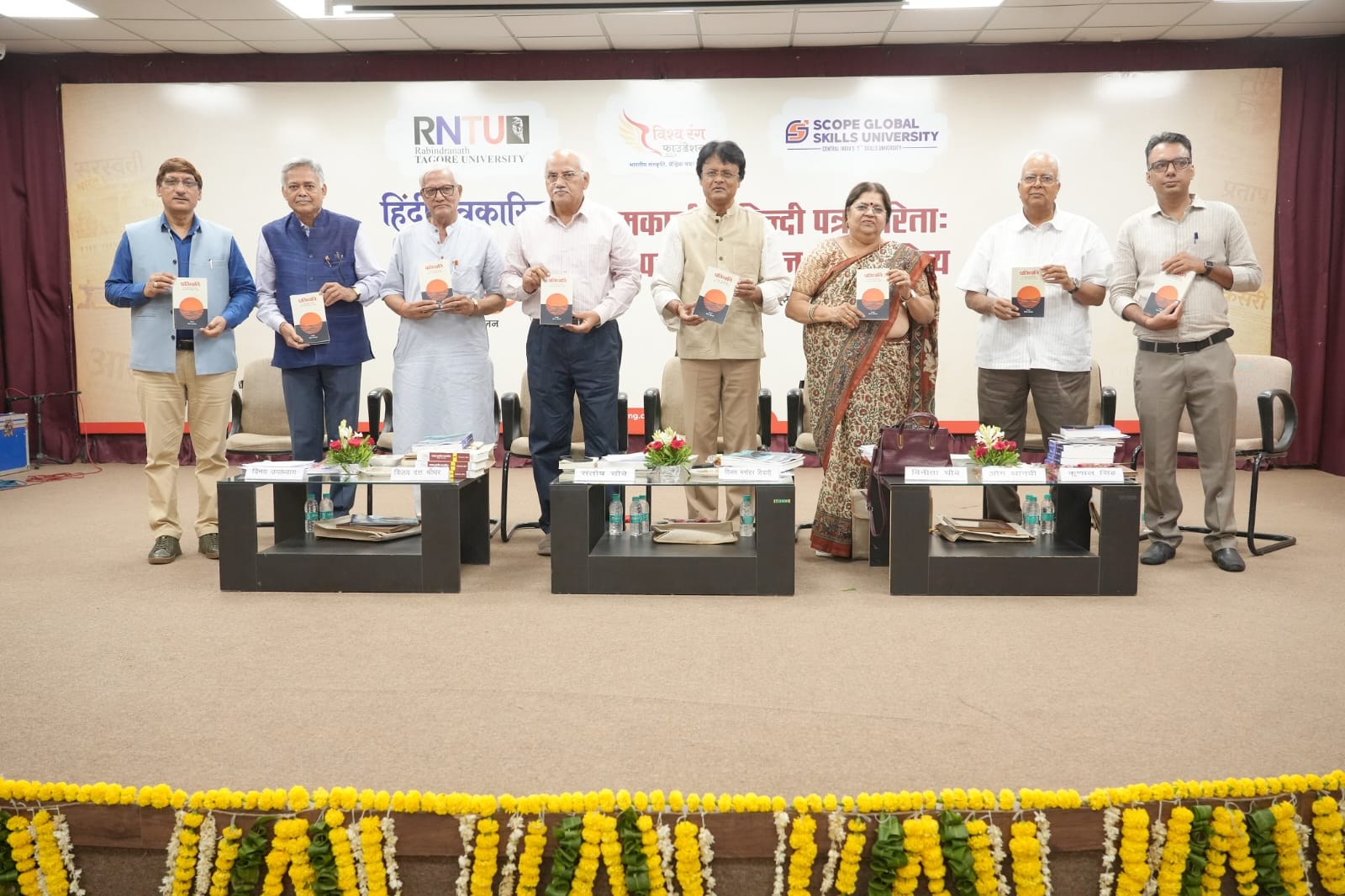
In the inaugural session, senior journalists Vijay Dutt Shridhar, Om Thanvi, Vijay Manohar Tiwari and university Chancellor and literary figure Santosh Choubey shared their views on the 200-year journey of Hindi journalism. Vinay Upadhyay, Director of the Tagore World Arts and Culture Centre, conducted the programme. Registrar Dr Sangeeta Johri proposed the vote of thanks.
Makhanlal Chaturvedi University Vice-Chancellor Vijay Manohar Tiwari said newspapers played an extremely important role in the freedom movement. Expressing concern over fake news, mobile-based journalism and the challenges of the digital era, he said both responsibility and regulation are necessary in journalism. He also stressed the need to bring forward the voice of the “real India” that is being left out of the mainstream.
Senior journalist Om Thanvi said journalism is not merely a medium for providing information, but also carries the responsibility of developing wisdom and understanding in society. He also spoke on the changing priorities of the media, the entertainment-driven nature of television and the credibility of print media.
Senior journalist Vijay Dutt Shridhar said journalism before Independence was inspired by the resolve of nation-building, while today the growing influence of market forces and resources is creating new challenges for journalism. He said newspapers are not merely a business, but a medium of social responsibility, and that public trust in print media remains the highest.
Seminar convener and literary figure Santosh Choubey said literature, art and culture connect human beings with humane values. Speaking on the balance between science and literature, the shrinking space for science writing in journalism, the challenges of artificial intelligence (AI) and the changing global scenario, he said preserving creativity and human sensitivities is the greatest need of the present time.
During the inaugural session, two books, including “Vishwamay Hindi Patrakarita”, were released. A souvenir of the research seminar was also released.
Discussion on the place of literature in Hindi journalism
In the second session, a wide-ranging discussion was held on the relationship between literature and journalism on the theme “The Place of Literature in Mainstream Hindi Journalism”. The session was chaired by Dr Sudheesh Pachauri. In his address, he said the objectives of literature and journalism are different. One dreams of social change, while the other operates within a commercial structure.
Sandeep Awasthi said literature not only relieves human beings of stress but also enriches their sensitivities. Manoj Shrivastava said algorithms are today deciding what society should read and watch. Senior journalist Priyadarshan said the space for literature in mainstream media is continuously shrinking, which has increased the distance between literature and journalism.
Balram Gumasta said protecting human sensitivities and social values is today the shared responsibility of both literature and journalism.
Discussion on contemporary Hindi literary journalism
In the third session, discussion was held on “The Landscape of Contemporary Hindi Literary Journalism and Vanmali Katha”. The session was chaired by Santosh Choubey. In this session, Pankaj Subir, Kshama Sharma, Akhilesh Mukesh Verma, Geetashree and other speakers shared their views on the changing landscape of literary journalism and contemporary challenges.
Deliberations also held on science journalism
The fourth session of the day discussed “Science Journalism in the Present Environment: Special Reference to ‘Electroniki Aapke Liye’ (‘Electronics for You’)”. The session was chaired by Manoj Kumar Pateria. Devendra Mewari, Krishna Kumar Mishra, Manish Mohan Gore and Sameer Ganguly participated in it. Kumar Suresh, Veena Sinha and Raag Telang joined the dialogue, while Mohan Sagoria conducted the session.
Special session held on research seminar
In a special session held under the national seminar, university students presented research papers. The session was chaired by Dr Mukesh Mishra, Director, Dattopant Thengadi Research Institute. On the occasion, Dr Savitri Singh Parihar and Dr Smita Tiwari, as experts, presented their views and suggestions on the research papers. The session was coordinated by Dr Vishakha Rajurkar Raj and Dr Yogesh Patel. Research scholars presented their research on various subjects related to contemporary journalism and mass communication, on which experts offered academically useful guidance.
Across the day’s sessions, serious deliberations were held on the 200-year journey of journalism, literature, culture, science journalism, technological change, artificial intelligence and the future of media. University Vice-Chancellor Prof R.P. Dubey, along with senior journalists, literary figures, academicians, research scholars and a large number of students from across the country, were present.
On the final day, 11 July, sessions will be held on subjects related to journalism, culture, art and the global scenario. A special discussion on “Rang Samvad: Culture and Creation” will also be organised. New issues of various magazines and publications related to the history of Hindi journalism will also be released.
Hashtags: #RNTU #HindiJournalism #Bhopal #MadhyaPradesh #JournalismSeminar #ITDCNews #RabindranathTagoreUniversity #OmThanvi #VijayDuttShridhar #SantoshChoubey