


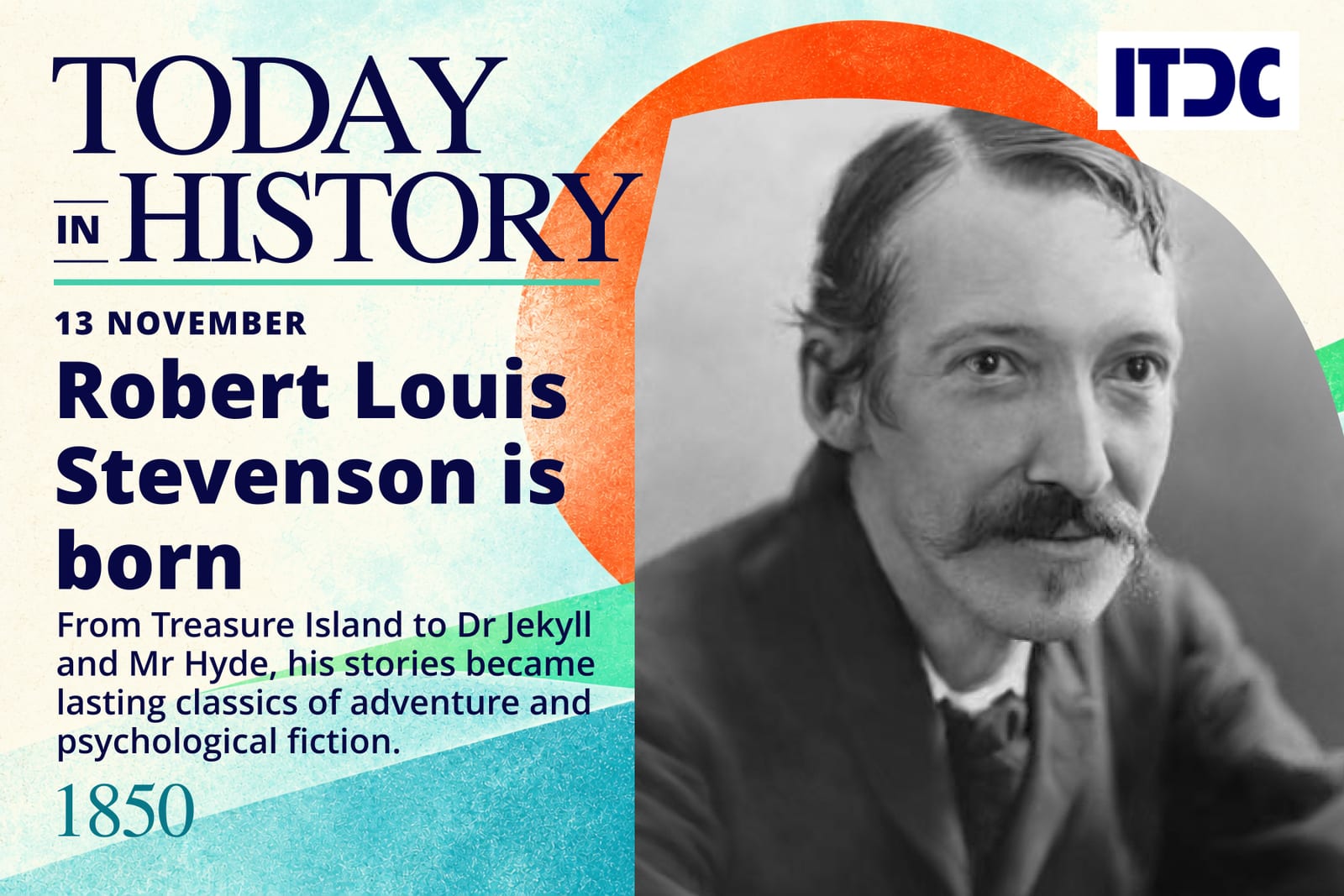
Henry Walter Barnett / State Library of NSW
Robert Louis Stevenson could send a reader towards a pirate island or into the disturbing privacy of a respectable London life. Born in Edinburgh on 13 November 1850, he became a writer whose range is sometimes obscured by the fame of a handful of unforgettable characters.
His family expected a different career. The Stevensons were associated with the building of Scottish lighthouses, and his father Thomas was an engineer. Robert entered the University of Edinburgh with that professional tradition before him, but literature increasingly commanded his attention. He eventually studied law rather than follow the family engineering business.
Ill health also shaped his childhood and adult life. The Robert Louis Stevenson Museum describes recurrent illness and periods of education at home. Reading and storytelling offered imaginative space when physical activity was constrained. That background is part of his development, though it should not be turned into an explanation for every later story.
Treasure Island first appeared in serial form in 1881–82 and as a book in 1883. Through Jim Hawkins, readers enter a world in which excitement and danger are difficult to separate. The voyage promises discovery, but trust becomes as important as the map. Long John Silver’s enduring fascination comes partly from the difficulty of fitting him into a simple category.
More than a writer for children
Stevenson’s work also explored uncertainty within apparently settled lives. Strange Case of Dr Jekyll and Mr Hyde, published in 1886, makes secrecy and divided identity the machinery of a compact, unsettling narrative. Its cultural familiarity can conceal how carefully the original story controls what the reader knows.
Kidnapped, also published in 1886, brought historical conflict into an adventure shaped by pursuit, companionship and shifting loyalties. A Child’s Garden of Verses approached childhood through poetry, while essays and travel writing offered still other forms for his observant prose.
His own travels carried him far from Scotland. He eventually settled in Samoa, where the final part of his life unfolded, and died in 1894. The geographical distance did not erase the importance of his Scottish background, but it widened the world from which he wrote.
Stevenson’s lasting achievement lies in making a story move while allowing moral uncertainty to travel with it. A journey may promise treasure or safety, yet the deeper question is often whom a character can trust, including themselves.
His birthday recalls an author who understood that adventure need not be an escape from serious questions. Sometimes the voyage, the pursuit or the secret doorway is precisely what allows those questions to be asked.




